GUIDES · THE GEOMETRY
The golden ratio in the human body: what is measured, and what is wished.
The navel, the hand, the face, the DNA molecule, Leonardo’s circle and square. Some of it holds up when you put a tape measure on it, some of it is a spiral dragged over a photograph. Here is the list, sorted honestly.
Where the idea comes from
The claim is old. Luca Pacioli called the ratio “divine” in 1509 and Leonardo drew the pictures for his book; Adolf Zeising, a German psychologist, measured thousands of bodies in the 1850s and announced that the navel divides the height at the golden section, and that the same proportion governs the limbs, the face and, eventually, everything. Zeising was a believer looking for confirmation, and he found it, as believers do. But the navel claim is the one part of his system that survived the century, because it is the one part that a tape measure will roughly confirm.
What holds up
The navel, roughly. Large anthropometric surveys — the kind used to design car seats and aircraft cabins — put the average navel height at about 60 to 62 % of stature, for men and women, across populations. That is within a few percent of 0.618, which is close enough to be interesting and not close enough to be a law: the spread between individuals is wider than the distance to the golden ratio, so any particular person is as likely to be at 0.59 as at 0.62. The honest statement is that the golden section is a good average of where the navel falls, not a rule the body obeys.
The forearm and the hand, roughly. Elbow to wrist divided by wrist to middle fingertip averages around 1.6. The same is true of upper arm to forearm, and of the segments of the leg — thigh to shin comes out near 1.6 too. These are averages over people whose limbs differ, and the ratios move with age and sex; but they cluster where the story says they should, and I think that is worth saying plainly rather than either oversold or dismissed.
The reason is not mystical. Bones that grow under load tend towards proportions that spread that load evenly, and a chain of segments in which each is about 1.6 times the next is close to the proportion that distributes leverage well along a limb. The ratio is a good engineering answer that evolution found approximately, in the same way the sunflower found the golden angle exactly because packing rewards it. The golden ratio in nature sorts those cases the same way.
What is roughly true, and usually overstated
The face. The claim is that a beautiful face has a golden rectangle around it, the eyes at its golden section, the mouth at the golden section of the lower half, and so on down to the width of the nostrils. Some of these averages come out near 1.6 on some faces; most do not, and the “golden mask” that was sold as a beauty template for a while fits a small number of faces from one population and slides off the rest. Studies that asked people to rate faces found that the ratios they preferred were close to the population average, not to φ — which is a duller and better-supported answer.
DNA. One turn of the B-form double helix is about 34 ångströms long and about 21 wide, and 34 and 21 are Fibonacci numbers, so the molecule is said to be built on the golden ratio. The measurements are roughly right — 33.2 and about 20 to 23 depending on how you define the width — and the ratio is roughly 1.5 to 1.6. It is a pleasant coincidence in the second decimal place and nothing turns on it. The helix does not know about Fibonacci.
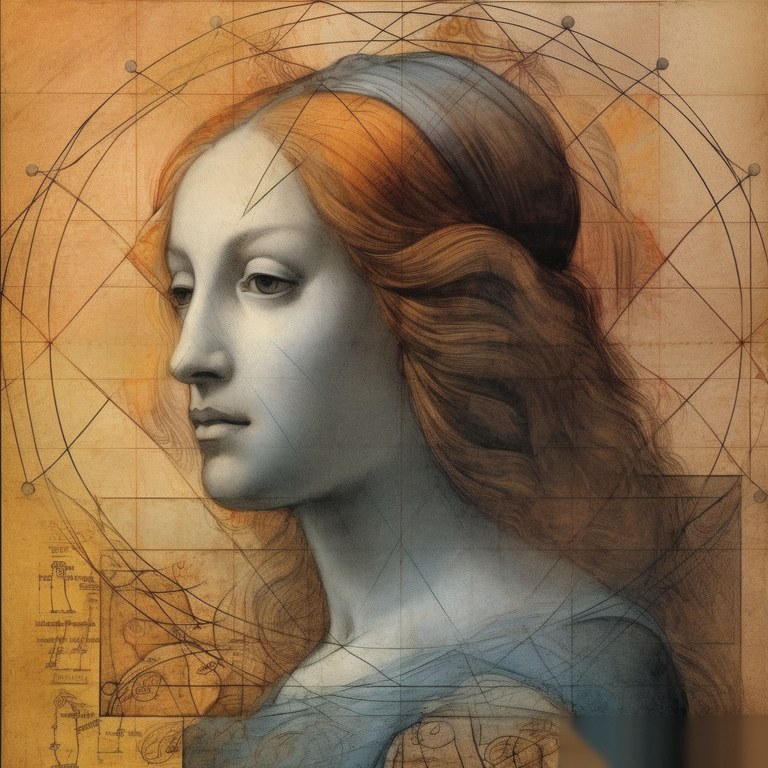
Vitruvian Man. Leonardo’s drawing puts a man in a circle and a square, after the Roman architect Vitruvius, and it is often shown with golden rectangles laid over it. The drawing is about the ratios Vitruvius listed — the span of the arms equals the height, the head is an eighth of it — and none of those is φ. The square’s side divided by the circle’s radius comes out near 1.6, which is where the claim comes from, but Leonardo did not construct the drawing that way and never said he did. Da Vinci and the golden ratio goes through what he actually used.
What is simply wrong
The fingers. The story goes that the bones of a finger are 2, 3, 5 and 8 centimetres long, or otherwise in Fibonacci proportion, so that a curled finger traces the golden spiral. Measured, the phalanges of the index finger run about 1 : 1.3 : 1.9 from tip to base, nowhere near 1 : 1.6 : 2.6, and the metacarpal behind them is longer still. The finger curls into a fine spiral, as any chain of hinged segments does; it is not a golden one.
The heartbeat, the ear, the teeth. There is a paper for almost every organ, and most of them do the same thing: take two measurements, divide, get something between 1.4 and 1.9, and call it φ. A ratio near 1.6 is what you get from a great many pairs of things that are of different but comparable size — it is the most ordinary ratio in the world, which is precisely why it is so easy to find. The test is whether the number is closer to 1.618 than to the neighbouring simple fractions, 3/2 and 5/3. Most of these are not.
Le Corbusier, who built on it anyway
The most useful thing ever made from the body’s golden ratio was not a discovery but a decision. In the 1940s Le Corbusier took a man 1.83 m tall — he began with 1.75 and changed it so the numbers would come out round in feet and inches — put his navel at 1.13 m, the golden section of his height, and built two ladders of measurements from it, each step 1.618 times the last. He called it the Modulor and used it to size everything in his buildings, from the height of a shelf to the bay of a façade, so that a body moving through the rooms would meet the same proportion at every scale. It works not because bodies are golden but because a building set out on one consistent ratio reads as calm, for the same reason a wall does. The golden ratio in interior design is the household version of the same idea.
So what is true?
That the body is roughly golden at the navel and the limbs, on average; that the face and the molecule are golden only if you squint; that the fingers are not; and that the proportion’s real home in the human world is the one Leonardo, Pacioli and Le Corbusier gave it — on the page, in the plan, as a decision about how a made thing should relate to the person who uses it. That is where I use it, and I try to say so rather than dress it as anatomy.


Questions
Is the human body based on the golden ratio?
Roughly, in a few places, on average. The navel divides standing height at about 0.60–0.62, near the golden section of 0.618; forearm to hand and thigh to shin average near 1.6. Individuals vary widely around those averages, so it is a good average rather than a rule.
Is the navel at the golden section of the body?
On average it is close: large surveys put it at 60–62 % of height. The spread between people is wider than the gap to 0.618, so any one person may be at 0.58 or 0.64.
Do fingers follow the Fibonacci sequence?
No. Measured finger bones run about 1 : 1.3 : 1.9 from tip to base, not the 1 : 1.6 : 2.6 a Fibonacci sequence would need. The curled finger makes a spiral, but not a golden one.
Is DNA built on the golden ratio?
Only loosely. One turn of the double helix is about 34 Å long and about 21 Å wide, which are Fibonacci numbers, but both figures are approximate and the ratio is somewhere between 1.5 and 1.6. It is a coincidence, not a design.
Did Leonardo use the golden ratio in Vitruvian Man?
No. The drawing follows the proportions Vitruvius listed — arm span equals height, the head is one eighth — and none of them is the golden ratio. The near-1.6 ratio between the square and the circle is a by-product, not a construction.
What is Le Corbusier’s Modulor?
A measuring scale built from a 1.83 m man with the navel at the golden section of his height, each step 1.618 times the last. Le Corbusier used it to size everything in his buildings so that one proportion recurred at every scale.
For a wall you're responsible for.
Tell me the room and what you want it to feel like. I will send three works that fit, and a mock-up of each one in place.
Write to me