GUIDES · THE GEOMETRY
The golden ratio in nature: exact, approximate and myth.
The ratio is real in nature and it is also the most over-claimed number in popular science. This guide sorts the examples into three drawers — exact, approximate, and myth — so that you can enjoy the true ones without having to defend the false ones.
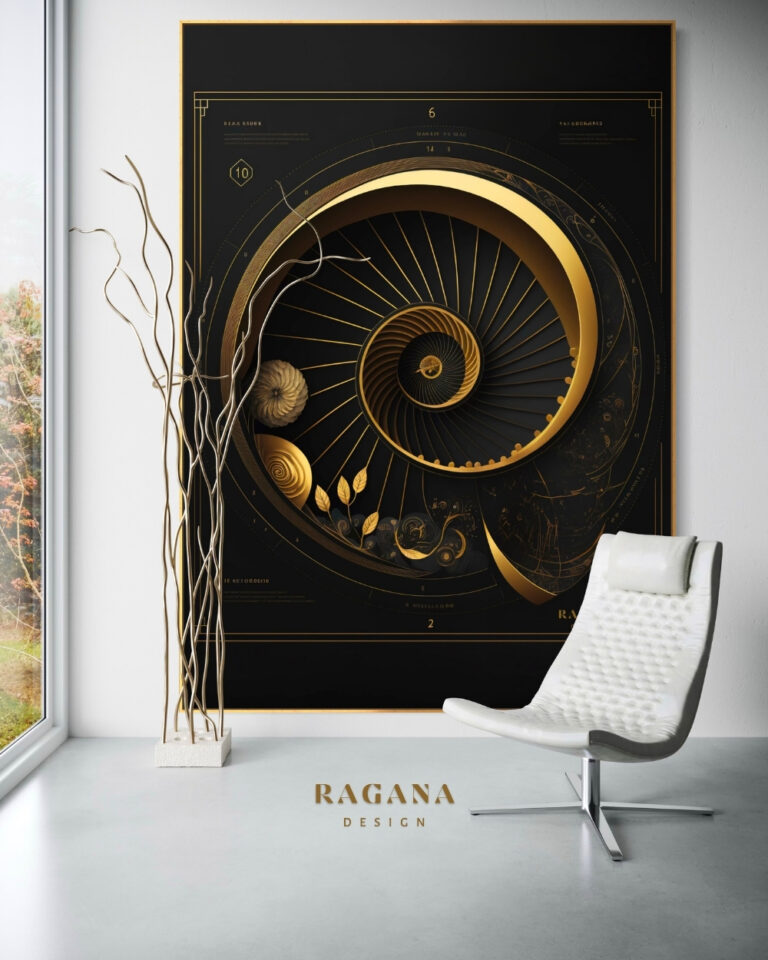
Exact: seeds, scales and leaves
The one place the golden ratio is written into living things is the arrangement of parts around a stem or a centre — botanists call it phyllotaxis. A sunflower places each new floret 137.5 degrees round from the last. That angle is the full circle divided by the golden ratio, and it is the angle that packs new seeds into the gaps left by the old ones without ever lining them up into wasteful rows. The result is the pattern everyone has seen: two families of spirals running opposite ways, and their counts are always neighbouring Fibonacci numbers — 34 and 55 on a typical head, 55 and 89 on a large one, 89 and 144 on a giant.
The same rule gives pine cones their 8 and 13 spirals, pineapples 8 and 13 or 13 and 21, and romanesco broccoli its 13 and 21 with a fractal thrown in. It governs the leaves on many stems, which is why successive leaves on a plant are so often spaced two-fifths or three-eighths of a turn apart — fractions of Fibonacci numbers, the whole-number approximations to the golden angle. This is not a coincidence and not a mystery: it is the geometry of packing, and it has been reproduced in the laboratory with drops of ferrofluid. The Sovereign Garden and The Sunflower Compass are built on this rule, and it is the one that deserves the reverence the shell usually gets.
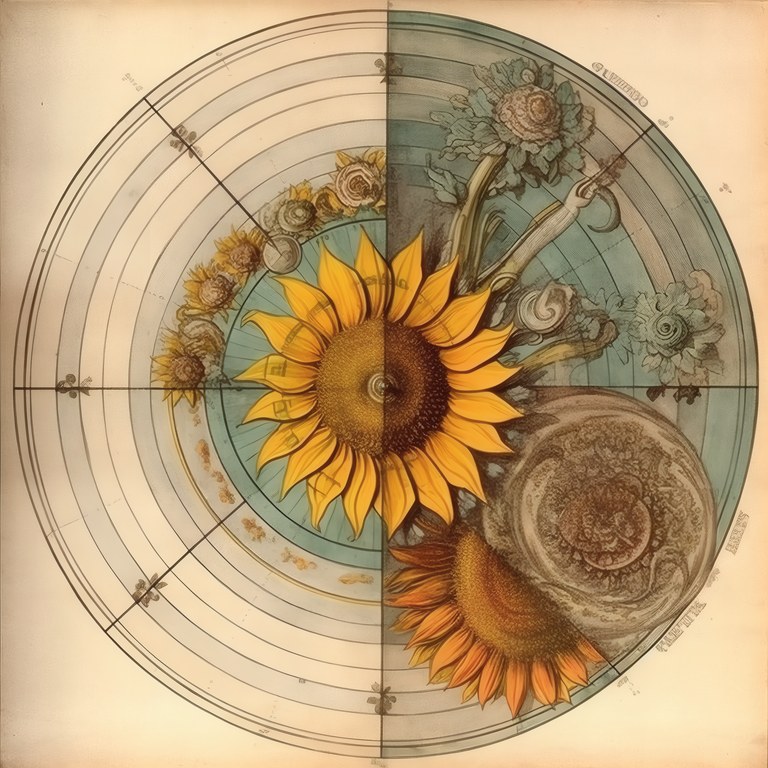
Approximate: shells, horns and spirals that grow
Anything that grows by adding to itself while keeping its shape produces a logarithmic spiral — a curve that gets wider by a constant factor every turn. Nautilus shells, ammonites, ram’s horns, a cat’s claw, the curl of a fern. The golden spiral is one member of that family, the one that widens by 1.618 every quarter turn. Real shells do not use that factor. The nautilus widens by about 3 per full turn where the golden spiral widens by about 6.85; ammonites vary from species to species and none of them is golden. So the shell is a true logarithmic spiral and an approximate golden one, and the honest phrase is “a spiral of the same family”.
That is the drawer my nautilus works belong in, and I say so on their pages: The Tidal Chart, drawn from an ammonite, keeps the measured shell beside the constructed spiral so that the difference is visible. The idealised shell is a decision, not a discovery.
Myth: hurricanes, galaxies, bodies, DNA
Hurricanes and spiral galaxies are the two pictures most often stamped with a golden spiral, and both fail on measurement. A hurricane’s cloud bands are only loosely spiral and change from hour to hour; a galaxy’s arms open at anything from three to ten times per turn depending on the galaxy, and the arms are not even continuous curves. The overlays fit because the spiral is placed by hand and the photograph is chosen to suit it.
The human body is the next favourite: navel height to total height, forearm to hand, the famous “golden face”. Measured across real populations, these ratios scatter widely around values that are sometimes near 1.6 and sometimes not, and a claim that averages to the ratio only after choosing which body parts to compare is not a claim about bodies. Leonardo’s Vitruvian Man, which is usually cited, is built on Vitruvius’s whole-number ratios — a square and a circle — and does not use the golden ratio at all. The Vitruvian Muse in the Da Vinci collection borrows Leonardo’s manner precisely because the golden section is being added to the figure on purpose, not found in it.
DNA: the double helix is often said to measure 34 by 21 ångströms per turn, two Fibonacci numbers. The real figures are about 34 by 20, and the resemblance is a coincidence of units. Add to the myth drawer the pyramids (a plausible near-fit with no evidence of intent), the Parthenon (measured properly, closer to 9:4), and the stock market, which follows the ratio about as well as it follows anything.
Why it appears at all
The reason the true examples exist is that the golden ratio is, in a precise sense, the most irrational number: it is the hardest number to approximate with a simple fraction. Anything that has to spread parts around a centre without repeating — seeds, leaves, scales — finds that angle by trial, because every simpler angle leaves gaps. Growth that keeps its shape produces logarithmic spirals for a different reason, and the golden one is only a special case. There is no single law of nature that prefers 1.618; there are two ordinary processes, and one of them happens to land on it exactly.
That is enough. A number that plants cannot avoid, that growing things approximate, and that the eye has learned to read as living — that is a better story than the one with the hurricanes in it, and it has the advantage of being true.
Questions
Where does the golden ratio appear exactly in nature?
In phyllotaxis — the arrangement of seeds, scales and leaves. Each new part is placed 137.5 degrees round from the last (the golden angle), which produces spiral counts in neighbouring Fibonacci numbers: 34/55 on sunflowers, 8/13 on pine cones.
Is the nautilus a golden spiral?
No, only approximately. It is a logarithmic spiral of the same family, but it widens by about 3 per turn where a golden spiral widens by about 6.85.
Do hurricanes and galaxies follow the golden ratio?
No. Their spirals vary widely and are not continuous curves; the golden-spiral overlays are placed by hand on chosen photographs.
Is the human body built on the golden ratio?
Not in any measurable way. Real bodies scatter widely around the claimed ratios, and Leonardo’s Vitruvian Man uses whole-number proportions, not 1.618.
For a wall you're responsible for.
Tell me the room and what you want it to feel like. I will send three works that fit, and a mock-up of each one in place.
Write to me