GUIDES · THE GEOMETRY
The golden ratio in art, explained with a nautilus.
Most explanations of the golden ratio start with a formula. This one starts with a shell, because that is where most people first see it — and because the shell explains the formula better than the formula explains the shell.
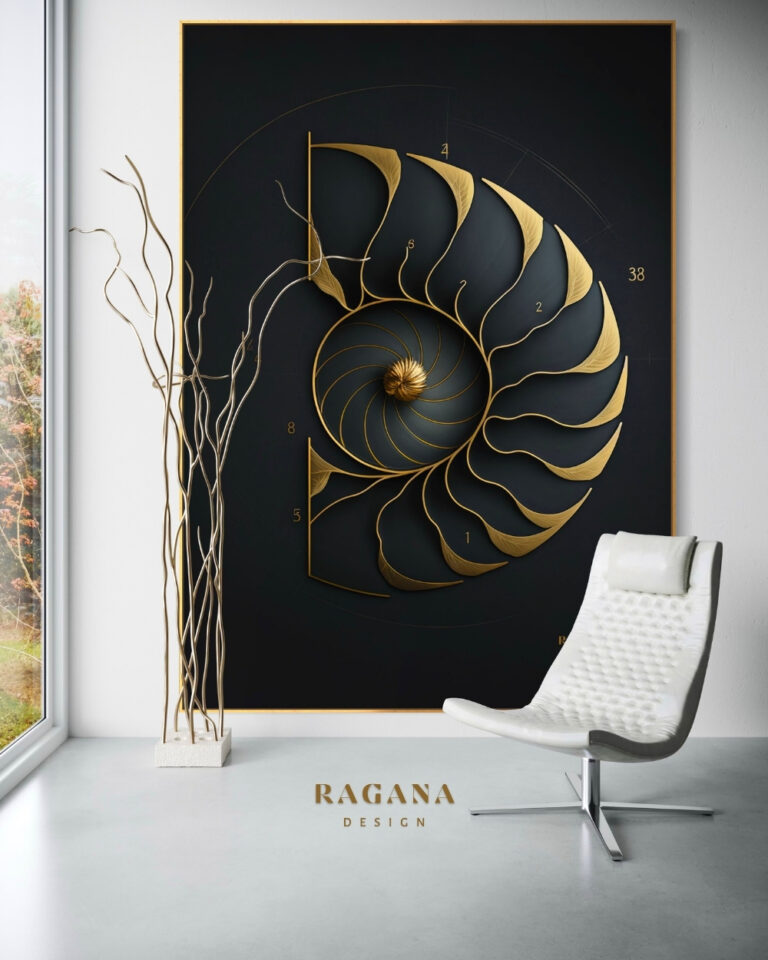
One number, three names
The golden ratio is a single number: 1.618, and then a tail of digits that never ends. Mathematicians write it as the Greek letter phi. Designers call it the golden section or the divine proportion. It is the answer to a simple question: how do you cut a line into two pieces so that the whole relates to the larger piece exactly as the larger piece relates to the smaller? There is only one cut that does it, and the two pieces are then in the ratio 1.618 to 1.
That is the entire definition. Everything else people say about it — the spirals, the sunflowers, the Parthenon, the face of the Mona Lisa — follows from the fact that this particular proportion is self-similar. Whatever you build from it can be grown or shrunk by the same step and stay in proportion with itself.
Where Fibonacci comes in
Leonardo of Pisa, called Fibonacci, published a sequence in 1202 that starts 1, 1, 2, 3, 5, 8, 13, 21, 34, 55, 89 — each number the sum of the two before it. Divide any number in the sequence by the one before it and you get closer and closer to 1.618: 8 ÷ 5 is 1.6, 13 ÷ 8 is 1.625, 55 ÷ 34 is 1.6176. The sequence is the ratio arriving in whole numbers, one step at a time.
That is why the two names are used together. The ratio is the destination; the sequence is the staircase. When a work is described as “built on the Fibonacci sequence”, it means the sizes of its parts step up by this staircase, and the whole resolves on 1.618.
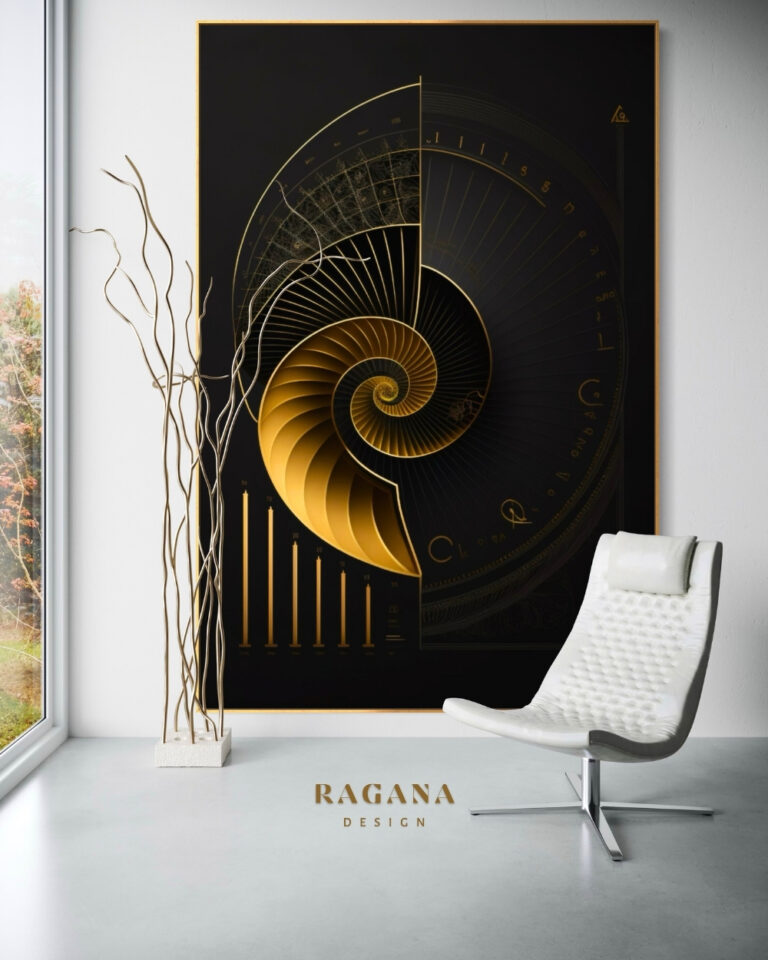
How the shell is built
Draw a square. Beside it, draw a second square the same size. On top of the pair, draw a square whose side equals their combined width — that is the 2. Beside that, a square of 3; then 5, then 8, each new square laid against the growing rectangle. Now draw a quarter-circle inside every square, corner to corner, and join them. The curve that appears is the golden spiral, and it is the curve of a nautilus shell in section.
The shell does not know any of this. It grows by adding a chamber that is a fixed proportion larger than the last, because the animal inside grows at a steady rate and its shape has to stay the same. A steady rate of growth with a constant shape produces exactly this spiral. The mathematics is not imposed on the shell; it is the shell’s only option.
The same rule shows up in the seed head of a sunflower, where new seeds push out from the centre and pack most efficiently when each one is placed 137.5 degrees round from the last — the golden angle, the ratio turned into a rotation. It is in the branching of some trees, the arrangement of leaves on a stem, and the curl of a fern before it opens. Not everywhere, and not as often as the enthusiasts claim, but often enough that the eye learns it early and recognises it as living.
How painters have used it
Artists have used the proportion for at least two and a half thousand years, sometimes deliberately and sometimes because a trained eye drifts toward it. Greek architects set the facade of the Parthenon close to a golden rectangle. Renaissance painters — Leonardo most famously, in his illustrations for Luca Pacioli’s book on the divine proportion in 1509 — used it to place the horizon, the figure, the point the eye rests on. The Dutch painter Piet Mondrian and the architect Le Corbusier built whole systems on it in the twentieth century.
What the ratio does inside a picture is simple to state and hard to fake. A composition divided at the golden section feels settled without feeling symmetrical. The eye is led from the larger area to the smaller, then back, and finds a place to stop. Split the picture exactly in half instead and it goes still in a dead way; split it at a third and it works, but with less pull. The golden section sits between the two, which is where a good deal of what we call “balance” lives.
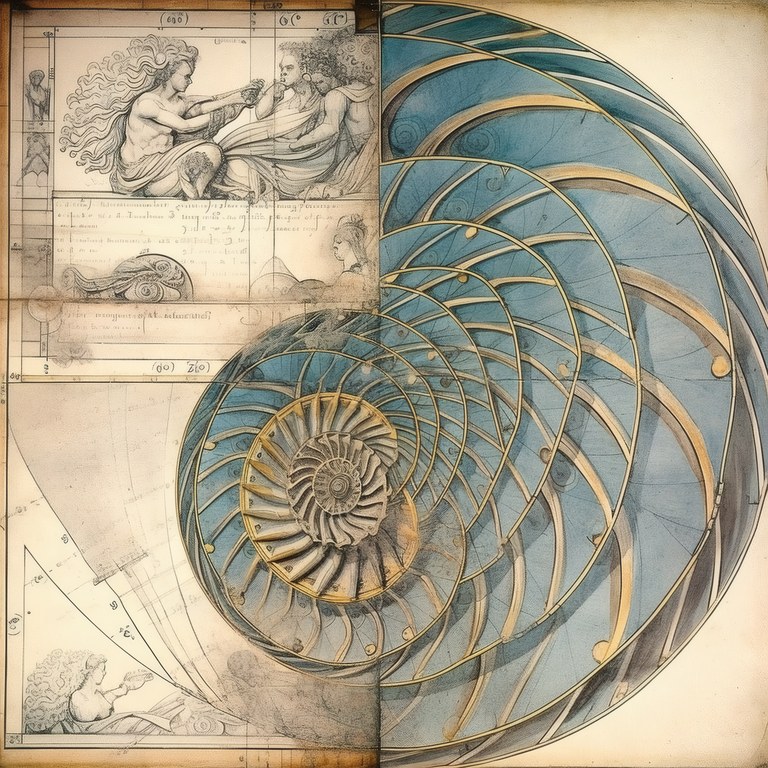
How to see it in a work
You do not need a ruler. Look for three things. First, a spiral that tightens toward a centre and never quite reaches it — a logarithmic curve, not a coil of rope where every turn is the same width. Second, rectangles inside the picture that echo the outer frame: a golden rectangle contains a square and a smaller golden rectangle, which contains a square and a smaller one again, so the format repeats itself inward. Third, the resting point: the place your eye keeps returning to is usually a little off centre, roughly 38 percent in from one edge, which is the golden section of the width.
In my own work the construction is often left visible on purpose — the squares, the arcs, the numbers in the margin — because the geometry is the subject, not a hidden scaffold. In the Klimt and Da Vinci collections it is quieter: the mosaic bands widen by the ratio, the figure sits at the section, the frame repeats inside itself. Either way, it is there to be found.
What it is not
A few honest limits. The golden ratio is not a guarantee of beauty; plenty of dull things are built on it and plenty of beautiful ones are not. It does not appear in every shell — most snail shells are not golden spirals, and the nautilus itself is only approximately one. And the claims that it governs the human body, the pyramids and the stock market are mostly wishful measurement. It is a real, useful proportion with a real history, and it needs no exaggeration.
What is true is enough: it is the one proportion that stays itself as it grows, nature reaches for it whenever growth has to keep a shape, and the eye has learned to read it as calm. That is why I work in it, and why the works on this site are built on it rather than merely decorated with it.
Three works to see the construction in: The Sovereign Ledger, where the squares and arcs stay on the page; The Chronos Equation, which annotates the shell like an instrument; and The Golden Aperture, which keeps only the curve.
Questions
Is the golden ratio the same as the Fibonacci sequence?
No, but they are linked. The golden ratio is the number 1.618…; the Fibonacci sequence (1, 1, 2, 3, 5, 8, 13…) is a run of whole numbers whose consecutive ratios get closer and closer to it. Art built on the sequence resolves on the ratio.
Is a nautilus shell really a golden spiral?
Approximately. The nautilus grows by a constant proportion, which produces a logarithmic spiral; the growth factor is close to, but not exactly, the golden ratio. It remains the clearest example in nature of the shape.
How do I know if a piece of wall art uses the golden ratio?
Look for a spiral that tightens toward a centre without reaching it, rectangles inside the picture that repeat the outer frame, and a resting point about 38 percent in from one edge. Works on this site leave the construction visible or describe it on the product page.
For a wall you're responsible for.
Tell me the room and what you want it to feel like. I will send three works that fit, and a mock-up of each one in place.
Write to me