GUIDES · THE GEOMETRY
Golden spiral vs Fibonacci spiral: they are not the same curve.
One is a smooth logarithmic spiral that grows by 1.618 every quarter turn. The other is a chain of quarter circles drawn inside Fibonacci squares, which only approaches it. Both are beautiful; only one is what people mean by “the golden spiral” — and the difference decides how a work is drawn.
Two ways to draw a spiral
The Fibonacci spiral is the one everybody has seen. You draw a square, put another of the same size beside it, then a square of side 2 against the pair, then 3, 5, 8, 13, 21 — each new square as long as the two before it — and you run a quarter circle through each square, corner to corner. It takes a ruler and a compass and about ten minutes, which is why it is in every textbook and on every mood board. The second drawing above is that construction, with the joints marked.
The golden spiral is not drawn; it is calculated. It is the logarithmic spiral that grows by exactly φ = 1.618 every quarter turn, written r = a·φ^(2θ/π). No compass produces it, because its radius is never constant for even the shortest stretch: the curve is tightening at every point, and the rate at which it tightens is itself constant. The first drawing above is that curve, plotted from the formula inside a golden rectangle, with the two diagonals that cross at its pole.
They look the same at a glance. They are not the same, and the difference is not pedantry: it is the difference between a curve that is drawn and a curve that is grown.
Where they differ, measured
Put the two on one rectangle and the gap is visible only if you look for it. That is the honest picture, so here it is.
| Golden spiral | Fibonacci spiral | |
|---|---|---|
| The curve | Logarithmic: r = a·φ^(2θ/π) | Quarter-circle arcs, one per square |
| Growth per quarter turn | Exactly 1.618, everywhere | 1, 2, 1.5, 1.667, 1.6, 1.625, 1.615 … → 1.618 |
| Curvature | Changes smoothly, never jumps | Constant inside each square, jumps at each edge |
| Centre | None — a pole it approaches for ever | The first 1 × 1 square, where it ends |
| Drawn with a compass | No | Yes |
| Used for | Construction, overlays, the RAGANA works | Teaching the idea; the famous picture |
Three lines of that table matter more than the rest. The Fibonacci spiral’s growth is a list of ratios of neighbouring Fibonacci numbers, and the list converges on φ but only reaches it at infinity; at the scale of a drawing the arcs are fractionally too round in the big squares and fractionally too tight in the small ones. Its curvature is constant inside each square and changes only at the edges, which is what a seam is. And it has an end: two unit squares, and then nothing. The golden spiral has none of these. It is the limit the Fibonacci drawing is aiming at.
Both curves come from the same place — the sequence 1, 1, 2, 3, 5, 8, 13, 21, whose neighbouring ratios settle on φ. The squares make the sequence visible; the formula makes the limit visible. If the sequence itself is new to you, start with the Fibonacci sequence explained and come back; the spirals make more sense once the numbers do.
Why the difference matters on a wall
At the size of a phone screen you cannot tell the curves apart, and for a diagram that is fine. At a metre wide, the seams of a Fibonacci spiral are visible as slight changes of pace every quarter turn: the line is a quarter circle, then a smaller quarter circle, and the eye, which is very good at circles, registers each switch as a small event. A drawn curve reads as a drawing.
A true golden spiral has no events. Its curvature changes continuously, so nothing on the line asks the eye to stop, and that is most of what people mean when they call a spiral calming. It is why the works on this site are constructed on the calculated curve, not the compass one. The Golden Nautilus II is drawn on the logarithmic spiral with the Fibonacci squares left visible as scaffolding — the two curves side by side, as in the figure above, so the construction can be checked with a ruler. The Sovereign Ledger does the same in the notebook manner, with the numbers on the page.
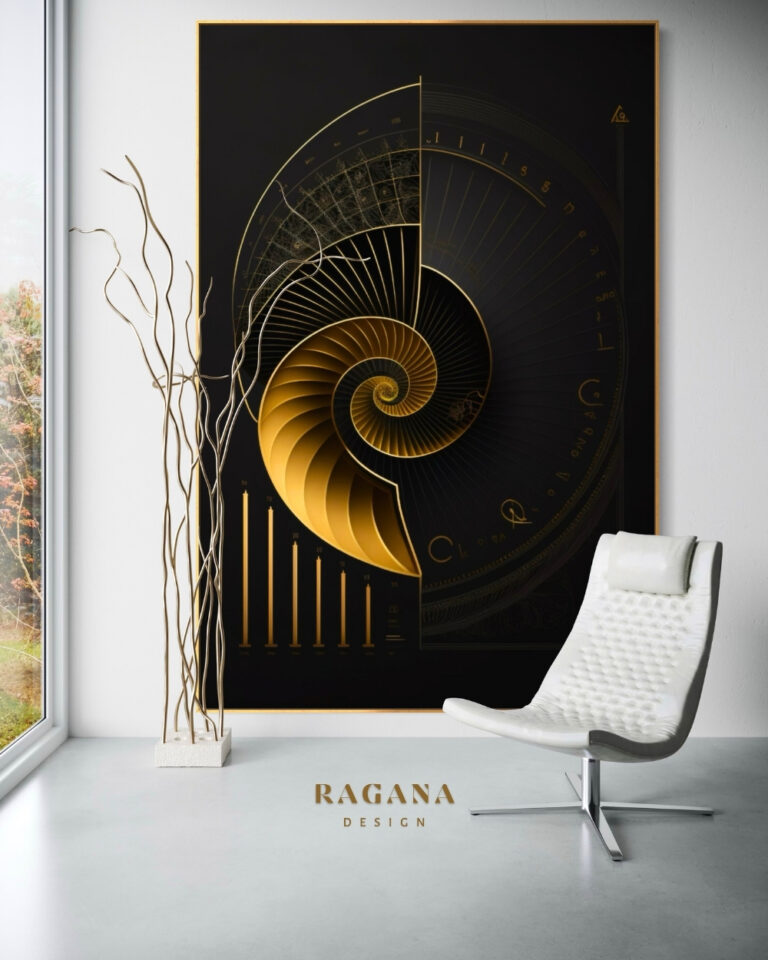
The same distinction settles the nautilus question. The shell is a smooth logarithmic spiral, which is why it looks right; but it grows by about 3 per turn rather than 6.85, so it is not a golden spiral, and it is certainly not a Fibonacci one. I have measured that separately in Is the nautilus shell really a golden spiral?
Which one should you use?
The squares show why the ratio appears at all — each number is the sum of the two before it — and the construction can be done by hand in ten minutes. Everyone should draw it once.
As an overlay on a photograph it is a question, not a proof; try it in all four orientations before deciding that a picture “fits”. The golden ratio in photography shows where the subject actually goes.
If a work is meant to feel continuous, its spiral has to be continuous. Look for the pole: a true golden spiral tightens towards a point and never arrives, and a Fibonacci one simply stops.


Questions
Is the Fibonacci spiral the same as the golden spiral?
No. The Fibonacci spiral is a chain of quarter circles drawn inside Fibonacci squares; the golden spiral is a smooth logarithmic curve that grows by 1.618 every quarter turn. The Fibonacci spiral approximates the golden spiral and gets closer the larger it is drawn, but the two never coincide.
Which one is the “real” golden spiral?
The logarithmic one, r = a·φ^(2θ/π). When a mathematician says golden spiral, that is the curve meant. The Fibonacci construction is the usual way of drawing an approximation of it by hand.
Is the nautilus shell a Fibonacci spiral?
No. The nautilus is a logarithmic spiral, like the golden spiral, but with a smaller growth rate — about 3 per turn instead of 6.85. It is neither golden nor Fibonacci.
Does it matter which one I use as an overlay?
For composition, barely: within three or four turns the curves are within a line’s width of each other. For anything printed large, the golden spiral is the one without seams.
Which spiral are the RAGANA works drawn on?
The golden spiral, calculated, with the Fibonacci squares often left visible so the construction can be checked with a ruler.
For a wall you're responsible for.
Tell me the room and what you want it to feel like. I will send three works that fit, and a mock-up of each one in place.
Write to me