GUIDES · THE GEOMETRY
The Fibonacci sequence, explained in six squares.
You do not need algebra to understand the sequence. You need a pencil, a ruler and six squares. By the time the sixth one is drawn the golden ratio and the golden spiral are both on the page, and you will know why they were always going to be.
The sequence and where it came from
The Fibonacci sequence is 1, 1, 2, 3, 5, 8, 13, 21, 34, 55, 89, 144 and so on for ever. The rule is the simplest one there is: each number is the sum of the two before it. Leonardo of Pisa — nicknamed Fibonacci, “son of Bonacci” — published it in 1202 in a book on arithmetic, as the answer to a puzzle about how fast a pair of rabbits would multiply. The puzzle is silly; the sequence turned out not to be. Indian scholars had known it centuries earlier from the rhythms of Sanskrit poetry, which is a better origin story, but the name stuck.
What makes the sequence more than a curiosity is what happens when you divide each number by the one before it. 3 ÷ 2 is 1.5. 5 ÷ 3 is 1.667. 8 ÷ 5 is 1.6. 13 ÷ 8 is 1.625. 21 ÷ 13 is 1.615. The answers rock back and forth, closer each time, around a single value: 1.618, the golden ratio. The sequence is the ratio arriving in whole numbers. Go far enough and the difference is smaller than any ruler can show.
Drawing it: six squares
Take a sheet of paper and draw a small square — call its side one unit; a centimetre will do. Draw a second square of the same size directly beside it. Together they make a rectangle two units wide and one high. Now draw a square on the long side of that rectangle: two units on a side. You have a rectangle three by two. Draw a square on its long side, three units; then five; then eight. Each new square sits against the long side of everything drawn so far, and its side is always the sum of the two squares before it. That is the sequence, drawn instead of written.
- Square 1: 1 unit. Square 2: 1 unit, beside it.
- Square 3: 2 units, on top of the pair.
- Square 4: 3 units, to the side.
- Square 5: 5 units, below.
- Square 6: 8 units, to the side — the rectangle is now 13 × 8.
Look at the rectangle you have made after six squares: 13 by 8. Divide: 1.625. After the seventh it would be 21 by 13, 1.615. The rectangle is turning into a golden rectangle — the one shape that, when you cut a square off one end, leaves a smaller rectangle of exactly the same proportions. That property is the whole reason the ratio matters in design: it is the only proportion that survives its own subdivision.
Where the spiral comes from
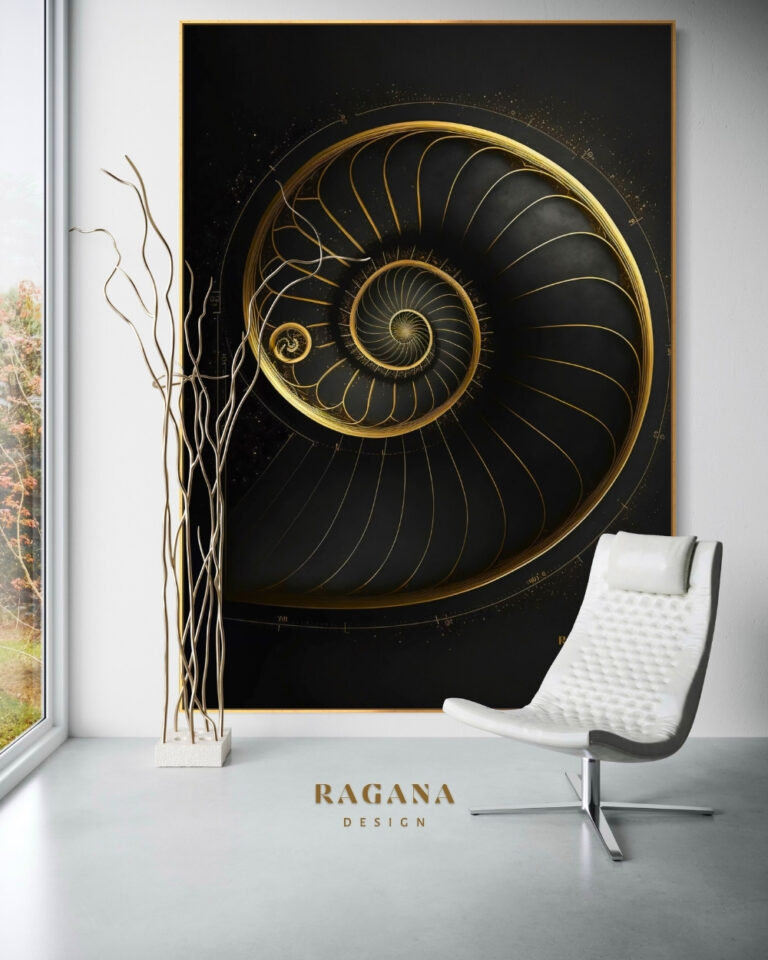
Now take a compass. In each square, draw a quarter-circle from one corner to the opposite corner, choosing the corners so that each arc continues the last. The curve that appears, running through all six squares, is the golden spiral. Nobody drew it; it fell out of the squares. It tightens toward a point it never reaches — the “eye” of the spiral, which in a golden rectangle sits at the crossing of the two diagonals — and every quarter turn it is 1.618 times wider than the one before.
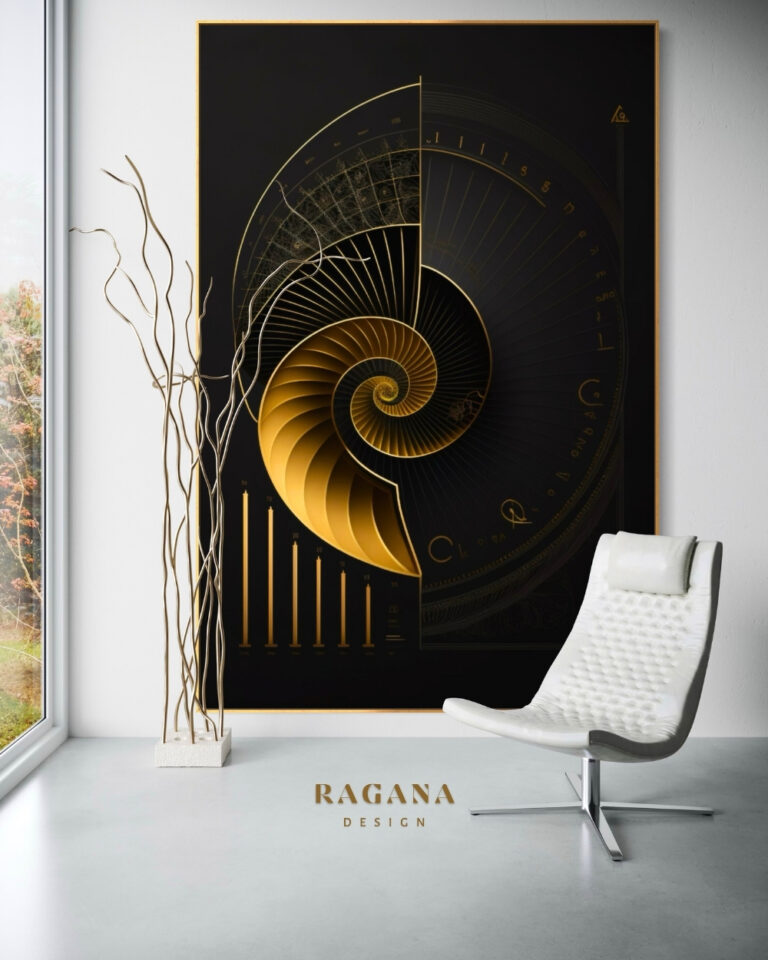
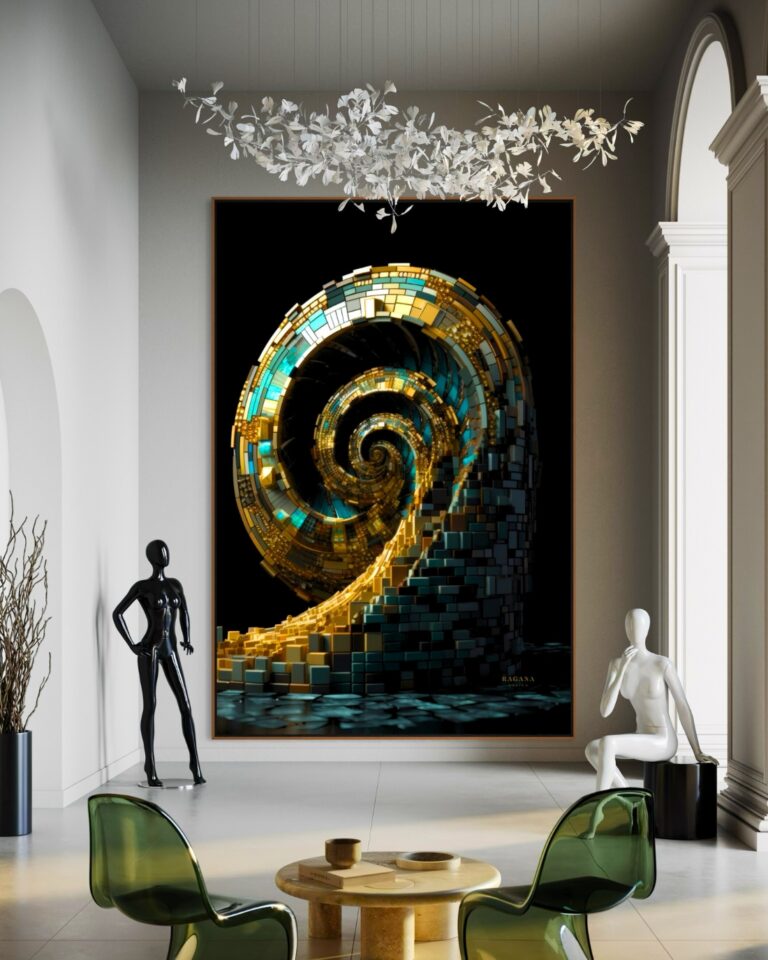
This is the picture that most of my work starts from. The Sovereign Ledger is the drawing with everything left in: six squares, the numbers in the margins, the arcs, the ruled lines. The Celestial Blueprint fills the same squares with clockwork. The Tectonic Fibonacci pulls the squares apart as if they were plates of stone and lets the spiral hold them together. In each case the sequence is the subject; the picture is what is built on it.
Why plants count in Fibonacci
The sequence would be a mathematician’s toy if it did not keep turning up in gardens. Cut a pineapple and count the diagonal rows of scales: 8 one way, 13 the other. A pine cone: 8 and 13, or 5 and 8. A sunflower: 34 and 55. Petal counts run 3, 5, 8, 13, 21. This is not coincidence and not mysticism; it is packing. A plant adds each new leaf or seed a fixed angle around from the last, and the angle that packs them without gaps is 137.5 degrees — a full turn divided by the golden ratio. Place points at that angle and the spirals your eye finds in the result always come in Fibonacci pairs. The Sovereign Garden is that rule made into a picture.
Using it in a print
The construction scales. If you want a print built on the sequence to sit on a real wall, choose the unit so that the 8-unit square fits the space. A 100 cm wide print with a 13 × 8 layout has a unit of about 7.7 cm; the largest square is 62 cm, the smallest under 8. That is roughly how the works here are laid out, which is why the eye finds a resting place in them at about 38 percent from one edge — the golden section of the width — rather than dead centre. If you want to check any of them, print the page, take a ruler to the largest square and the next, and divide. You will get 1.6 and change.
| Print width | Unit (width ÷ 13) | Largest square (8 units) | Golden section from left |
|---|---|---|---|
| 50 cm | 3.8 cm | 31 cm | 19 cm |
| 70 cm | 5.4 cm | 43 cm | 27 cm |
| 100 cm | 7.7 cm | 62 cm | 38 cm |
| 120 cm | 9.2 cm | 74 cm | 46 cm |
| 160 cm | 12.3 cm | 98 cm | 61 cm |
That is the whole of it. A rule you can say in one breath, a drawing you can make in five minutes, a proportion that keeps itself as it grows, and a reason — packing — why living things arrive at it without being told. Everything else on this site is built on those six squares.
Questions
What is the Fibonacci sequence?
1, 1, 2, 3, 5, 8, 13, 21, 34, 55… — each number is the sum of the two before it. Published by Leonardo of Pisa in 1202; known earlier in India. The ratio of consecutive terms approaches the golden ratio, 1.618.
How is the Fibonacci sequence related to the golden spiral?
Draw squares with sides 1, 1, 2, 3, 5, 8, each against the long side of the previous rectangle, then a quarter-circle through each square. The curve through the arcs is the golden spiral; the rectangle they form approaches a golden rectangle.
Which of your works show the Fibonacci construction directly?
The Sovereign Ledger, The Chronos Equation and The Celestial Blueprint leave the numbered squares and arcs visible. The Sunflower Compass and The Sovereign Garden are built on the golden angle, 137.5 degrees, instead.
For a wall you're responsible for.
Tell me the room and what you want it to feel like. I will send three works that fit, and a mock-up of each one in place.
Write to me