GUIDES · THE GEOMETRY
Is the nautilus shell really a golden spiral?
Almost every article about the golden ratio opens with a nautilus cut in half. It is a beautiful picture and a slightly wrong one. Here is what the shell really does, measured, and what that means for the art built on it.
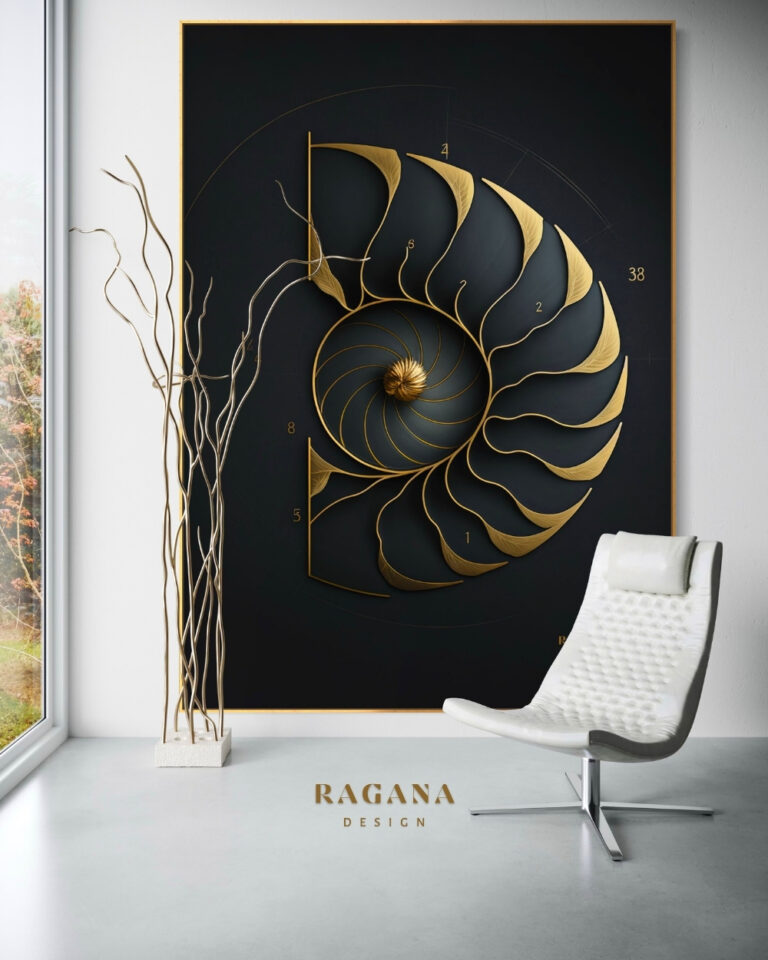
Two spirals that look alike
A spiral is “logarithmic” when it grows by the same factor with every turn: whatever the curve does in one quarter turn, it does again in the next, only larger. All logarithmic spirals look alike at a glance, the way all circles do. What separates them is the growth factor — how much wider the curve gets per turn. A tight factor gives a coil like a watch spring; a large one opens quickly and looks like a wave.
The golden spiral is one specific logarithmic spiral: it grows by the golden ratio, 1.618, every quarter turn. That makes it about 6.85 times wider per full turn. You can draw it without any formula by stacking Fibonacci squares — 1, 1, 2, 3, 5, 8 — and running a quarter-circle through each. The Sovereign Ledger is exactly that drawing, with the squares and the numbers left on the page.
What the nautilus actually does
The nautilus also grows by a constant factor, so it is a true logarithmic spiral — that part of the story is right. But when you measure real shells, the chambers open up by a factor of roughly 3 per full turn, not 6.85. Per quarter turn that is about 1.3, not 1.618. The shell grows more slowly than the golden spiral, and if you lay a golden spiral over a photograph of a nautilus, the two curves drift apart within a single turn. The famous overlay pictures either use a spiral that is not golden or a shell that has been stretched to fit.
There is a milder claim that does hold up: the nautilus is close to a spiral that grows by 1.618 every half turn rather than every quarter turn. That spiral opens by about 2.6 per turn, which is near the measured 3. So the shell is “golden” in a loose sense — a logarithmic spiral in the same family — but not the textbook golden spiral, and the ratio itself is not written into the animal.
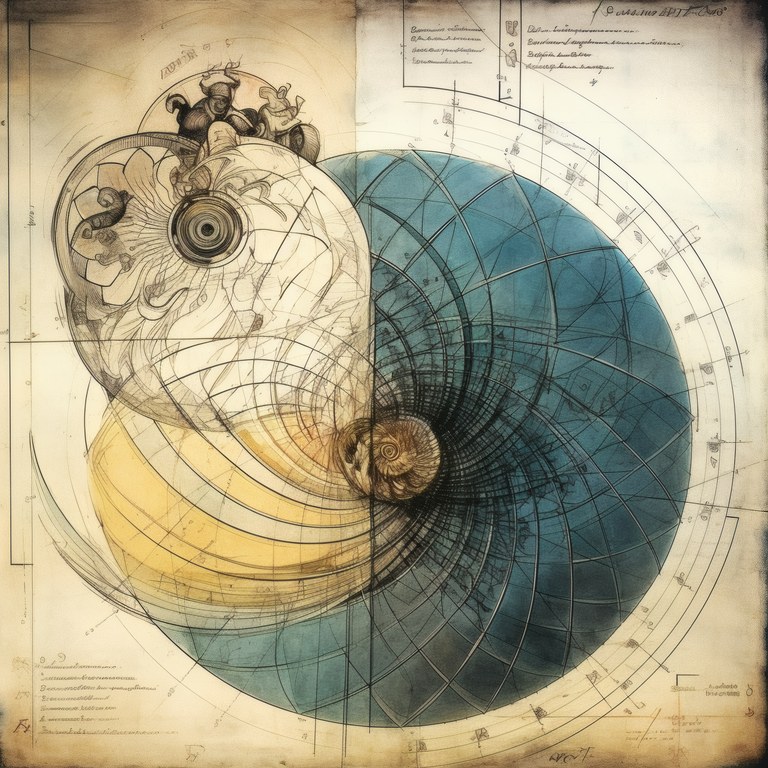
Why the shell grows that way at all
The reason is not mathematics but the animal. A nautilus builds its shell one chamber at a time, and each chamber has to be the same shape as the last, only larger, because the creature inside keeps its proportions as it grows. Steady growth plus constant shape gives a logarithmic spiral automatically; there is no other curve that does it. The growth factor is simply how fast a nautilus grows relative to how fast it turns. Nothing in that requires 1.618, and the shell does not produce it.
The same is true of ram’s horns, the curl of a chameleon’s tail and the arms of some galaxies: all logarithmic, all with their own growth factor, none of them golden. Galaxies in particular are cited constantly and fit worst — their arms open by anything from three to ten times per turn depending on the galaxy, and they are not even proper spirals in the mathematical sense.
Where the ratio really lives in nature
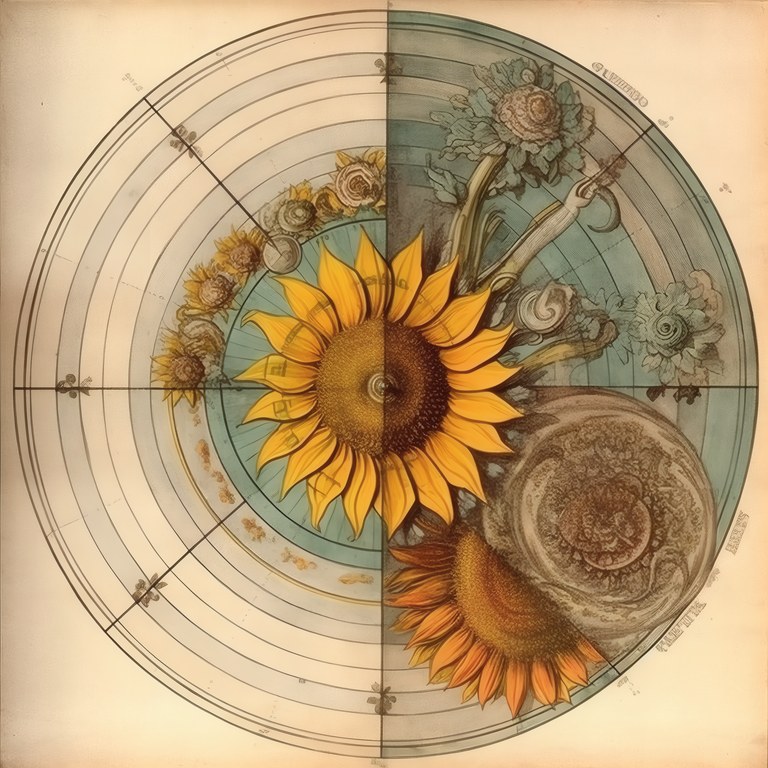
If the nautilus is the wrong example, the sunflower is the right one. Look at the seed head and you will see two sets of spirals running opposite ways. Count them: typical heads show 34 one way and 55 the other, or 55 and 89 — always two neighbouring Fibonacci numbers. Pine cones show 8 and 13, pineapples 8 and 13 or 13 and 21. This is not approximate; it is exact, and it is the same in almost every specimen.
The cause is packing. A plant places each new seed or scale a fixed angle round from the last. If that angle were a simple fraction of a turn, the seeds would line up in straight rows and waste space. The angle that avoids every simple fraction is the one that divides the circle by the golden ratio: 137.5 degrees, the golden angle. Seeds placed at that angle pack most tightly, and the spirals the eye picks out from the pattern come in Fibonacci pairs as a side effect. The Sunflower Compass is built on this rule rather than on the shell, and it is the more honest piece of geometry for it.
So why draw the shell?
Because the shell is where people meet the idea, and because an artist is allowed to draw the shell as it would be if it obeyed. My nautilus works are not portraits of a specimen; they are the shell built from the construction outward — the squares first, the spiral through their corners, the chambers filled in afterwards. The Golden Nautilus II and Nautilus Prime are that idealised animal, and they leave the scaffolding visible so that nobody has to take it on faith. Put a ruler on the print and the proportion is there.
That is the honest position: the golden ratio is real, its place in plants is exact, its place in shells is approximate, and its place in art is a decision. I make the decision in the open.
Questions
Is the nautilus shell a golden spiral?
Not exactly. It is a logarithmic spiral, which is the same family of curve, but it grows by about 3 per full turn, while a golden spiral grows by about 6.85. The two drift apart within one turn when overlaid.
Where does the golden ratio really appear in nature?
In the arrangement of seeds, scales and leaves. Sunflower heads show 34 and 55 spirals, pine cones 8 and 13 — neighbouring Fibonacci numbers — because each new seed is placed 137.5 degrees round from the last, the golden angle.
Do your nautilus works use the real shell or the golden spiral?
The golden spiral, deliberately. Works such as The Sovereign Ledger and Nautilus Prime are built from Fibonacci squares outward and keep the construction visible, so the proportion can be measured on the print.
For a wall you're responsible for.
Tell me the room and what you want it to feel like. I will send three works that fit, and a mock-up of each one in place.
Write to me