GUIDES · IN THE ROOM
The golden ratio in interior design: where the art goes, and why.
Furniture placement, wall composition and the one measurement that makes a room read as settled. A working guide with a drawn elevation, a tool you can type your own wall into, and no mysticism.
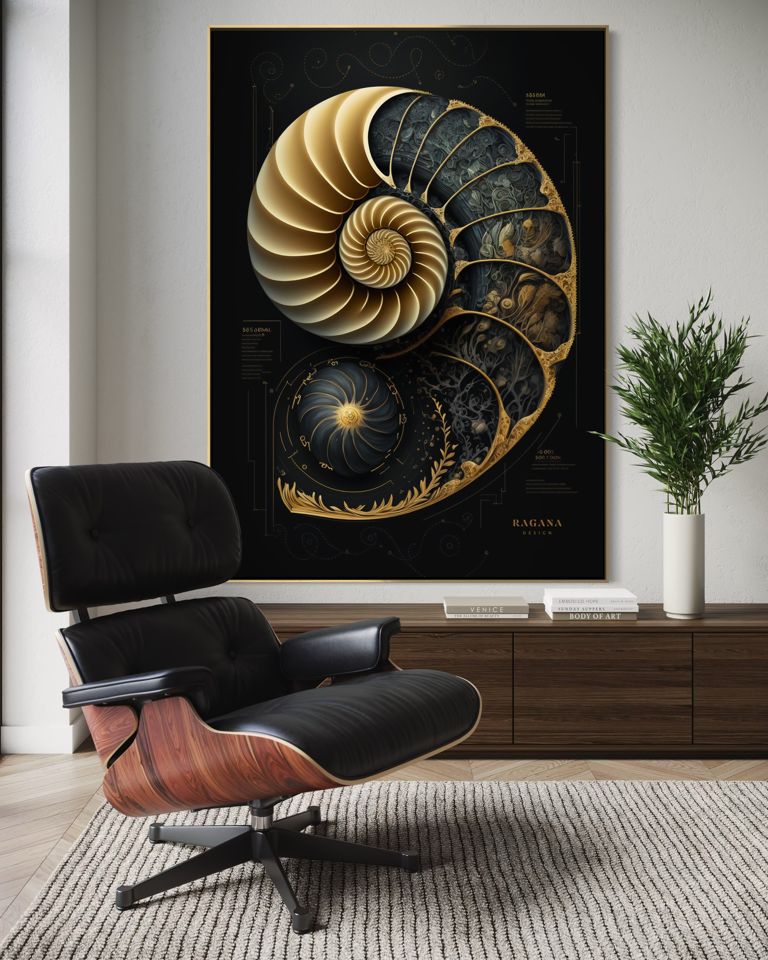
The wall is a rectangle. Treat it like one.
Every rule about hanging art is a rule about where the eye rests. A wall has two natural resting points, and neither is its centre: the vertical line at 61.8 % of its width, and the horizontal line at standing eye height, about 145 cm from the floor. Put the middle of the artwork where those two lines cross and the room stops arguing with itself. Centre the work on the wall instead and it sits exactly where the eye expects nothing, which is why centred pieces so often look pinned rather than placed.
That is the whole method. The elevation below shows it on a standard 220 cm sofa against a wall of 3.6 m, with the sofa itself placed on the golden section rather than in the middle. Everything else on this page is a consequence of it.
Where the furniture goes
Before the art, the sofa. On a short wall — up to about 3 m — centre the main piece of furniture; the wall is one object and the eye reads it as such. On a longer wall, or a wall with a door or window at one end, centre the sofa on the golden section instead: 61.8 % of the way along, measured from the end with more open space. The remaining 38.2 % takes a lamp, a plant, a reading chair, or nothing. The elevation above is this second case, and it is the more common one in real rooms, because walls are rarely symmetrical once the doors are in.
The same split works in plan. A rug that covers 61.8 % of a room’s length, a sofa placed 38.2 % of the way in from the window wall, a dining table whose long side is 1.618 times its short side: none of these is a law, but each one is a resting point the eye finds without being told. The number is doing quietly what a designer does by feel.
Three rules that follow
A work over a sofa should be about two thirds of the sofa’s width. Over a console or a bed the same fraction holds. A wall with nothing under it takes the golden section of its own width: a 3 m wall wants a work, or a group, about 185 cm wide.
The centre of the work at 145 cm on an open wall. Above furniture, the lower edge 20–25 cm above the furniture and the centre wherever that puts it — usually 150 to 165 cm — because a frame floating high over a sofa breaks the two into separate objects.
Two works side by side look right when their widths are 1 : 1.618 rather than equal. A trio reads as a set when the middle piece is the largest and the sides are 0.618 of it. Equal pairs read as a shop display.
What the number cannot do
The golden ratio will not rescue a work that is the wrong size, and it will not make a busy wall calm. It is a placement rule, and it works best on a wall that has one thing on it. If a room already has pattern — a bold rug, a gallery wall, a bookcase — the work should be quieter than the pattern and the rule should be applied to the group, not to each piece. Treat a gallery wall as a single rectangle: its centre goes on the golden section and the eye line, and inside it the gaps stay even, five centimetres or so.
Nor does the ratio move with the ceiling. In a room with a 3.5 m ceiling the eye line is still at 145 cm; the space above the work is meant to stay empty, and it is that emptiness — not a bigger frame — that makes the room feel tall. What size wall art for every room gives the sizes by room; how to hang wall art using the golden ratio has the hanging method with a tape measure.


Questions
Where should art be hung on a wall according to the golden ratio?
With its centre on the vertical line at 61.8 % of the wall’s width and on the eye line at about 145 cm from the floor. Above a sofa or console, keep the lower edge 20–25 cm above the furniture and let the centre rise as far as that requires.
How big should art be above a sofa?
About two thirds of the sofa’s width — between 60 and 75 %. For a 220 cm sofa that is a work or a group roughly 145 cm wide. A single portrait piece is usually half the sofa width; a pair of portraits spans the two thirds together.
Does the golden ratio apply to furniture placement too?
Yes, in the same way. On a long or asymmetrical wall, centre the main piece on the golden section rather than the middle. In plan, a rug covering 61.8 % of the room’s length or a table with sides in the ratio 1 : 1.618 gives the eye the same resting point.
Does the rule change for a gallery wall?
Treat the whole group as one rectangle. Its centre goes on the golden section and the eye line; inside it, keep the gaps even, about 5 cm, and let the largest piece sit near the group’s own golden section.
What about a very high ceiling?
The eye line does not move with the ceiling. Keep the centre at about 145 cm and let the wall above stay empty — that emptiness is what makes the room feel tall.
For a wall you're responsible for.
Tell me the room and what you want it to feel like. I will send three works that fit, and a mock-up of each one in place.
Write to me