GUIDES · DA VINCI REIMAGINED
Da Vinci and the golden ratio.
Leonardo is the one artist everybody associates with the golden ratio, and half of what is said about it is invented. Here is what he actually did — the book he illustrated, the way he drew, the proportion he measured — and how those notebook pages became a collection.
The book he illustrated
In 1498 the mathematician Luca Pacioli, then living in Milan under the same patron as Leonardo, wrote De Divina Proportione — “On the Divine Proportion” — the first book devoted to the golden ratio. Leonardo drew the illustrations: some sixty geometric solids, shown as skeletal frames so that every edge can be seen, floating in space with their shadows. They are the earliest drawings we have of a dodecahedron rendered in true perspective, and they are still the clearest.
That is the documented link. Leonardo knew the ratio, understood it as a mathematician’s friend explained it, and drew it. What he did with it in his paintings is less certain than the internet claims. The Mona Lisa can be overlaid with a golden rectangle, but so can most portraits; the Last Supper is composed on a perspective grid, not a golden one. Where the proportion is unambiguous is in the Vitruvian Man — and even there it comes from Vitruvius, the Roman architect whose text Leonardo was illustrating, who set out the body’s divisions in ratios that approach the golden section.
How the notebooks look, and why
Leonardo’s pages are recognisable at a glance: sepia ink on toned paper, mirror-writing running around the drawings, a machine or a muscle or a river current studied from several sides on one sheet, with numbers and arrows in the margins. The look is not a style he chose; it is what thinking on paper looks like when the thinker draws faster than he writes. The construction lines are left in. The mistakes are left in. The page is a record of finding out.
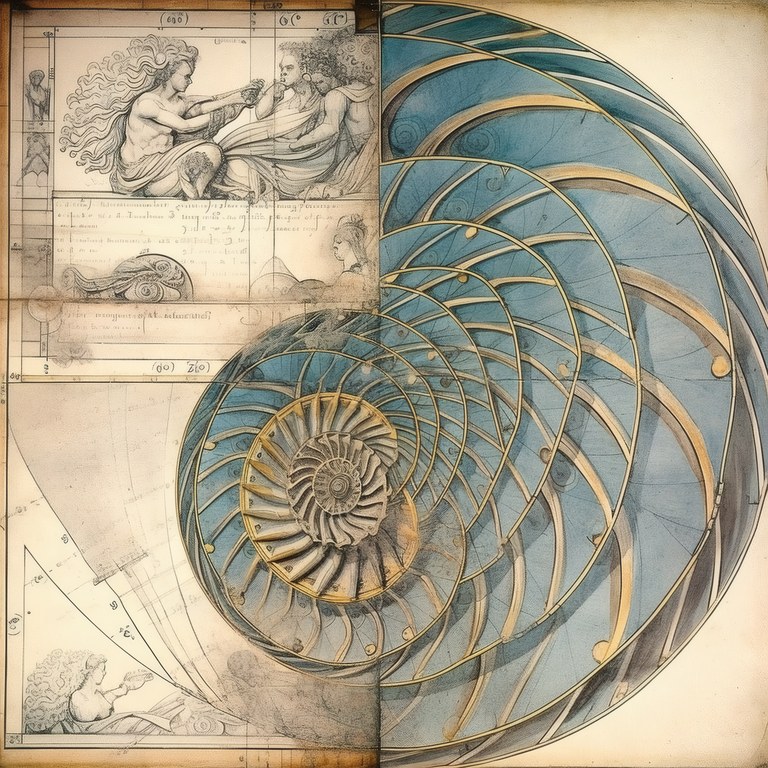
This is what the Da Vinci Reimagined collection takes from him — not a subject, but the page. Each work is set out as a sheet from a notebook that never existed: parchment ground, iron-gall line, annotations in a hand nobody was meant to read, and the construction lines of the golden spiral left visible, as he would have left them. Then, somewhere on the sheet, the study resolves: the spiral fills with colour and gold, and the drawing becomes a picture.
The spiral as an instrument
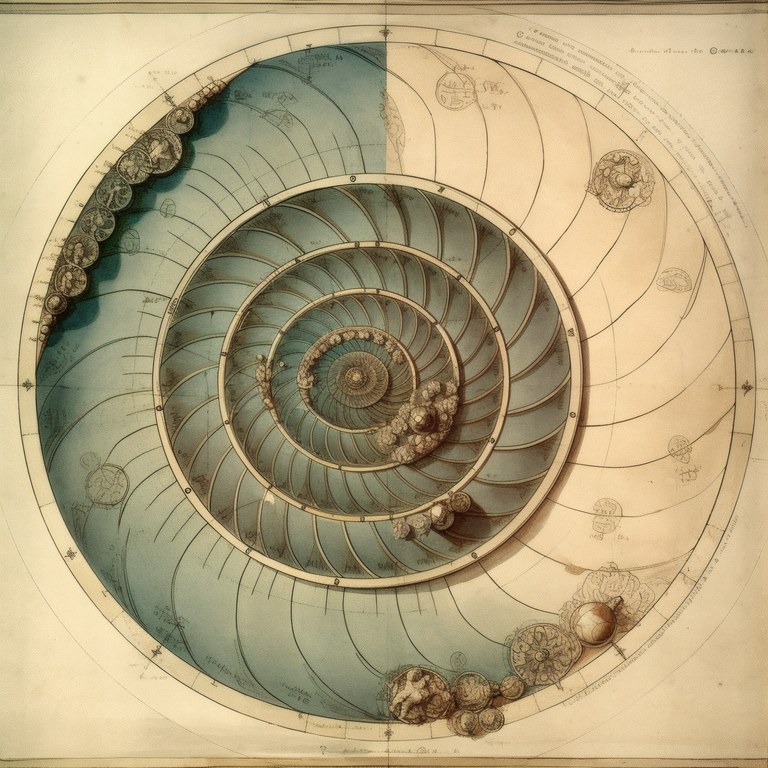
Leonardo drew spirals constantly — in water, in hair, in the growth of plants, in the flight of birds — and he understood them as records of motion, not as decoration. A curl of water is a diagram of how the water moved. That is the reading the collection takes. In The Tidal Chart the ammonite is drawn as a measuring device, every chamber ruled and numbered; in The Meridian Shell the nautilus is set against a compass rose like an instrument in a cabinet; in The Sunflower Compass the seed head sits at the cross-hairs of a ring, so that the flower and the instrument are the same thing.
The mathematics underneath is exact. The spiral in each work is constructed from Fibonacci squares, the chambers step up by 1.618, and the resting point of the composition is at the golden section of the sheet. Leonardo’s own spirals were freehand and approximate; these are the drawings he would have made if he had had the instrument.
The figure studies
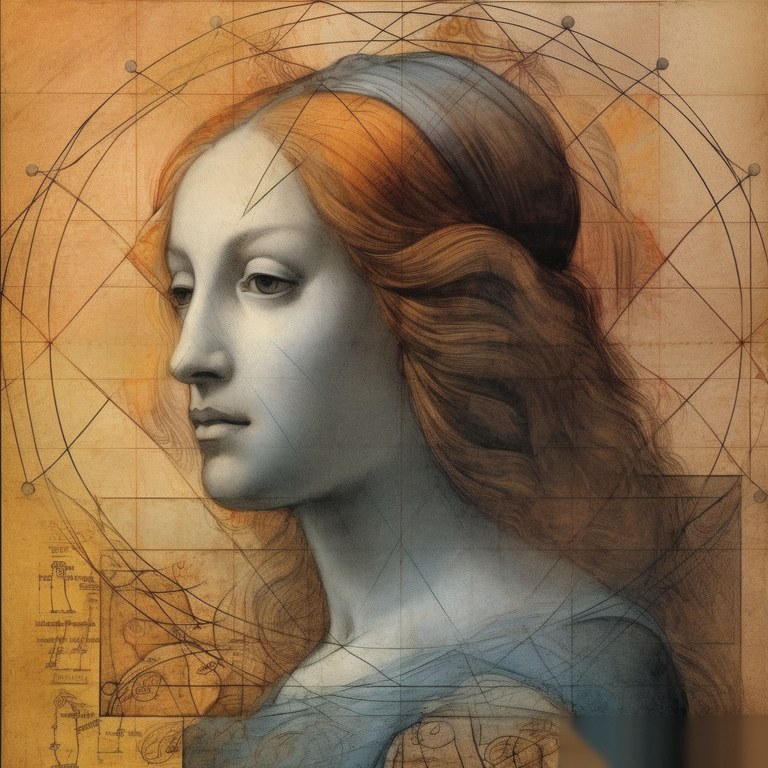
Two works in the collection are portraits: The Vitruvian Muse, a profile with the compass work still drawn across her face, and The Helical Vault, where the figures are left small to give scale to a staircase. Both take Leonardo’s habit of drawing the proportion lines onto the subject and leaving them there. In the Muse, every arc lands on a feature — the brow, the eye, the corner of the mouth — which is why she reads as calm: the face is not posed, it is measured, and the measurement is the composition.
Where the works go
These are the palest works in the archive — parchment, sepia, one colour and gold — and they behave differently from the dark pieces. They want a mid-tone wall, a warm grey or a soft green, and a frame in raw oak or pale walnut with a warm-white mat. They suit a study, a hallway, a consulting room, anywhere someone will stop and read them; they are the least suited to being glanced at. The square files (10,240 × 10,240 px) print to 90 cm square at close-viewing quality, and The Helical Vault, the tall one, to 60 by 90.
Questions
Did Leonardo da Vinci use the golden ratio?
He illustrated the first book about it — Pacioli’s De Divina Proportione, 1509 — with sixty perspective drawings of geometric solids, so he knew it well. Claims that the Mona Lisa or the Last Supper are composed on it are unproven; the Vitruvian Man follows proportions from Vitruvius that approach the golden section.
Are these reproductions of Leonardo’s drawings?
No. They are new works set out in the manner of a notebook page — parchment, sepia line, visible construction, marginalia — with the golden spiral constructed exactly on the Fibonacci sequence. No drawing by Leonardo is reproduced.
What format are the Da Vinci works?
Most are square, 10,240 × 10,240 pixels, printing to 90 cm square; The Helical Vault is tall, 8,960 × 13,440 pixels. Each product page states the exact size.
For a wall you're responsible for.
Tell me the room and what you want it to feel like. I will send three works that fit, and a mock-up of each one in place.
Write to me