
Matisse in Gold
Goldfish in Gold
Matisse Reimagined in Gold
from €9.99
GUIDES · ARTISTS
Henri Matisse spent his life making colour do the work. From the wild paintings of 1905 to the paper cut-outs of his last years, here is what to know before you hang his ideas on your wall.
Anyone looking for a Matisse print is really looking for colour. Henri Matisse was born in northern France in 1869 and died in Nice in 1954. He came to painting late, after training in law, and spent more than fifty years testing how far colour could go on its own, without the help of shading or perspective.
In the summer of 1905 he worked in Collioure, a small fishing port on the Mediterranean near the Spanish border. That autumn his canvases were shown at the Salon d'Automne in Paris, and the critic Louis Vauxcelles called the painters around him les fauves, the wild beasts. Fauvism, with its pink seas and green faces, became one of the first modern movements.
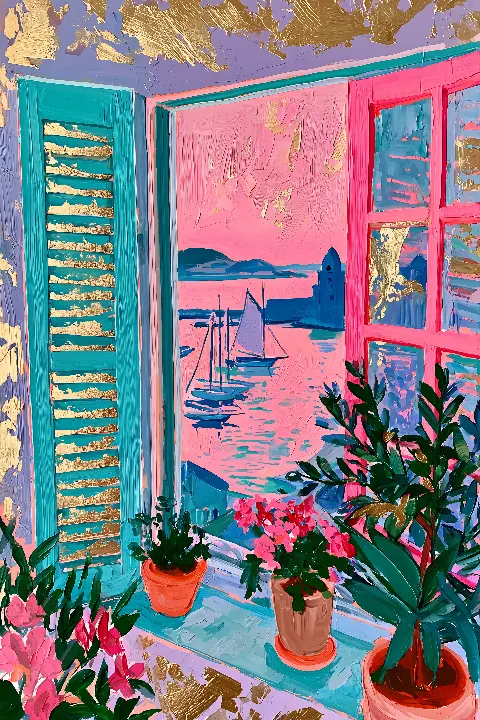
If you want a Matisse print with a famous painting behind it, three works in the Matisse in Gold collection follow real paintings made before 1931. The Open Window, Collioure goes back to that summer of 1905: a turquoise shutter and a pink window frame open onto a pink harbour with sailing boats, and gold leaf joins the sky. The painting it is based on hangs in the National Gallery of Art in Washington.
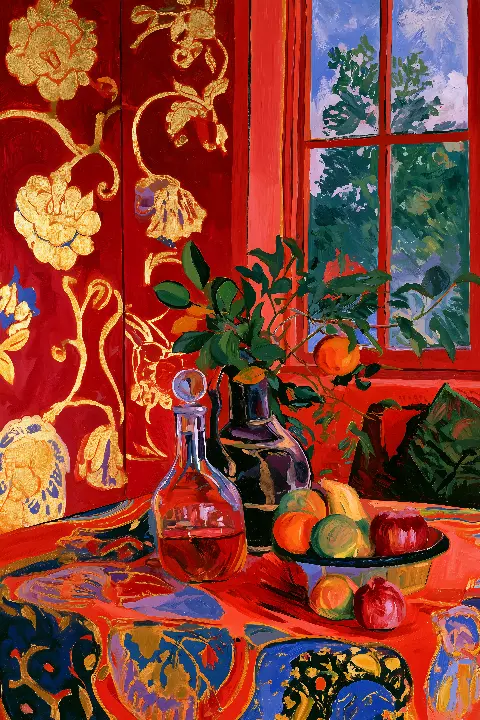
Harmony in Red & Gold is after Harmony in Red of 1908, painted for the Moscow collector Sergei Shchukin and now in the Hermitage in St Petersburg. Matisse began it in blue-green and repainted the whole surface red. Here gold arabesques curl across the red wall and table, and a window onto green trees gives the eye somewhere to rest.
Goldfish in Gold goes back to Goldfish of 1912, now in the Pushkin Museum in Moscow: three orange fish in a round glass bowl on a blue-and-white table, crowded by pink flowers and dark leaves, with small touches of gold on the stand.
After major surgery in 1941, Matisse found standing at the easel hard. Working from bed or a wheelchair in Nice, he had assistants brush sheets of paper with gouache, then cut shapes straight from the colour and had them pinned to the walls. He called it drawing with scissors. The method produced the book Jazz in 1947 and the Blue Nudes in 1952.
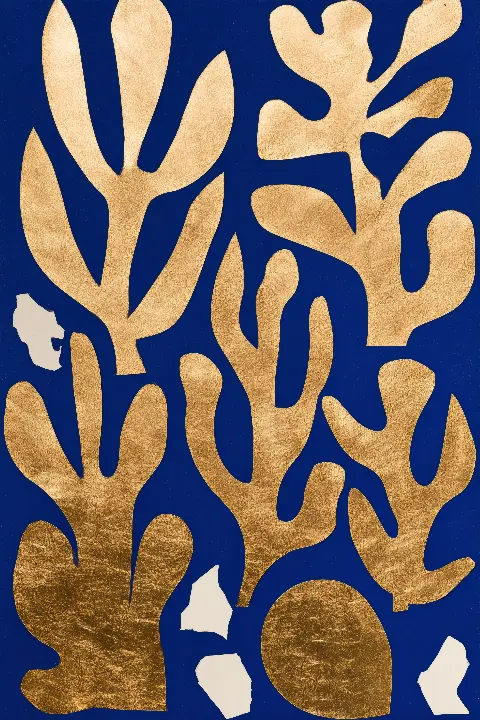
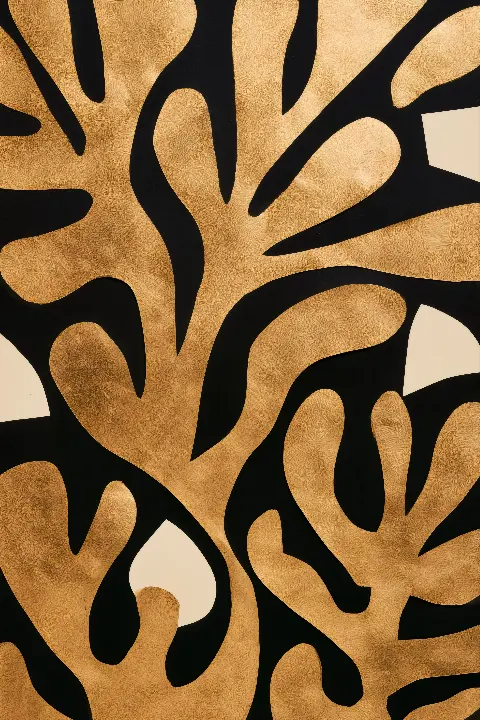
Our cut-out works are original compositions in that spirit, not versions of any of his. Golden Seaweed sets tall gold fronds with free, wavy edges on flat cobalt blue, with a few cream scraps floating like bubbles. Golden Leaves on Black packs large lobed gold leaves edge to edge, so the matte black survives only as narrow borders between them.
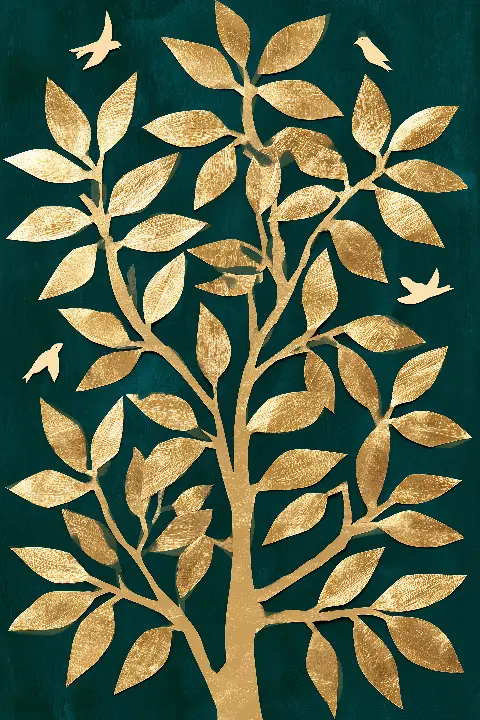
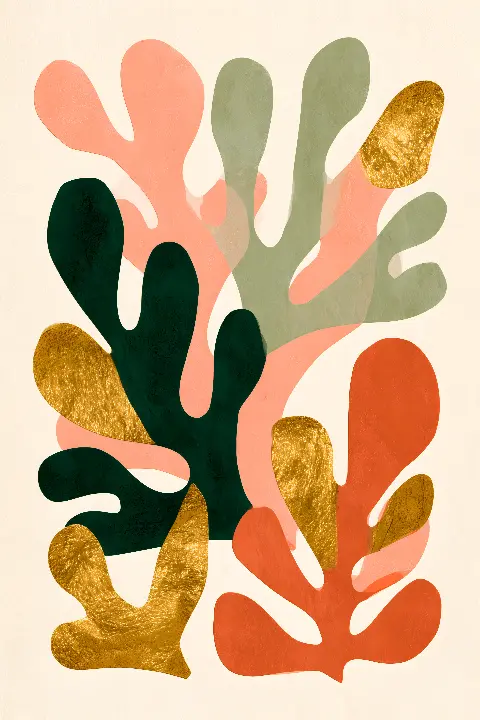
The Golden Tree with Birds rises in mirror image up a deep green ground, small gold birds circling its crown. Golden Cut-Outs is lighter, with coral, sage, orange and gold shapes scattered loosely over cream.
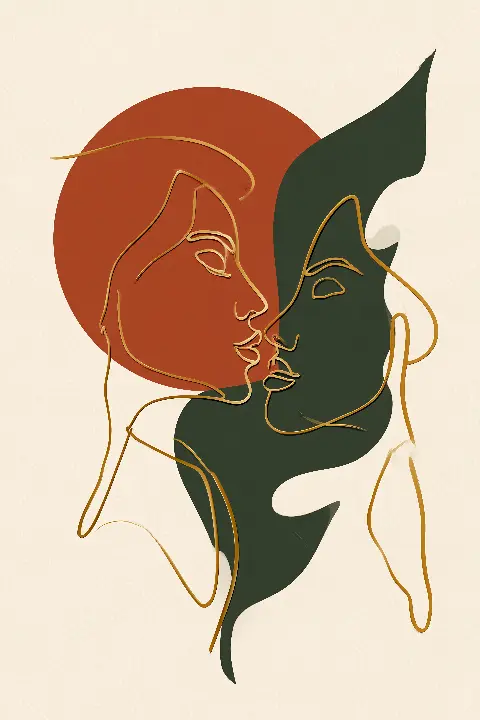
Matisse could catch a face in a few sure strokes, and his late drawings are as admired as his colour. The Lovers, an original line work, draws two profiles about to kiss in one continuous gold line, over a rust-red circle and a dark green leaf. It suits a bedroom, where a softer image is often wanted.
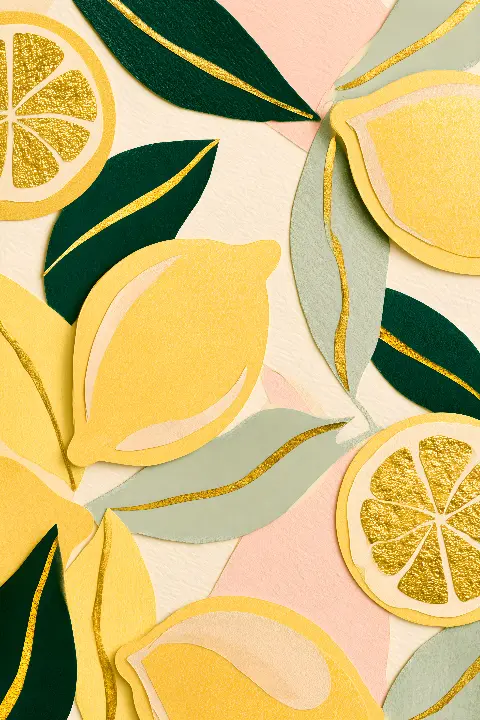
Golden Lemons is another original composition, borrowing the lemons that appear so often in his still lifes. Whole and halved lemons in butter yellow overlap with sage and dark green leaves on a pale pink ground, and a few edges are picked out in gold. It brings a kitchen or breakfast corner a cheerful note without shouting, and hung low above a counter or a bench it reads well at sitting height.
Because a Matisse print is all about colour, start with the wall. Strong works such as Harmony in Red & Gold or Golden Seaweed want a quiet background: warm white, pale stone or soft grey. On a coloured wall, pick a print that shares one tone with it, so cobalt blue near blue cushions, or sage with a sage kitchen.
Black and gold is the most adaptable choice. Golden Leaves on Black works in a modern living room, an office or a hallway with dark doors, and it holds its own beside plain furniture. The pastel cut-outs suit lighter rooms with natural wood and linen.
Matisse liked his cut-outs large, some covering whole walls, so be generous when you size a Matisse print. Every work is a printable download, and the portrait files at 7168 × 10752 px print sharply to about 60 × 90 cm. Printed versions are available on the site, and each download includes a Frame TV version.
Thin white, black or pale oak frames suit the flat shapes; ornate gilt frames fight them. Hang the centre at about 145 to 150 centimetres from the floor. A pair of cut-outs side by side, with six to eight centimetres between frames, gives the playful rhythm Matisse himself found when he pinned shapes across his walls.
Three paintings reimagined in gold, with original cut-out and line compositions made in the spirit of his late work.
They are the works Matisse made in his last years from paper painted with gouache and cut with scissors. Assistants pinned the shapes to the wall while he arranged them. Jazz of 1947 and the Blue Nudes of 1952 are well-known examples.
No. The cut-out and line works are original compositions in the spirit of his late style. Only Goldfish in Gold, The Open Window, Collioure and Harmony in Red & Gold are reimagined from his paintings of 1905, 1908 and 1912.
Golden Lemons is made for it, with butter yellow lemons and sage leaves on pale pink. Goldfish in Gold also works well in a bright kitchen or dining area, where its orange and pink lift the room.
Keep it simple. A thin white, black or pale oak frame lets the flat colour shapes lead. A wide white mount suits the cut-outs, echoing the way Matisse placed his shapes on large plain sheets.
Tell me the room and what you want it to feel like. I will send three works that fit, and a mock-up of each one in place.
Write to meThis site uses cookies for Google Analytics and Google Ads so I can see which pages and ads bring visitors. Nothing is sold or shared beyond that. Privacy