
Klimt Reimagined
The Eternal Kiss
The Kiss, Klimt Reimagined
from €9.99
GUIDES · ARTISTS
Gustav Klimt's golden embrace is one of the most recognised paintings in the world. Here is what it shows, where its gold comes from, and how to choose, size and hang a print of it.
The Kiss Klimt painted in Vienna in 1907 and 1908 is a square canvas, about 180 centimetres on each side, made with oil paint and real gold leaf. A man and a woman kneel at the edge of a meadow full of flowers. He bends over her and holds her face; she turns her cheek towards him with her eyes closed, and her bare feet curl over the rim of the ground, as if the meadow ended in a drop.
Both figures almost vanish into their robes. His is covered in black and white rectangles, hers in circles and small flowers, and the two patterns merge into one gold shape against a flat, speckled background. Only the faces, hands and feet are painted as skin. That contrast between soft flesh and hard ornament is what makes the picture recognisable from across a room, and it is the first thing to look for in any print of it.
The painting was shown at the Kunstschau exhibition in Vienna in 1908, and the Austrian state bought it that same year. Today it belongs to the Belvedere museum in Vienna.
Klimt was born near Vienna in 1862, the son of a gold engraver, and trained as a decorative painter before he became the leading figure of the Vienna Secession, the group of artists who broke away from the city's established artists' association in 1897. Gold was a material he had known since childhood.
The decisive push came in 1903, when he travelled to Ravenna in Italy and saw its Byzantine mosaics, where saints and emperors stand in fields of glittering tiles. In the years that followed, his so-called Golden Period, he laid gold leaf straight onto the canvas. The Kiss is the high point of that phase, together with his 1907 portrait of Adele Bloch-Bauer.
This matters when you compare The Kiss Klimt prints. The gold in the painting is flat and decorative, not a painted reflection, so a good interpretation keeps the ornament crisp and the faces calm rather than adding fake sparkle.

Three works in the Klimt Reimagined collection return to the embrace, each with a different idea of ornament. The Eternal Kiss stays closest to the pose: a single cloak of gold, orange and black mosaic wraps both figures, and the black tiles give the gold a sharp edge so it never blurs into one warm glow.
The Spiral Kiss shows both heads in profile, her eyes closed under a mass of red hair, surrounded by copper spirals and small black-and-white squares that read like stitching up close. The Mosaic Kiss moves the kiss to her forehead, and her long black hair cuts a dark, flowing line through the bright squares, with only a few grey-blue tiles to cool the amber and ochre.
The three were made as a set, The Golden Kiss, to hang side by side. In a row the same gesture repeats with small changes, a little like Klimt's own habit of returning to one motif again and again.
If The Kiss Klimt made famous feels too familiar for your main wall, the rest of his golden vocabulary works just as well. The Lady in Gold draws on the portrait of Adele Bloch-Bauer: a short black bob, one hand resting against her cheek, and a dress of spirals, rectangular blocks and almond-shaped eyes packed edge to edge.
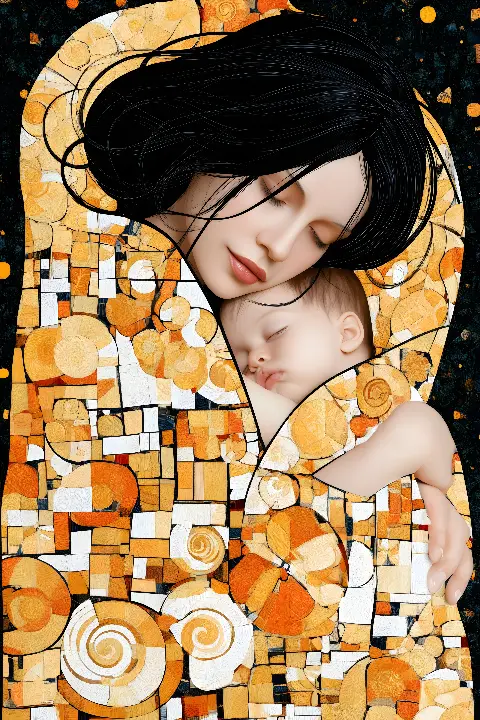
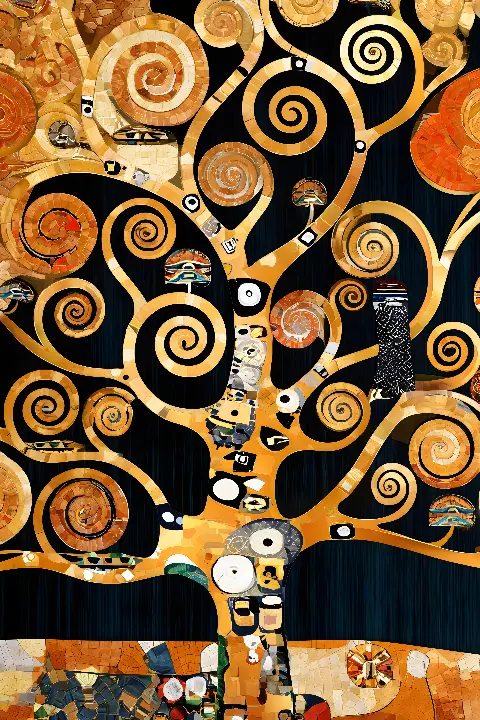
The Golden Mother and Child is quieter still, a mother with closed eyes and a sleeping baby pressed against her cheek, wrapped in white, orange and gold squares. The Midnight Tree of Life, after the tree in Klimt's Stoclet Frieze, sets curling gold branches and tiny birds on deep black, with a band of ochre mosaic at its foot.
For a darker, more formal note, The Gilded Silhouette places a woman in a long sequinned black dress inside a gold arch, against overlapping circles of gold and slate blue. Mixed with one of the kisses, these keep a group of Klimt prints varied without losing the thread.

The Kiss Klimt left behind is square, while our works after it are tall. That is no loss: a portrait format suits the upright shape of two figures and fits the narrow walls beside a bed or along a hallway. Every work is a printable download, and the portrait files at 7168 × 10752 px print sharply to about 60 × 90 cm.
Choose a matte or lightly textured fine art paper. Printed gold is ink, not metal, so it glows through colour and contrast; a glossy surface only adds glare. A slim black frame sharpens the dark tiles in the mosaic, while warm brass or oak softens them. A pale mount of five to eight centimetres gives the dense pattern room to breathe.
If you would rather not print yourself, printed versions are available on the site, and each download also includes a Frame TV version for a television that doubles as a picture.
The Kiss is an intimate subject, which is why it so often ends up above a bed. Leave 20 to 30 centimetres between the headboard and the lower edge of the frame, and aim for a width of about two thirds of the bed, which usually means a pair or, for a wide bed, a row of three.
On an open wall, the centre of the picture should sit about 145 to 150 centimetres from the floor, roughly at eye level. Keep five to eight centimetres between frames in a set. Light it from the side with a warm bulb of around 2700 K: a window straight opposite tends to flatten the gold, while a low lamp in the evening brings the mosaic to life.
Three embraces from The Golden Kiss set, with portraits and a tree that share Klimt's gold mosaic language.




The painting hangs in the Belvedere museum in Vienna. The Austrian state bought it in 1908, the year it was first exhibited, so it has stayed in the city where it was painted. It is a square canvas of about 180 by 180 centimetres.
Yes. Gustav Klimt died in 1918, so his paintings have long been in the public domain. Our works are reimagined in gold after his painting, with new figures and new mosaic patterns, so each one is a fresh interpretation of the embrace rather than a photograph of the canvas.
Bedrooms are the classic choice because the subject is private and tender. A hallway or a dining room also works, especially with a warm wall in cream, deep green or charcoal, which lets the gold and orange in the mosaic stand forward.
No. Each one stands on its own, and one large print above a bed is often enough. Hung as a row of three, with five to eight centimetres between frames, they read as a single quiet story told three ways.
Tell me the room and what you want it to feel like. I will send three works that fit, and a mock-up of each one in place.
Write to meThis site uses cookies for Google Analytics and Google Ads so I can see which pages and ads bring visitors. Nothing is sold or shared beyond that. Privacy