GUIDES · KLIMT REIMAGINED
Klimt and the golden ratio.
Gustav Klimt never wrote about the golden ratio, and there is no evidence he measured anything with it. But look at the spirals on the Stoclet Frieze, the way the gold squares step down in size around a figure, the place he puts a face inside a field of ornament — and you find the proportion everywhere, arrived at by eye. This is what I borrowed, and what I changed.
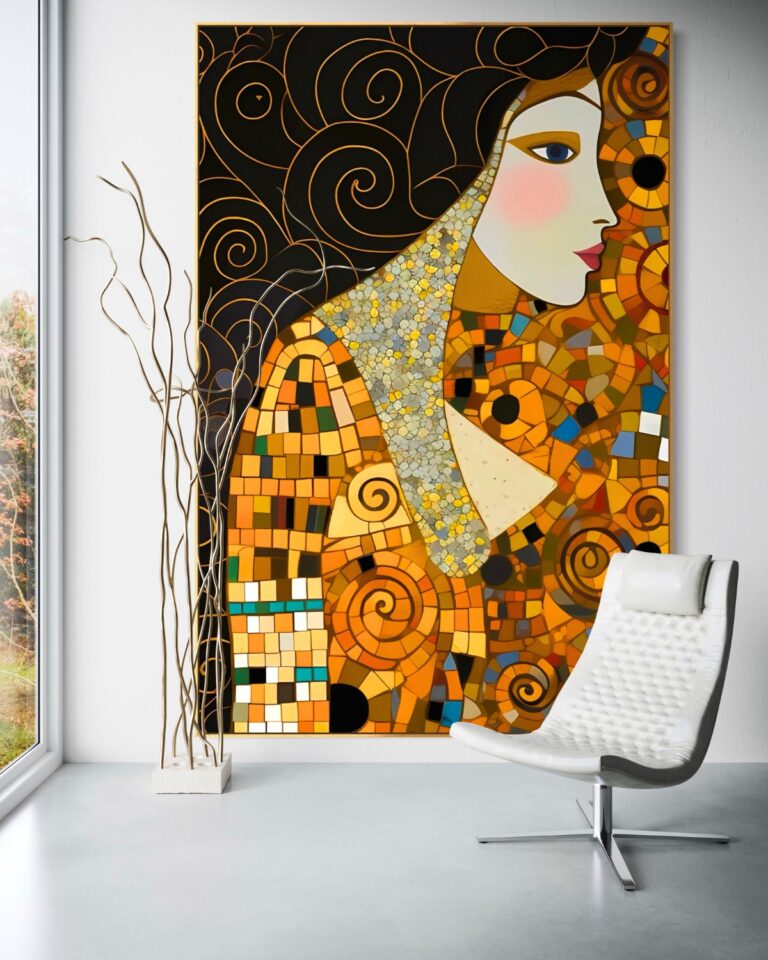
Where the gold came from
Klimt’s father was a gold engraver, and the son grew up with the material — its weight, the way it takes a line, the way it turns a flat surface into something that changes with the light. When he went to Ravenna in 1903 and saw the Byzantine mosaics in San Vitale, the two things joined: gold leaf laid down in small tesserae, each one at a slightly different angle, so that a wall shimmers rather than shines. The Golden Period that followed — the Portrait of Adele Bloch-Bauer, The Kiss, the Beethoven Frieze — is Byzantine mosaic translated into oil and leaf.
What is easy to miss under the glamour is how strictly it is organised. The ornament is never random. Squares sit inside rectangles that sit inside larger rectangles; the eyes and mouths of the figures fall at the divisions of the picture; and the spiral — the “Tree of Life” curl that turns and turns and never closes — is a logarithmic spiral, which is to say the same curve as a nautilus, drawn by hand.
The spiral in the Tree of Life
The Stoclet Frieze in Brussels is Klimt’s clearest statement of the form. The Tree of Life fills the wall with branches that coil back on themselves, each coil tightening toward its centre and widening away from it. Measure the turns and they step up by something close to the golden ratio: each loop is roughly 1.6 times the one inside it. He would have reached this by eye, because that is the spiral the eye finds natural — the one that grows at a steady rate without changing shape.
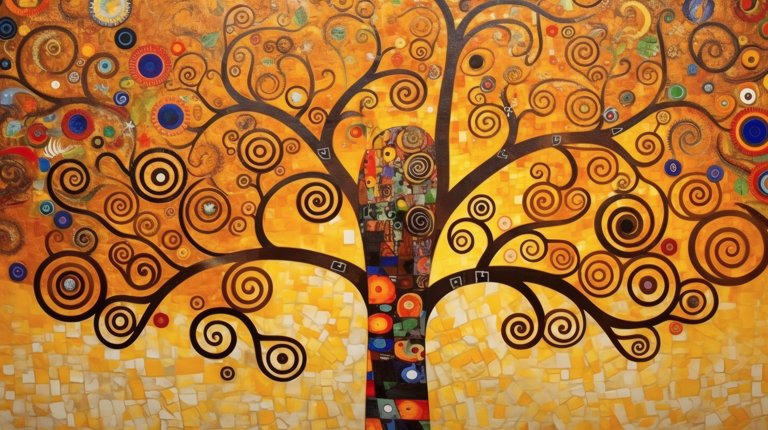
In The Golden Tree of Life in this collection I kept his format — a long horizontal, made to run across a wall — and replaced the freehand curl with the constructed one. Each spiral is built from Fibonacci squares, so the turns step up by exactly 1.618 rather than roughly. The difference is small in a photograph and large on a wall: the constructed spiral has a stillness the drawn one does not, because nothing in it is approximate.
The figure at the section
Klimt’s portraits put the head high and slightly off centre, inside a column of pattern that reaches to the frame. In Adele Bloch-Bauer I, the face sits at almost exactly the golden section of the height, and the pattern around it — eyes, spirals, the famous Egyptian-looking triangles — is denser near the face and looser away from it, so that the ornament itself leads you to the sitter.
The portraits in Klimt Reimagined — The Golden Visionary, The Solar Sovereign, The Oracle of Silence, The Threshold of Grace — follow this rule strictly. The face is placed at the section; the mosaic is sized on the sequence, so the tiles nearest the face are the smallest and step outward by the ratio. The effect Klimt got by instinct becomes a structure, and the structure is what lets the pictures hold together at two metres wide.

Colour: what stays, what changes
Klimt’s palette is gold with three or four supporting colours: a lapis blue, an oxblood red, a green, occasionally violet. I kept that discipline. The Mosaic Covenant is gold with blue and ochre; The Amethyst Mosaic and The Violet Constellation take the violet he used sparingly and make it the ground; The Magenta Muse pushes it to rose, which he never did, and is the most modern piece in the set because of it.
What I removed is the crowding. Klimt’s surfaces are full to the edge; there is nowhere for the eye to rest except the face. In these works there is always a field of plain dark or plain gold, sized on the ratio, and the ornament is confined to a band or a column. It reads as Klimt from across a room and as something quieter when you stand in front of it, which is the balance a wall you live with needs.
Where the works go
The portraits want a wall where they will be met at eye level and looked at slowly — a hallway, a landing, the wall you face from a favourite chair. The architectural pieces — The Gilded Archway, The Gilded Ascent and its counterpart The Golden Descent — want height: a stairwell, the wall beside a tall door. The Tree of Life and The Tessellated Spiral run wide, over a bed or a sofa. All of them are dark-ground works and sit best on a pale wall in a dark frame, with the mat off-white rather than white.
Questions
Did Klimt use the golden ratio deliberately?
There is no record that he measured with it, but his compositions place faces at the golden section of the height and his spirals step up by close to 1.6 per turn. He reached the proportion by eye, which is common among painters trained to look rather than to calculate.
Are the Klimt Reimagined works copies of Klimt paintings?
No. They borrow his materials — gold, mosaic, the spiral, the figure inside ornament — and rebuild them on the Fibonacci sequence with new subjects. No Klimt painting is reproduced.
Which of the Klimt works are ready to download?
The portraits and the mosaic pieces are live on the product pages; the remaining works in the collection are being released in batches and can be requested from the contact page.
For a wall you're responsible for.
Tell me the room and what you want it to feel like. I will send three works that fit, and a mock-up of each one in place.
Write to me