GUIDES · ARTISTS
Matisse cut-outs, explained: painting with scissors.
In his seventies, often confined to bed or a wheelchair, Henri Matisse began cutting shapes out of painted paper — and made some of the most joyful art of the century. Here is how the cut-outs were made and what they mean.

Painting with scissors
In 1941 Henri Matisse, then 71, had major surgery for cancer. He survived, but was often confined to bed or a wheelchair for the rest of his life, and standing at an easel became difficult. He called the years that followed his second life — and he spent much of it with a pair of scissors.
Assistants painted large sheets of paper with gouache in the colours he chose. Matisse cut shapes from them freehand, without drawing first, and directed his assistants as they pinned the pieces to the walls of his studio, moving them again and again until the composition was right. He described it as cutting directly into colour, and compared it to a sculptor carving stone: drawing and colour happened in a single gesture.
Jazz and the first cut-outs
Matisse had used cut paper before, to plan large compositions. The first time the cut-outs became the art itself was Jazz, an artist’s book published by Tériade in 1947: twenty colour plates of circus scenes, swimmers, lagoons and the figure of Icarus falling with a red heart, printed from his cut-outs, alongside pages of his own handwritten thoughts.
The shapes he returned to again and again come from a journey he had made to Tahiti in 1930: seaweed, coral, leaves, birds, stars and swimmers floating in clear water. Fifteen years later he cut them from memory in Oceania, the Sky and Oceania, the Sea (1946), white shapes on a beige ground covering whole walls of his Paris apartment.
The great cut-outs of the 1950s
In his last years the cut-outs grew to the size of rooms. Blue Nude (1952) is a series of seated figures cut from one blue, so simple they seem inevitable. The Swimming Pool (1952) ran around the walls of his dining room in Nice as a frieze of blue divers. The Snail (1953), nearly three metres square, is a spiral of coloured paper rectangles — a snail made of colour rather than drawn. He also designed the windows, vestments and walls of the Chapel of the Rosary in Vence (1949–1951) from cut-outs, including the stained-glass Tree of Life.
Matisse died in 1954. Sixty years later, in 2014, an exhibition of the cut-outs at Tate Modern in London and the Museum of Modern Art in New York became one of the most visited in Tate’s history.
What makes a Matisse cut-out work
The Henri Matisse art style in the cut-outs comes down to a few things. The shapes are simple but never geometric: every leaf and seaweed has a slight irregularity left by the scissors, which keeps it alive. Colours are few and pure — cobalt blue, black, coral, lemon, green — set on white or a single colour. And there is always space: the shapes float, so the white of the paper becomes part of the picture.
That is also why Matisse cut-outs are so easy to live with. They are cheerful without being busy, and they work beside modern furniture, mid-century pieces or plain white walls.
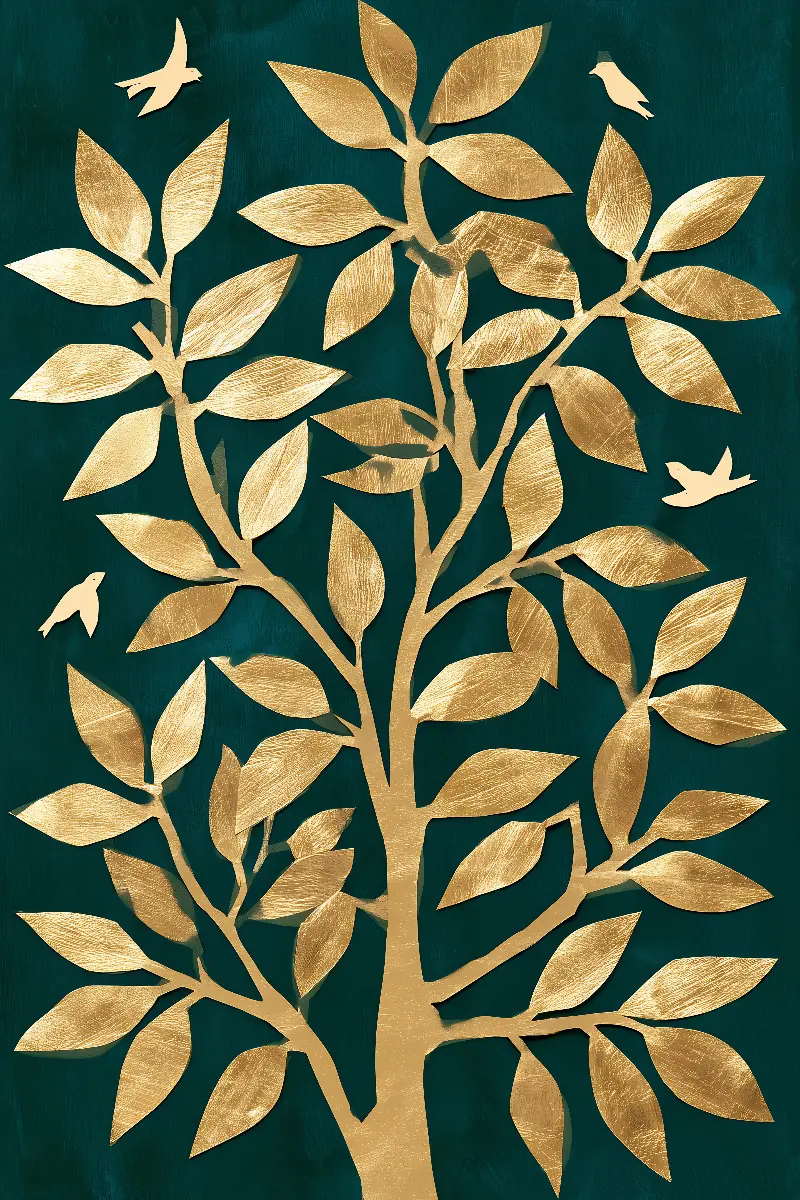
Line drawings, goldfish and the other Matisse
The cut-outs have a twin in Matisse’s line drawings. In series such as Themes and Variations (1941–1942) he drew the same face or bouquet again and again until a single continuous line said everything — the Matisse line drawing that is now copied everywhere. And before both came the painter of colour: the fauvist of 1905 and the painter of Goldfish (1912), one of the most loved Matisse paintings. You can read about that period in What is fauvism?.
The Matisse in Gold collection reimagines all three sides of Matisse in gold leaf: cut-outs (Golden Seaweed, Golden Leaves on Black, The Golden Tree with Birds, Golden Cut-Outs, Coral Cut-Outs), line drawings (The Golden Bouquet, The Lovers, The Woman with a Bird) and paintings (Goldfish in Gold).
Questions
Why did Matisse make cut-outs?
After cancer surgery in 1941 Matisse was often confined to bed or a wheelchair and could no longer paint easily at an easel. Cutting shapes from paper painted with gouache let him work with colour directly, and he found it freeing rather than limiting.
What are Matisse’s most famous cut-outs?
Jazz (1947), Oceania, the Sky and Oceania, the Sea (1946), Blue Nude (1952), The Swimming Pool (1952) and The Snail (1953), as well as the designs for the Chapel of the Rosary in Vence.
What do Matisse’s cut-out shapes mean?
Most come from nature and from his memories of Tahiti in 1930: seaweed, coral, leaves, birds, stars and swimmers. They are meant to be felt as rhythm and joy more than read as symbols.
Are Matisse’s works in the public domain?
Matisse died in 1954. In the European Union his works entered the public domain on 1 January 2025; rules differ in some other countries.
For a wall you're responsible for.
Tell me the room and what you want it to feel like. I will send three works that fit, and a mock-up of each one in place.
Write to me