GUIDES · ART MOVEMENTS
What is Bauhaus? Art, design and style, explained.
A small art school that existed for only fourteen years shaped the chairs we sit on, the type we read and the buildings we live in. Here is what the Bauhaus was, and how to recognise Bauhaus style.
A school, not a style
The Bauhaus was a school of art and design founded in 1919 in Weimar, Germany, by the architect Walter Gropius. The name means roughly “building house”. Gropius wanted to end the separation between fine artists and craftsmen: students would learn painting, weaving, metalwork, carpentry, typography and pottery side by side, and design things for real life and for industry.
It lasted only fourteen years. In 1925 the school moved to Dessau, into a famous building of glass and white walls that Gropius designed for it. Hannes Meyer led it from 1928 and Ludwig Mies van der Rohe from 1930. In 1932 it moved to Berlin, and in 1933, under pressure from the new Nazi government, it closed. Its teachers and students scattered across the world — and took the ideas with them.
The teachers
Few schools have had such a staff. Johannes Itten created the famous preliminary course, in which every student studied form, colour and materials from scratch. Paul Klee and Wassily Kandinsky taught colour and form theory. László Moholy-Nagy brought photography and new materials; Josef Albers, first a student, became a teacher and later a pioneer of colour studies in America. Oskar Schlemmer ran the theatre workshop, Lyonel Feininger the printing workshop.
Students became masters in turn: Marcel Breuer designed the tubular steel chairs that still furnish offices, Marianne Brandt the metal teapots and lamps that look modern a century later, Gunta Stölzl led the weaving workshop, and Herbert Bayer designed a typeface using lower-case letters only.
The hallmarks of Bauhaus style
Bauhaus teachers always insisted there was no “Bauhaus style”. In practice, the work they produced shares a recognisable look.
Basic shapes: circle, square and triangle, often used on their own. In 1923 Kandinsky even asked everyone at the school to match the three shapes to three colours; most answered yellow for the triangle, red for the square and blue for the circle. Primary colours, plus black, white and grey. Asymmetric balance on a clear grid rather than central symmetry. Sans-serif type, often set at an angle or in lower case. And a dislike of ornament for its own sake: decoration should come from material, proportion and colour.
You will often hear “form follows function” attached to the Bauhaus. The phrase is actually older — the American architect Louis Sullivan wrote it in 1896 — but it sums up much of the Bauhaus approach to design.
Bauhaus architecture and interior design
The Dessau building of 1925–1926, with its glass curtain wall and separate wings for workshops, studios and the student residence, became a model for modern architecture. Bauhaus architecture means flat roofs, white rendered walls, large windows, steel and glass, and plans organised around use. The Bauhaus sites in Weimar and Dessau are a UNESCO World Heritage Site, and so is the White City of Tel Aviv, where architects trained at the Bauhaus built thousands of buildings in the 1930s.
Bauhaus interior design follows the same logic: clear, open rooms; furniture in tubular steel, leather and plywood; built-in storage; few objects, each chosen. A single strong graphic print is often the only decoration — which is exactly the role a Bauhaus poster plays.
Bauhaus graphic design and the Bauhaus poster
The school’s printing workshop and its teachers reinvented graphic design. Posters and books for the great Bauhaus exhibition of 1923 used bold geometry, photographs, thick rules and sans-serif type to make information as clear and striking as possible. Joost Schmidt’s poster for that exhibition, a composition of circles, squares and diagonal type, is one of the most copied designs of the twentieth century.
That is why the Bauhaus poster is still a favourite piece of wall art: it is abstract enough to fit any room, graphic enough to be seen from across it, and it carries a hundred years of design history.
Bauhaus posters in gold
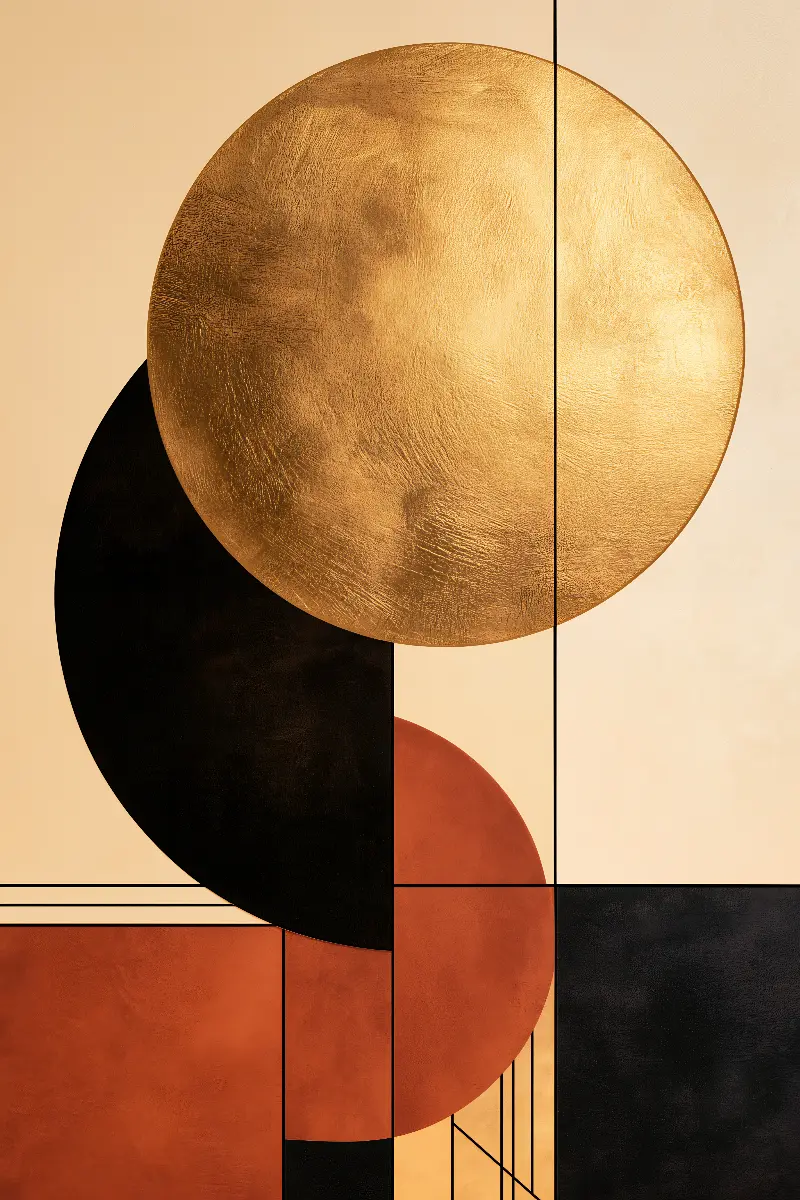
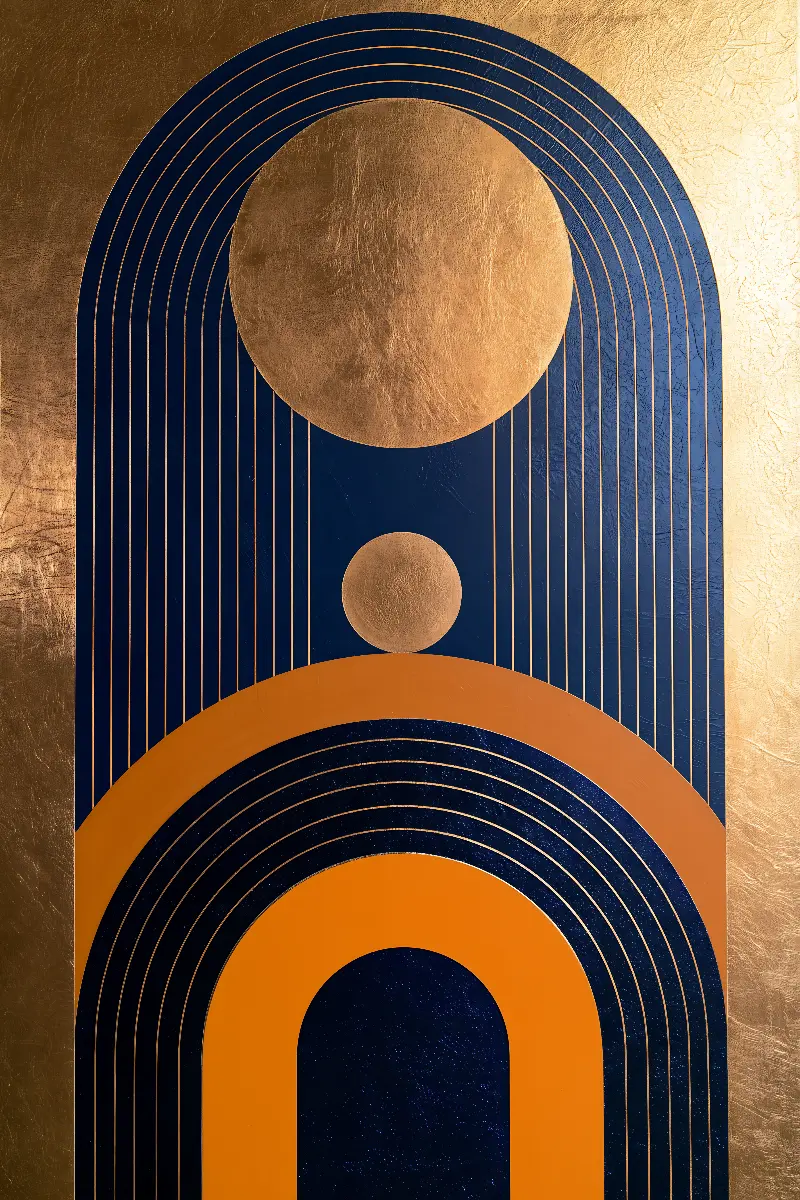
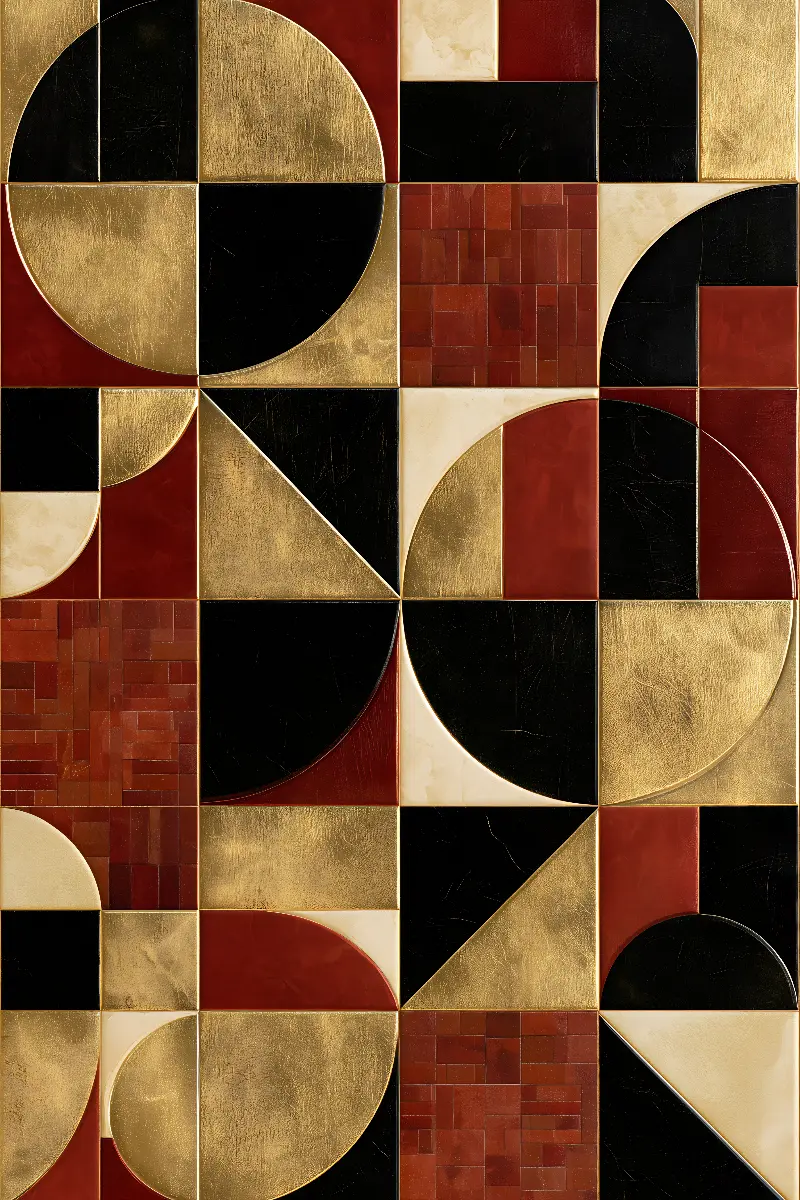
The three Bauhaus works in the Abstract Masters in Gold collection are original compositions in the Bauhaus manner, with raised gold leaf in place of yellow: The Golden Sun, a circle rising over horizontal bands; Arches in Navy & Gold; and The Golden Grid. Together they form the Bauhaus set.
The same collection reimagines works by three painters connected with the spirit of the Bauhaus and the birth of abstract art — Kandinsky, Hilma af Klint and Mondrian. Read their story in the pioneers of abstract art.
Questions
What is Bauhaus in simple words?
The Bauhaus was a German school of art, design and architecture (1919–1933), founded by Walter Gropius. It combined art and craft and created the clean, geometric, functional look of modern design.
What are the main characteristics of Bauhaus style?
Simple geometric shapes, primary colours with black and white, asymmetric balance on a grid, sans-serif typography, modern materials such as steel and glass, and little ornament for its own sake.
Who were the most famous Bauhaus artists?
Teachers included Walter Gropius, Wassily Kandinsky, Paul Klee, László Moholy-Nagy, Josef Albers, Johannes Itten, Oskar Schlemmer and Lyonel Feininger; Marcel Breuer, Marianne Brandt, Gunta Stölzl and Herbert Bayer studied and later taught there.
Why did the Bauhaus close?
Under pressure from the Nazi government, which saw it as politically suspect, the school closed in 1933 after moving from Dessau to Berlin. Many of its members emigrated and spread its ideas abroad.
For a wall you're responsible for.
Tell me the room and what you want it to feel like. I will send three works that fit, and a mock-up of each one in place.
Write to me