GUIDES · ART MOVEMENTS
What is op art? Optical illusion art, explained.
Op art is the art of pictures that move while standing still. Here is where it came from, why your eye cannot leave it alone, and how to hang a piece of it without making a room restless.
A movement named in 1964
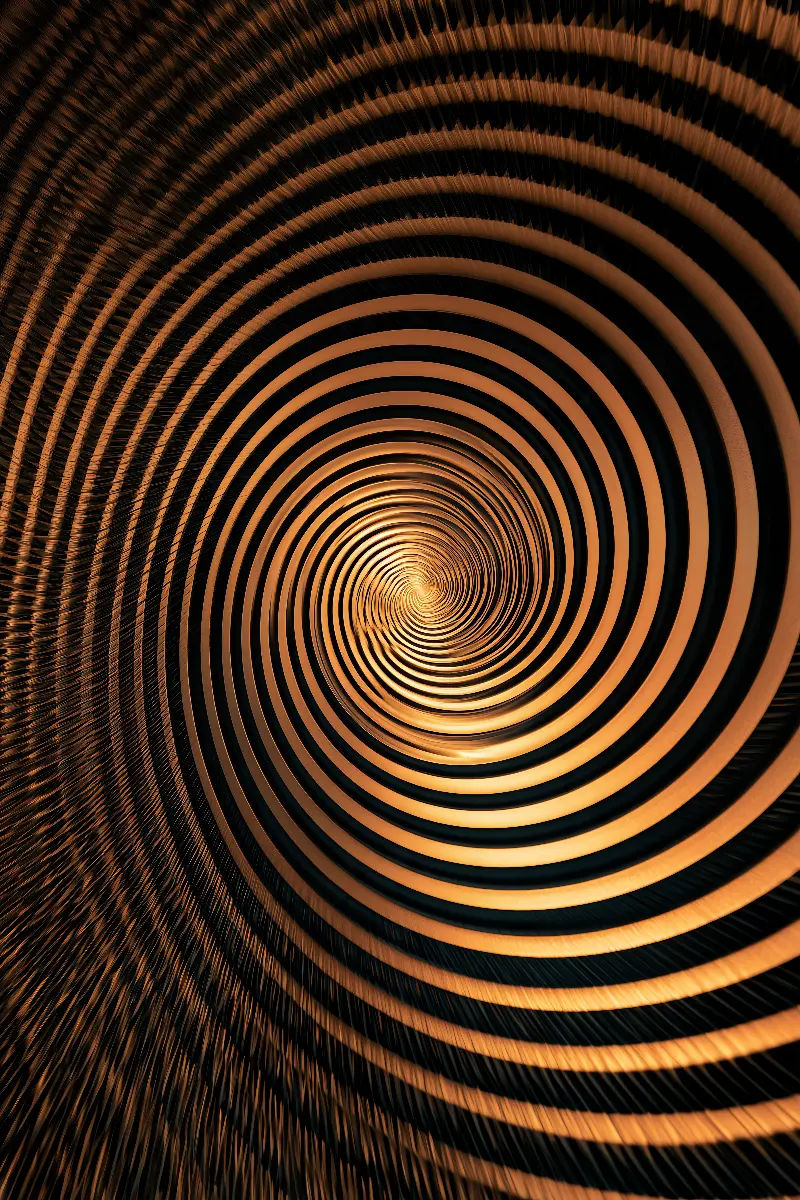
Op art is short for optical art. It describes abstract pictures, usually built from lines, circles, squares and stripes, that are designed to make the eye see things that are not there: movement, flicker, depth, a surface that swells or sinks. The name first appeared in print in 1964, and a year later the Museum of Modern Art in New York gave the style its big moment with an exhibition called The Responsive Eye. It drew huge crowds, and within months op art patterns were on dresses, shop windows and record sleeves.
The ideas are older than the name. Victor Vasarely, a Hungarian-born painter who worked in Paris, was making black-and-white line pictures of zebras and chessboards in the 1930s that already played with the eye. Teachers at the Bauhaus had spent the 1920s studying how colours and shapes change one another. Op art took those experiments, removed everything else, and made the experiment itself the picture.
Why a still picture seems to move
Your eyes are never perfectly still. Even when you stare at one point they make tiny jumps, several times a second, and your brain stitches the pieces together. Most of the time that stitching is invisible. A pattern of fine, high-contrast lines repeated across a surface is where it breaks down: each jump lands the lines in a slightly different place, the brain cannot settle on one version, and the surface seems to shimmer, ripple or turn.
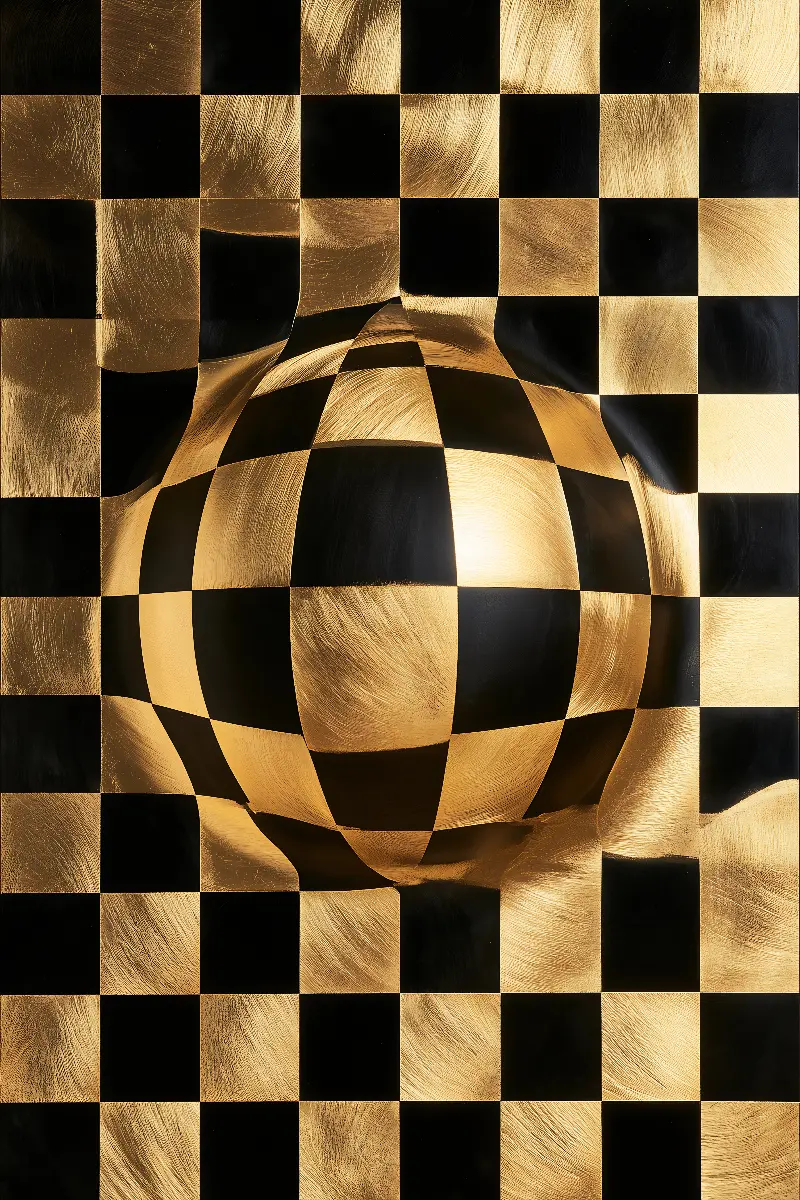
Depth works by a different trick. When a grid of squares gets slowly larger towards the middle, the brain reads the change in size as a curve — the same rule it uses to read a hill or a ball in the real world. The picture stays perfectly flat; the sphere is built entirely in your head. Afterimages, moiré patterns between two overlapping grids, and colours that seem to vibrate where they meet are the other tools op artists use.
Bridget Riley, Victor Vasarely and the others
Two names come up in almost every conversation about op art. Victor Vasarely (1906–1997) built a whole system out of it: grids of circles and squares that bulge, twist and recede, often in strong colour. His sphere pictures of the late 1960s, in which a flat grid appears to swell out of the canvas, are probably the most copied optical illusions in art.
Bridget Riley, born in London in 1931, made her name with black-and-white paintings in the early 1960s — curving stripes and squares that seem to pulse. She has said she is less interested in tricks than in the physical experience of looking. Later she moved into colour stripes and curves that are calmer but no less alive.
Around them worked Jesús Rafael Soto and Carlos Cruz-Diez, who made art that changes as you walk past it, Richard Anuszkiewicz with his vibrating colours, and many others. Op art never had a manifesto or a fixed membership; it was a shared interest in what happens between a picture and the eye.
Op art and optical illusion art are not quite the same
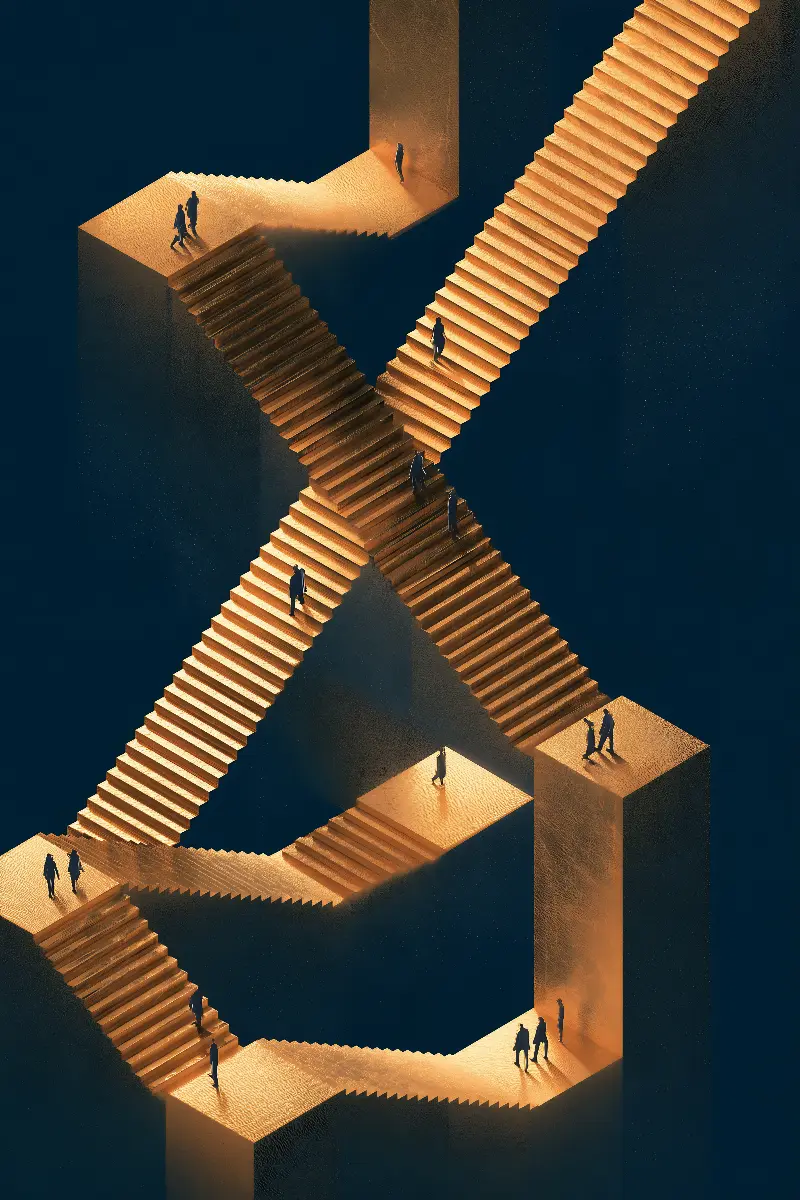
People use the two terms as if they meant one thing, and for a print on a wall they mostly do. Strictly, though, optical illusion art is the wider family. It includes trompe-l’œil paintings that fool you into seeing a real object, hidden images, anamorphic pictures that only make sense from one angle, and impossible figures such as the staircase that climbs forever.
That staircase has its own history. The psychiatrist Lionel Penrose and his son Roger, later a Nobel-prize-winning physicist, published it in 1958 in a journal of psychology: four flights of stairs, each going up, that join in a loop. It cannot exist, and yet every corner of the drawing is correct. Since then it has turned up in prints, films and drawn optical illusions of every kind.
Op art is the abstract branch of the family: no objects, no story, only pattern doing something to your eye.
Why op art in gold
Classic op art is black and white, because the strongest contrast gives the strongest effect. Gold changes the experience in an interesting way. Raised gold leaf reflects light differently depending on where you stand, so a golden op art print moves twice: once in your eye, and once on the wall as the light shifts during the day.
In the Surreal Illusions in Gold collection the op art works are original compositions. The Golden Vortex and The Golden Tunnel use concentric rings that seem to turn; The Breathing Sphere and The Sinking Sphere build depth out of squares; The Endless Staircase and The Impossible Stairs are impossible figures in gold.

How to live with an op art print
Op art is strong medicine, so give it room. One large piece on a calm wall works better than three small ones fighting each other. It suits places you pass through or look at from a distance — a hallway, a stairwell, the wall opposite a sofa — more than the wall right beside your desk.
If you hang a set of three, put the strongest piece in the middle and the quieter ones either side; the Op Art in Gold set is arranged that way. Keep the frame plain and thin: a heavy ornate frame competes with the pattern. Warm, even light is best — a single spotlight on gold leaf can create a hot spot that interrupts the illusion.
For size, use the same rule as for any picture: about two-thirds of the width of the furniture below it. The golden ratio calculator works it out for your wall.
Questions
What is op art in simple words?
Op art (optical art) is abstract art made of lines, shapes and colours arranged so that a flat, still picture seems to move, flicker, swell or sink. It became a movement in the 1960s, with artists such as Victor Vasarely and Bridget Riley.
Who are the most famous op artists?
Victor Vasarely and Bridget Riley are the best known. Jesús Rafael Soto, Carlos Cruz-Diez and Richard Anuszkiewicz are other important names. The 1965 exhibition The Responsive Eye in New York made the style famous.
Is op art the same as optical illusion art?
Not exactly. Optical illusion art is the wider family and also includes trompe-l’œil, hidden images and impossible figures. Op art is its abstract branch: pure pattern designed to act on the eye.
Can op art make you dizzy?
Very strong black-and-white op art can feel intense at close range. Gold and softer contrasts are gentler. Hang it where you see it from a few steps away, and it reads as movement rather than strain.
For a wall you're responsible for.
Tell me the room and what you want it to feel like. I will send three works that fit, and a mock-up of each one in place.
Write to me