GUIDES · ART MOVEMENTS
What is surrealism? Surreal art, explained.
Surrealism set out to paint what dreams look like. A hundred years later “surreal” has become an everyday word — here is what it meant then, and what surreal art means now.
A movement that began with a manifesto
Surrealism began in Paris in 1924, when the poet André Breton published the Manifesto of Surrealism. He defined it as “pure psychic automatism” — thought expressed without the control of reason, and free of any aesthetic or moral concern. The word itself had been coined a few years earlier by the poet Guillaume Apollinaire.
The movement grew out of Dada, the anti-art protest that followed the First World War, and out of a new fascination with the ideas of Sigmund Freud: that dreams carry meaning, and that much of what we are lies below the conscious mind. The surrealists wanted art and writing that reached that hidden layer. At first they were mostly poets; painters soon became the most visible part of the surrealist movement.
Two ways to paint a dream
Surrealist painters went about it in two quite different ways. The first was automatism: letting the hand move before the mind decides. Max Ernst rubbed pencil over wood grain and leaves (frottage) and pressed paint between sheets (decalcomania), then looked for creatures and landscapes in the accidents. Joan Miró and André Masson drew freely and let shapes find their own meaning.
The second way was the opposite: painting impossible things with total, almost photographic clarity. René Magritte placed ordinary objects in situations that make no sense — a pipe captioned “this is not a pipe”, a door with a ragged hole cut through it, day and night in one picture. Giorgio de Chirico, whose empty squares and long shadows came a few years before surrealism, gave the movement its mood of strange stillness. Yves Tanguy painted soft, unknown objects on endless plains.
Women artists were central too, and are now better known than ever: Leonora Carrington and Remedios Varo, who painted magical, alchemical worlds in Mexico; Dorothea Tanning; Meret Oppenheim, whose fur-covered teacup of 1936 is one of the most famous surrealist objects.

How to recognise surreal paintings
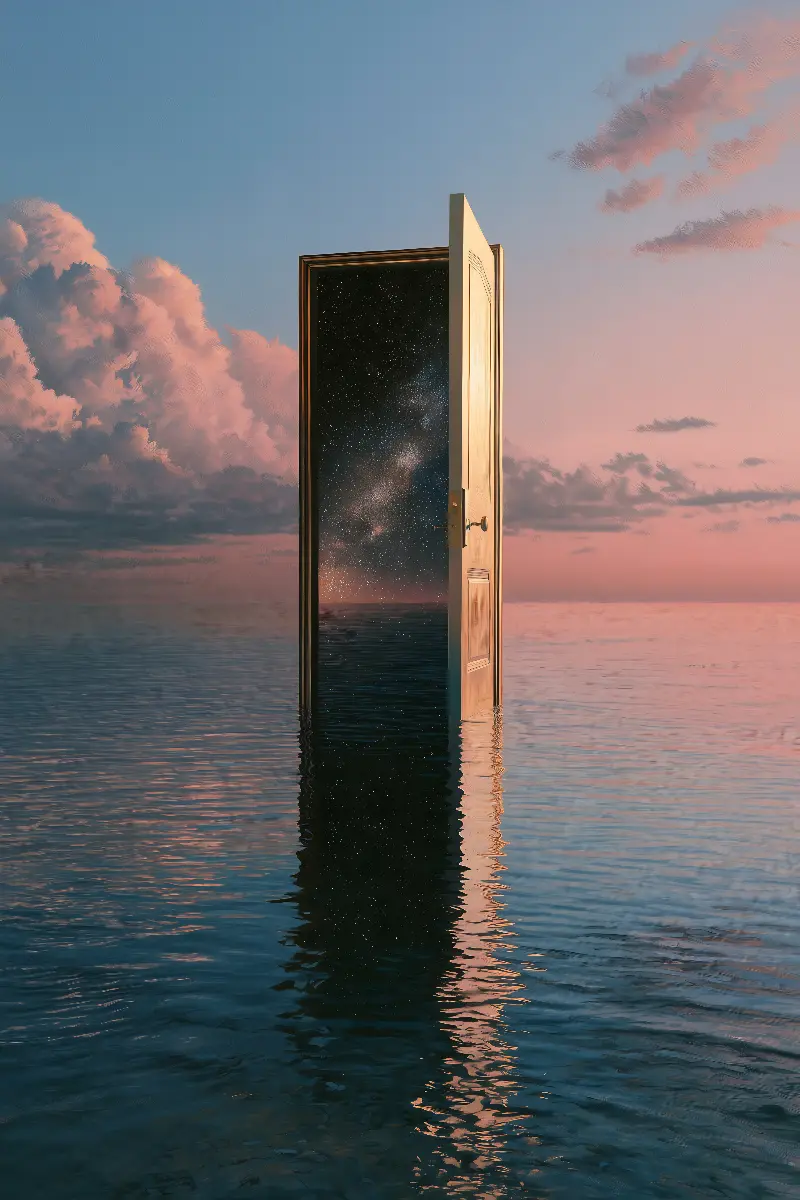
Most surreal paintings share a few habits. Everyday things appear in the wrong place, the wrong size or the wrong material: a whale in the sky, a door in the sea, a library that never ends. The scene is often calm and carefully painted, which makes the impossibility more unsettling, not less. Light can come from two directions at once. Horizons are low and empty, so the strange object stands alone.
Under the strangeness there is usually a feeling rather than a puzzle to solve. That is the difference between a surreal picture and a joke: a joke ends when you get it, a good surreal image keeps working on you.
Surrealism, magic realism and pop surrealism
Three words get mixed up constantly. Magic realism was coined by the German critic Franz Roh in 1925 for painting that shows the ordinary world so precisely that it begins to feel uncanny; later the term was used mainly for Latin American literature in which miraculous things happen in everyday life. Where surrealism looks inward, into the dream, magic realism finds the strangeness inside the real.
Pop surrealism, also called lowbrow art, grew up in California in the 1990s and 2000s, mixing surrealist dream logic with comics, toys and pop culture.
Today, when people search for surreal art they usually mean something broader still: any dreamlike image, painted, photographed or made digitally, in which reality has been gently bent. Surreal photography, built from many photographs combined into one impossible scene, is one of the most popular forms.
Surreal art in gold
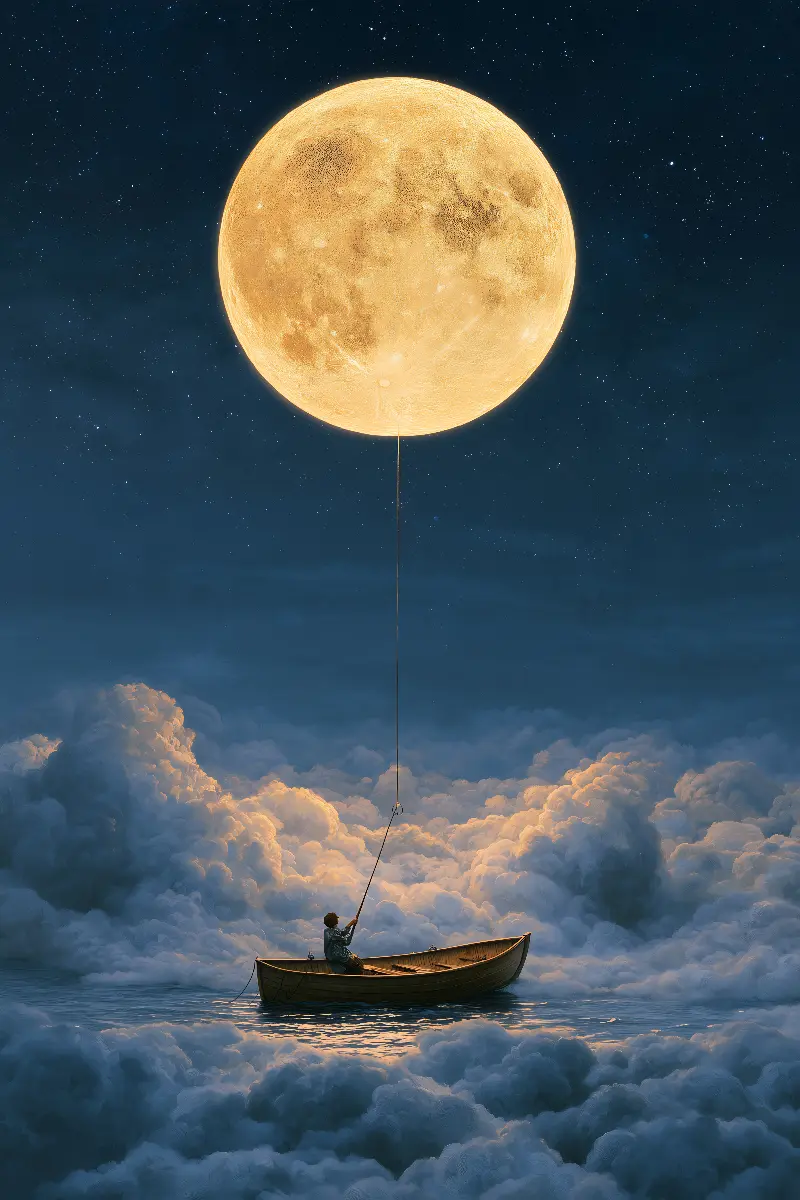
The surreal works in the Surreal Illusions in Gold collection are original compositions in that broad, dreamlike sense, built on a few surrealist devices. A door stands alone in a still sea and opens onto stars (The Door to the Stars). A fisherman casts his line from a boat on the clouds up to the moon (The Moon Fisher, Catching the Moon). A whale of golden light swims over a sleeping town (The Sky Whale). A library spirals up into a galaxy (The Infinite Library).
Each one keeps to the rule of the best surreal paintings: one impossible thing, in a calm and believable world.
Living with surreal art
Surreal art suits rooms where the mind is allowed to wander: bedrooms, reading corners, a study, a child’s room. Because most dreamlike pictures have a deep, dark ground, they look best on light walls, where they open like a window. A set of three works well along a bed or a sofa — the Surreal Dreams in Gold set follows a door, a moon and a whale from dusk into night.
If you want the strangeness without the darkness, choose the dusk scenes with pink and blue skies; if the room is already dark and moody, the night scenes and libraries will feel like they belong there.
Questions
What is surrealism in simple words?
Surrealism is an art and writing movement that began in Paris in 1924. It tried to show the world of dreams and the unconscious mind, often by painting impossible scenes in a very realistic way.
Who started the surrealist movement?
The poet André Breton, with his Manifesto of Surrealism in 1924. Max Ernst, René Magritte, Joan Miró, Yves Tanguy, Leonora Carrington and Remedios Varo are among the best-known surrealist artists.
What is the difference between surrealism and magic realism?
Surrealism looks inward and paints dreams and the unconscious. Magic realism shows the ordinary world so precisely, or with such calm miracles, that reality itself feels strange.
What makes a painting surreal?
Usually an everyday thing in an impossible place, size or material, painted calmly and clearly: a door in the sea, a whale in the sky. The calm is what makes the impossibility stay with you.
For a wall you're responsible for.
Tell me the room and what you want it to feel like. I will send three works that fit, and a mock-up of each one in place.
Write to me