GUIDES · JAPANESE ART
Kintsugi: the meaning of the Japanese art of repairing with gold.
In kintsugi a broken bowl is not hidden or thrown away. Its cracks are filled with lacquer and gold, so the repair becomes the most beautiful part. Here is how it is done, where it comes from, and what it has come to mean.

Golden joinery
Kintsugi means “golden joinery”; it is also called kintsukuroi, “golden repair”. It is the Japanese technique of mending broken ceramics with urushi lacquer — a natural resin tapped from the lacquer tree — and finishing the seams with powdered gold. Silver and platinum are sometimes used instead.
The result does the opposite of an invisible repair. The cracks are traced in shining metal, so anyone can see exactly where and how the piece broke. The object carries its history openly, and many people think it is more beautiful than before.
Where kintsugi comes from
The usual story places its beginning in the fifteenth century. The shogun Ashikaga Yoshimasa, so it is said, broke a favourite Chinese tea bowl and sent it back to China to be repaired. It returned held together with ugly metal staples, and Japanese craftsmen set out to find a more beautiful way. Whether or not the story is exactly true, lacquer repair was certainly well established by the time the tea ceremony flourished in the sixteenth century.
The tea ceremony is the key. Its masters prized simple, irregular, often old bowls over perfect ones, and a bowl with a visible, golden repair fitted that taste perfectly. Some collectors, it is said, even broke bowls on purpose so that they could be mended.
How Japanese pottery is repaired with gold
Traditional kintsugi is slow. The broken pieces are glued with lacquer mixed with rice paste or flour; missing chips are filled with a putty of lacquer and clay powder. Each layer must cure in a warm, humid box for days before it is smoothed and the next layer applied. Only at the end is a fine line of red or black lacquer painted along the seam and gold powder dusted onto it while it is still tacky. A single bowl can take weeks or months.
Urushi is related to poison ivy and can cause strong skin reactions before it cures, so craftspeople work with care. Once fully cured, traditional lacquer repair is durable and safe. Many modern “kintsugi kits” use epoxy glue and gold-coloured powder instead: quick and pretty, but not the same technique, and usually not suitable for food.

The meaning of kintsugi
Kintsugi is closely tied to wabi-sabi, the Japanese appreciation of things that are imperfect, impermanent and incomplete — the beauty of the worn, the weathered and the asymmetrical. It also touches mottainai, the regret felt when something with value is wasted. Breakage is treated as part of an object’s life, not the end of it.
That is why the word has travelled so far beyond pottery. Today the meaning of kintsugi is most often about people: the idea that what has been broken and mended — by illness, loss or a hard year — is not less than before, and that the scars can be worn with something like pride. Therapists, writers and athletes use it; it has become one of the most widely understood images of resilience in the world.
Kintsugi art beyond the bowl
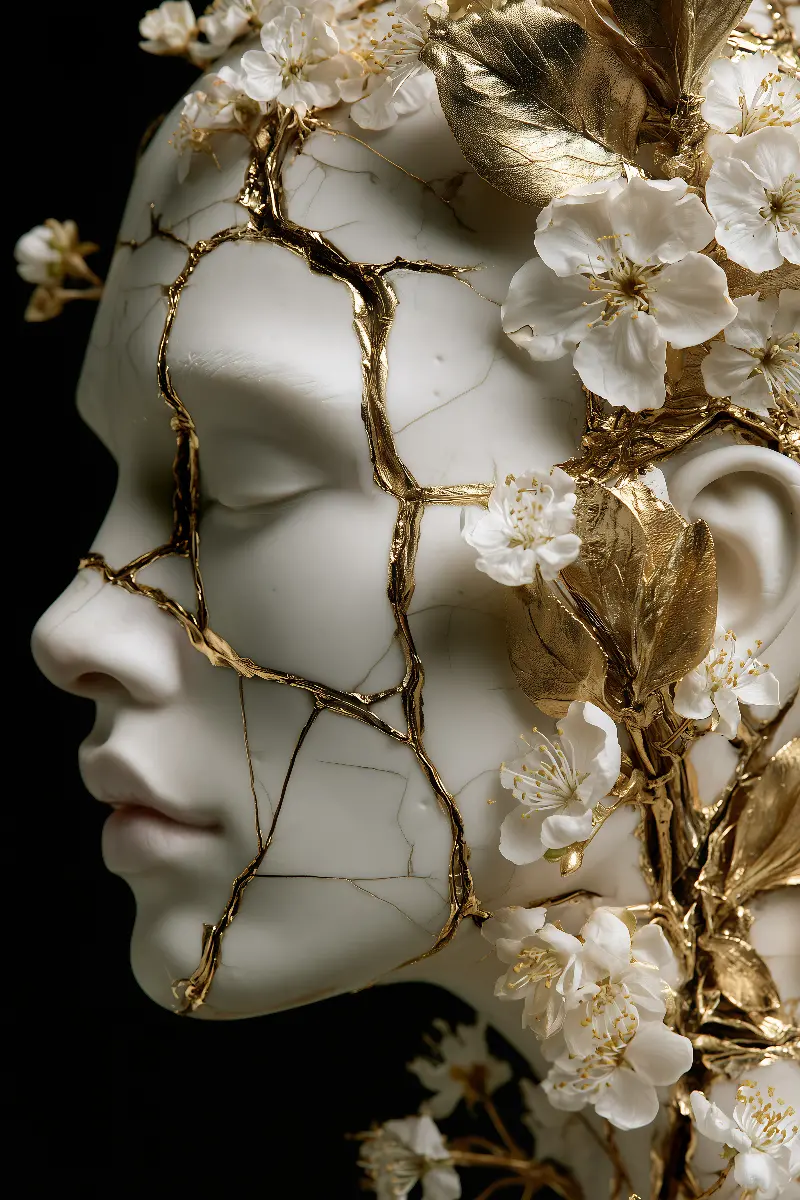
Artists now apply the idea of the golden seam to everything: sculptures, paintings, photographs, even buildings. The Surreal Illusions in Gold collection has four kintsugi works. The Kintsugi Moon and The Golden Mended Moon show a full moon cracked and healed with gold over a dark sea. The Kintsugi Muse and Blossoming Gold are porcelain faces whose golden seams grow white flowers — the repair turning into new life.
They are often chosen as gifts: for someone recovering, for a new beginning after a difficult time, or simply as a quiet reminder on a bedroom wall. The Kintsugi in Gold set puts a moon and two faces together.
Questions
What does kintsugi mean?
Kintsugi means “golden joinery”. It is the Japanese art of repairing broken pottery with lacquer and gold, so the cracks become visible and beautiful instead of hidden.
What is the difference between kintsugi and kintsukuroi?
They describe the same practice. Kintsugi means golden joinery and kintsukuroi means golden repair; kintsugi is the more common word today.
What does kintsugi symbolise?
It symbolises the value of imperfection and history, linked to the Japanese idea of wabi-sabi. Today it is widely used as a symbol of healing and resilience: what was broken and mended can be more beautiful than before.
Is kintsugi pottery food safe?
Traditional kintsugi with fully cured urushi lacquer is durable and has been used for centuries. Modern kits made with epoxy and gold-coloured powder are usually not food safe; check the instructions.
For a wall you're responsible for.
Tell me the room and what you want it to feel like. I will send three works that fit, and a mock-up of each one in place.
Write to me