GUIDES · JAPANESE ART
What is ukiyo-e? Japanese woodblock prints, explained.
The Great Wave is probably the most reproduced picture in the world. It comes from a tradition of cheap, brilliant prints called ukiyo-e — here is what the word means, how the prints were made, and why they changed Western art.

Pictures of the floating world
Ukiyo-e means “pictures of the floating world”. The word ukiyo began as a Buddhist term for the sorrowful, passing world; in the seventeenth century, written with a different character, it came to mean the opposite — the fleeting pleasures of city life in Edo (today’s Tokyo): kabuki actors, famous beauties, teahouses, festivals, travel.
Ukiyo-e flourished during the Edo period (1603–1868), when a long peace and a growing merchant class created a large public that wanted pictures. A woodblock print cost about as much as a bowl of noodles. People bought them the way we buy posters, and collected the latest actors and the newest views.
How a Japanese woodblock print was made
A print was a team effort, organised by a publisher. The artist drew the design in ink on thin paper. A carver pasted the drawing face-down on a block of cherry wood and cut away everything except the lines — destroying the original drawing in the process. Proofs from this key block went back to the artist, who marked which areas should take which colour, and the carver cut a separate block for each colour.
The printer then brushed water-based pigment onto each block in turn and rubbed damp paper onto it by hand with a flat pad called a baren, lining the sheet up with two small notches cut into every block. Full-colour prints, called nishiki-e or “brocade pictures”, became possible from 1765. A popular design could be printed thousands of times until the blocks wore out.
Hokusai and The Great Wave
Katsushika Hokusai (1760–1849) worked for seventy years and signed himself, near the end, “the old man mad about painting”. Around 1830–1832, already in his seventies, he published the series Thirty-six Views of Mount Fuji. Its first and most famous sheet is Under the Wave off Kanagawa — The Great Wave.
The picture shows three long fishing boats, the rowers bent low, under a wave whose crest breaks into claws of foam. Mount Fuji, Japan’s sacred mountain, sits tiny in the distance, framed in the curve of the wave as if it were just another wave. The deep blue is Prussian blue, a new imported pigment that made the series feel fresh at the time. The wave is often called a tsunami, but it is more likely a huge open-sea wave; what makes it unforgettable is the contrast between the fragile boats, the enormous water and the calm, permanent mountain.
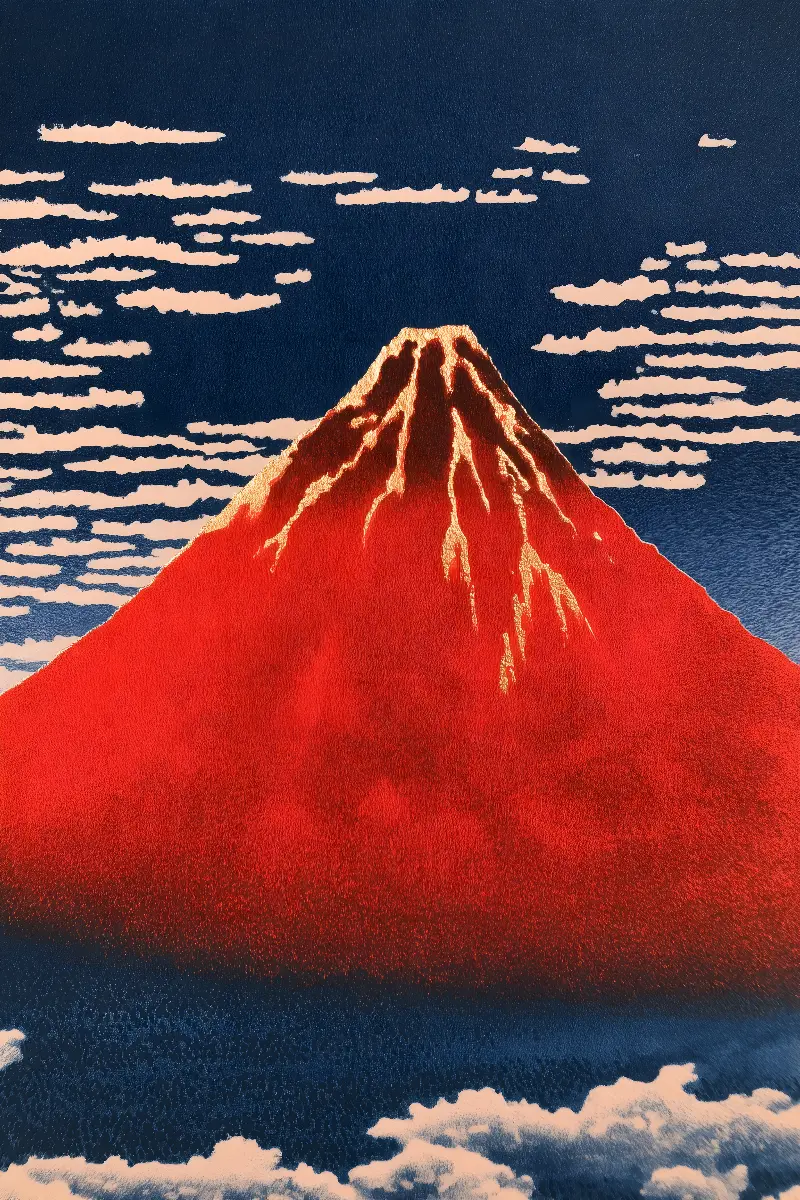
Another sheet from the same series, Fine Wind, Clear Morning, shows Fuji turned red by early sunlight in late summer. It is known everywhere simply as Red Fuji.
Hiroshige and the art of the view
Utagawa Hiroshige (1797–1858) made the landscape print his own. His series The Fifty-three Stations of the Tōkaidō (1833–1834) follows the great road between Edo and Kyoto, and his last great series, One Hundred Famous Views of Edo (1856–1858), shows the city season by season: plum blossom, iris gardens, fireworks over the river, snow on the bridges.
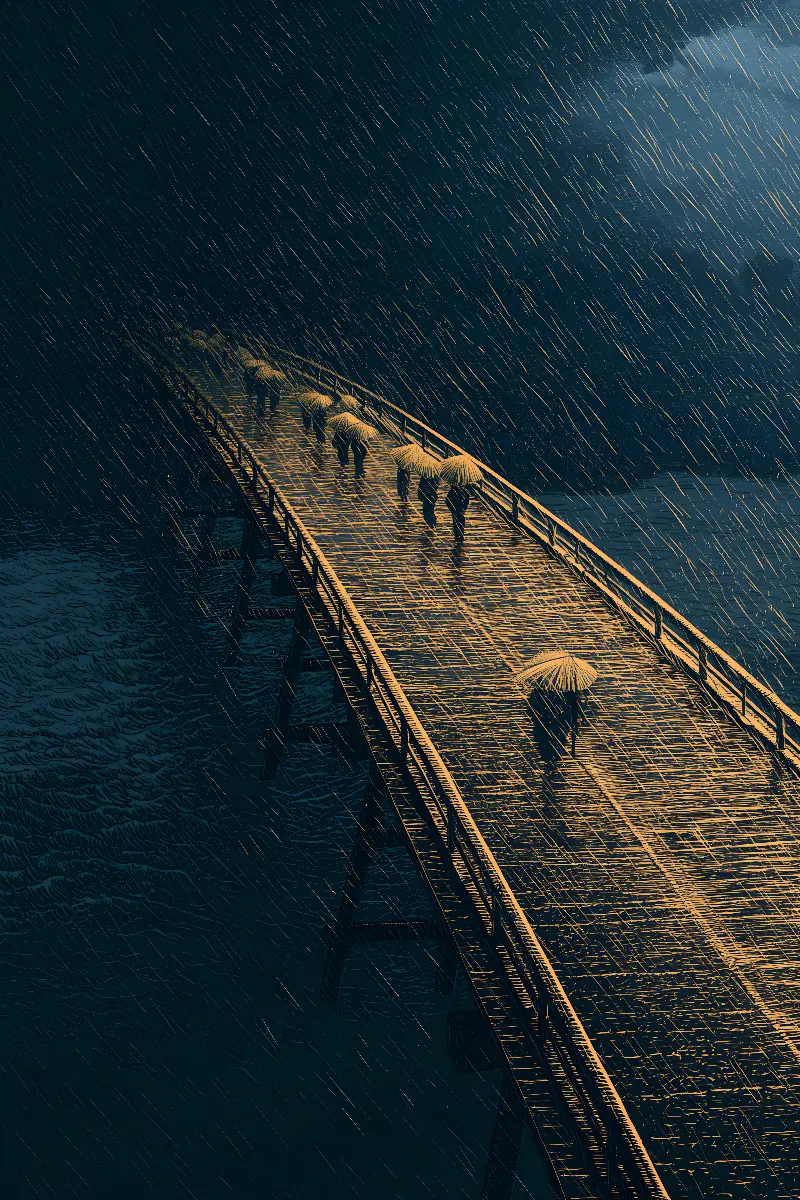
Where Hokusai is dramatic, Hiroshige is atmospheric. He is the master of weather — mist, rain drawn as fine dark lines, falling snow, the moon behind clouds. Two of his Edo views, the plum garden at Kameido and a sudden shower over the Ōhashi bridge, were copied in oil by Vincent van Gogh in 1887.
Beauties, actors and warriors
Landscapes came late. For most of its history ukiyo-e was about people. Kitagawa Utamaro drew elegant women in close-up, a genre called bijin-ga. The mysterious Tōshūsai Sharaku produced powerful, almost caricatured portraits of kabuki actors in only about ten months in 1794–1795 and then disappeared. Utagawa Kuniyoshi drew heroic warriors, monsters and, famously, cats.
These are the main Japanese art styles people mean when they talk about ukiyo-e: beauties, actors, warriors, landscapes and birds and flowers (kachō-e).
How ukiyo-e changed Western art
When Japan opened its ports in the 1850s, prints arrived in Europe in large numbers — sometimes, so the story goes, as wrapping paper for porcelain. Artists in Paris were astonished: flat areas of colour, bold outlines, everyday subjects, compositions cut off at the edge, high viewpoints. The craze was called Japonisme. Monet filled his house at Giverny with Japanese prints and built a Japanese bridge over his water-lily pond; Van Gogh collected hundreds; Degas, Whistler, Toulouse-Lautrec and the Art Nouveau designers all borrowed from them.
The Japanese Art in Gold collection reimagines this tradition with gold leaf: Hokusai’s Red Fuji and Great Wave, Hiroshige’s plum garden, iris garden and fireworks, and new motifs such as cranes at sunrise and koi. All the originals are centuries old and in the public domain.
Questions
What does ukiyo-e mean?
Ukiyo-e means “pictures of the floating world” — the fleeting pleasures of city life in Edo-period Japan. The prints showed actors, beauties, travel, landscapes and festivals.
What is the story behind The Great Wave off Kanagawa?
Hokusai published it around 1830–1832 as the first sheet of his series Thirty-six Views of Mount Fuji. It shows three fishing boats under a huge wave, with Mount Fuji small in the distance.
What is the difference between Hokusai and Hiroshige?
Both were landscape masters. Hokusai (1760–1849) is bold and dramatic, famous for The Great Wave and Red Fuji. Hiroshige (1797–1858) is atmospheric, famous for rain, snow, mist and his views of the Tōkaidō road and of Edo.
Are Japanese woodblock prints still made?
Yes. Traditional workshops in Japan still carve and print by hand, and the shin-hanga and sōsaku-hanga movements of the twentieth century renewed the art.
For a wall you're responsible for.
Tell me the room and what you want it to feel like. I will send three works that fit, and a mock-up of each one in place.
Write to me