GUIDES · ARTISTS
William Morris and the Arts and Crafts movement.
Designer, poet, printer, campaigner: William Morris tried to change how ordinary things are made. Here is who he was, what the Arts and Crafts movement believed, and why its style still feels like home.
Who was William Morris?
William Morris (1834–1896) was an English designer, poet, translator, printer and political campaigner — one of the most energetic people of the Victorian age. At Oxford he met the painter Edward Burne-Jones, who became a lifelong friend, and both fell under the spell of the critic John Ruskin, who argued that the craftsmen of the Middle Ages had been free to think with their hands, while the factory worker of the nineteenth century was reduced to a machine.
Morris trained briefly as an architect and then as a painter, but found his calling in making things: wallpapers, textiles, stained glass, furniture, tapestries, tiles and, at the end of his life, books. He learned each craft himself, often up to his elbows in dye.
Red House: the house of William Morris
In 1859 Morris married Jane Burden and asked his friend the architect Philip Webb to design a home for them at Bexleyheath, then in the Kent countryside. Red House, finished in 1860, was built of plain red brick with steep roofs and a well in the garden; inside there was almost nothing you could buy in a shop that Morris wanted, so he and his friends made the furniture, painted the walls and embroidered the hangings themselves.
That experience became a business. In 1861 Morris and his friends founded the firm Morris, Marshall, Faulkner & Co., which became Morris & Co. in 1875. Later Morris lived at Kelmscott Manor in Oxfordshire, the old stone house whose garden inspired many of his patterns, and moved his workshops to Merton Abbey on the river Wandle, where the water was good for dyeing. Red House now belongs to the National Trust and is open to visitors.
What the Arts and Crafts movement believed
The Arts and Crafts movement took its name from the Arts and Crafts Exhibition Society, which held its first show in London in 1888. Its members — designers, architects, metalworkers, bookbinders, potters — shared a few convictions that came largely from Ruskin and Morris.
Things should be made well, by people who take pleasure in making them. Materials should be honest: wood should look like wood, and decoration should grow out of the material and the use. Design should take its forms from nature rather than from copying past styles. And art should not be a luxury hung in galleries but part of everyday life — a chair, a jug, a curtain.
Morris put it most memorably in a lecture of 1880: “Have nothing in your houses that you do not know to be useful, or believe to be beautiful.” It is probably the most quoted sentence about interiors ever written.
The Arts and Crafts style in the home
The Arts and Crafts style is easy to recognise once you know it. Solid oak furniture with visible joints. Hand-printed fabrics and wallpapers full of leaves, flowers and birds. Copper, brass and hand-thrown pottery. Built-in benches and bookcases, inglenook fireplaces, small-paned windows, and a general feeling of warmth and calm rather than display.
The movement spread fast. In Britain it shaped the houses of architects such as C. F. A. Voysey and the Guild of Handicraft of C. R. Ashbee. In the United States Gustav Stickley published The Craftsman magazine and sold sturdy oak furniture; the Craftsman bungalow, with its low roof and deep porch, became one of America’s favourite house types. Arts and Crafts architecture also fed directly into Art Nouveau and, later, into the ideals of the Bauhaus.
The contradiction Morris lived with
Morris was honest about the problem at the heart of his work. Hand-printing and hand-weaving were slow and expensive, so the beautiful things he made were bought mostly by the rich, while he wanted art for everyone. The frustration helped turn him into a committed socialist in the 1880s, writing and speaking about work, pleasure and fairness until the end of his life.
In his last years he founded the Kelmscott Press (1891), which printed books with his own typefaces and borders; its great edition of Chaucer appeared in 1896, the year he died.
William Morris art today
Morris’s patterns are now more popular than at any time since his death: wallpapers, cushions, mugs and, of course, prints. Their structure — a strong underlying grid that you never quite notice, filled with plants that seem to grow freely — makes them restful to live with.
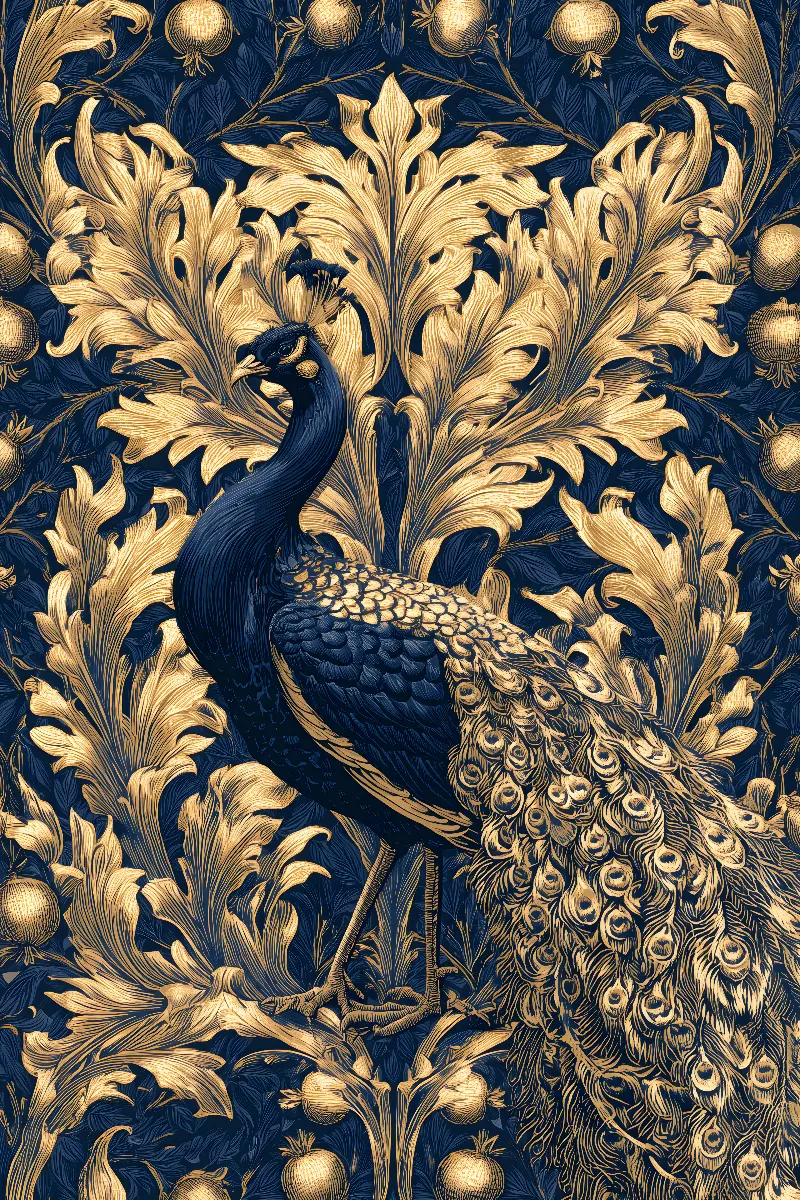
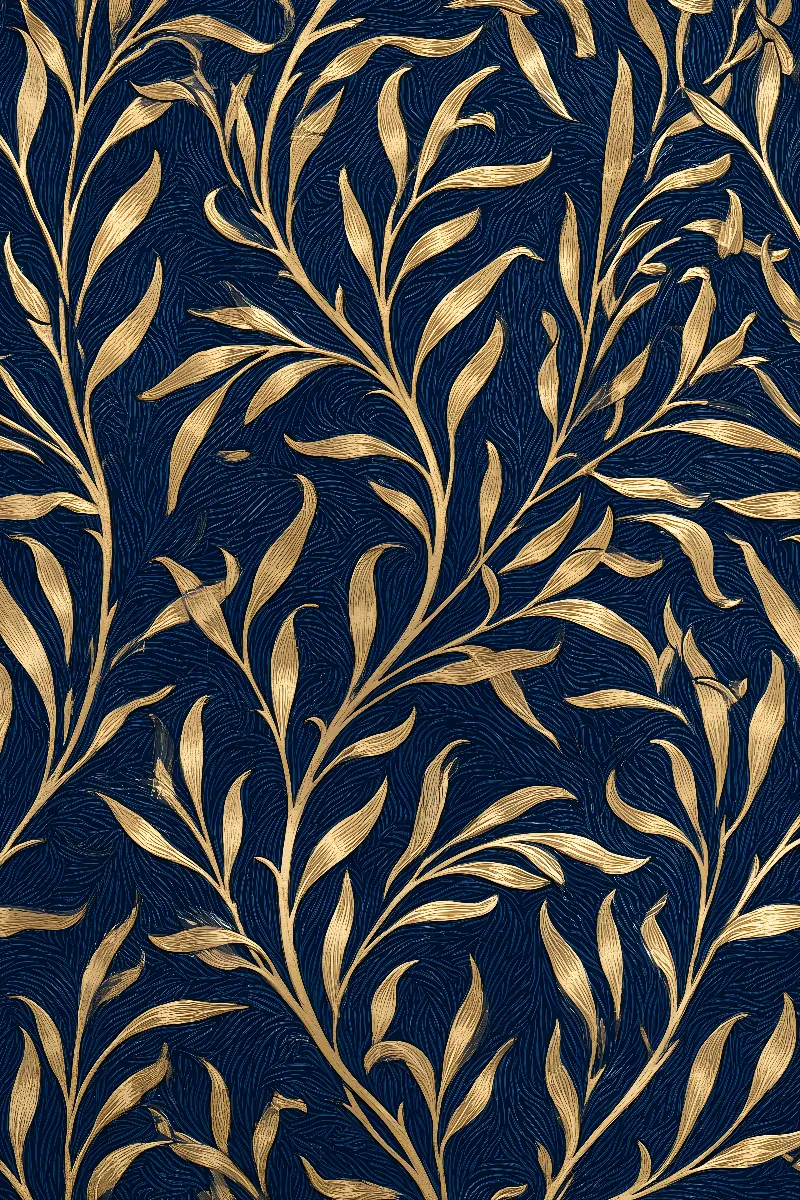
The William Morris in Gold collection reimagines his designs with gold leaf on deep indigo, sage and cream: The Golden Strawberry Thief, The Golden Willow Bough, The Golden Lily, Emerald Acanthus, Brother Rabbit and others. Morris’s designs are in the public domain; the gold versions are new works. For the story of the patterns themselves, read the Strawberry Thief and Morris’s most famous patterns.
Questions
Who was William Morris?
William Morris (1834–1896) was an English designer, poet, printer and socialist, and the leading figure of the Arts and Crafts movement. He is best known today for his wallpaper and textile patterns, such as Strawberry Thief and Willow Bough.
What was the Arts and Crafts movement?
A design movement of the late nineteenth and early twentieth centuries that championed handcraft, honest materials and forms taken from nature, against cheap factory goods. It took its name from the Arts and Crafts Exhibition Society, founded in London in 1887.
What is the most famous William Morris quote?
“Have nothing in your houses that you do not know to be useful, or believe to be beautiful,” from his 1880 lecture The Beauty of Life.
Can you visit William Morris’s house?
Yes. Red House in Bexleyheath, south-east London, is run by the National Trust, and Kelmscott Manor in Oxfordshire is also open to visitors. The William Morris Gallery in Walthamstow occupies his family home.
For a wall you're responsible for.
Tell me the room and what you want it to feel like. I will send three works that fit, and a mock-up of each one in place.
Write to me