Golden Masters
The Golden Wave
Hokusai Reimagined in Gold
from €9.99
GUIDES · JAPANESE ART
A small woodblock print made in Edo around 1831 became one of the most familiar images on earth. Here is how it was made, what it shows, and how to bring it to your wall.
Most people searching for a great wave print mean one picture: Under the Wave off Kanagawa by Katsushika Hokusai. It was published around 1831 as part of his series Thirty-six Views of Mount Fuji, when Hokusai was in his early seventies, in Edo, the city now called Tokyo.
It was never a single painting. It is a colour woodblock print, made to be sold cheaply in large numbers, and the sheet is small, only about 26 by 38 centimetres. Many impressions survive, and museums across the world hold them, which is why the image feels so familiar.
Its strong blue came partly from Prussian blue, a synthetic pigment that had only recently become available in Japan. That deep, lasting colour helped the series sell and changed the look of Japanese landscape prints.
Ukiyo-e prints were a team effort. A publisher commissioned the design, the artist drew it in ink, and a carver pasted the drawing onto a block of cherry wood and cut away everything except the lines. That key block printed the outline; further blocks, one for each colour, were carved to match.
The printer then laid damp paper on each inked block in turn, rubbing the back with a flat pad, and used small registration marks to keep the colours aligned. Because blocks wore down with use, early impressions are crisper than later ones, which is one reason museums prize them.
Paper mattered too. Printers used tough washi made from mulberry bark, which could take repeated rubbing without tearing. When you choose a great wave print today, a matte, slightly fibrous fine art paper is the closest modern match and keeps the blues deep rather than shiny.
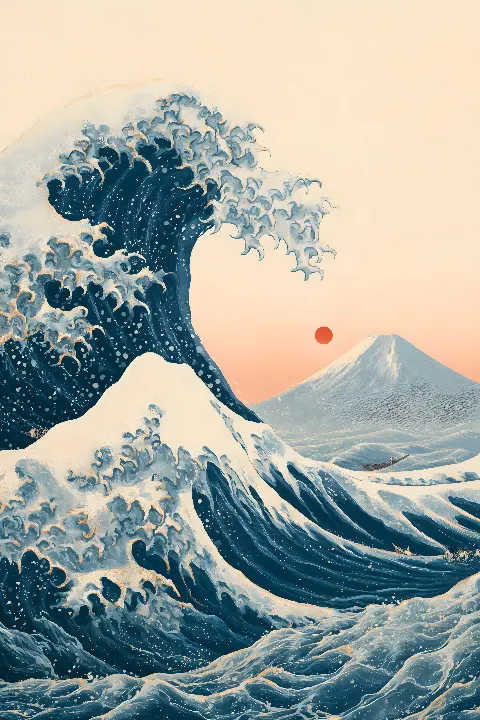
The genius of the composition is scale. A huge wave rears up in the foreground and breaks into claw-like fingers of foam, while three long boats with their rowers crouch in the troughs. Far behind, Mount Fuji appears small and snow-capped, caught inside the curve of the water as if it were another wave.
Look at any great wave print and the eye follows the same route: up the rising wall of water, over the curling crest, down onto the boats and across to the mountain. That movement is why it works on a wall. It reads at once from across a room and still holds detail up close.
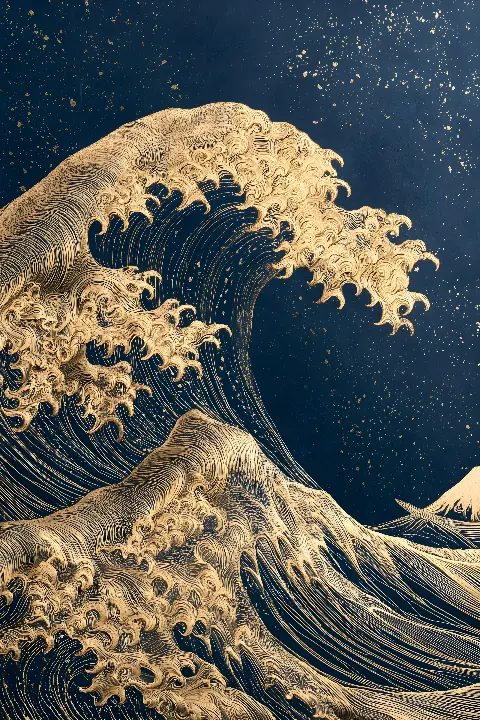
The Golden Wave tells the scene in line alone. Thousands of fine gold strokes, laid side by side, build the breaking wave and a smaller second wave below it on deep navy, with tiny gold specks in the sky like spray.
The Great Wave in Cream & Gold is the lighter version: the wave in navy and blue-grey with cream foam, a warm cream-peach sky, Fuji small and pale inside the curve, and a little red sun as the only warm accent.
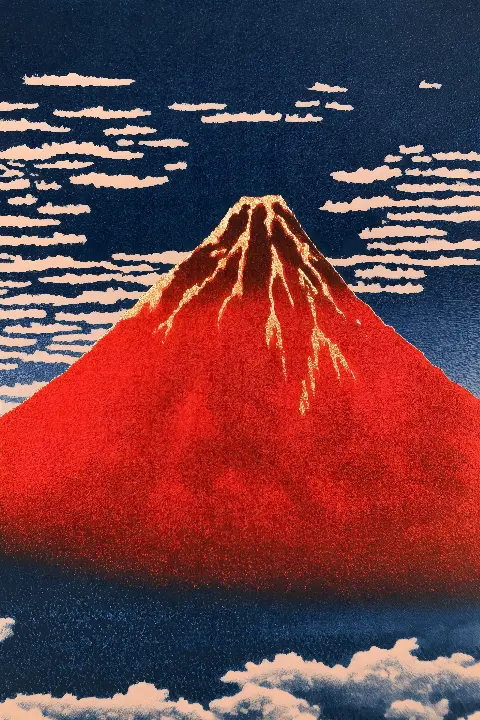
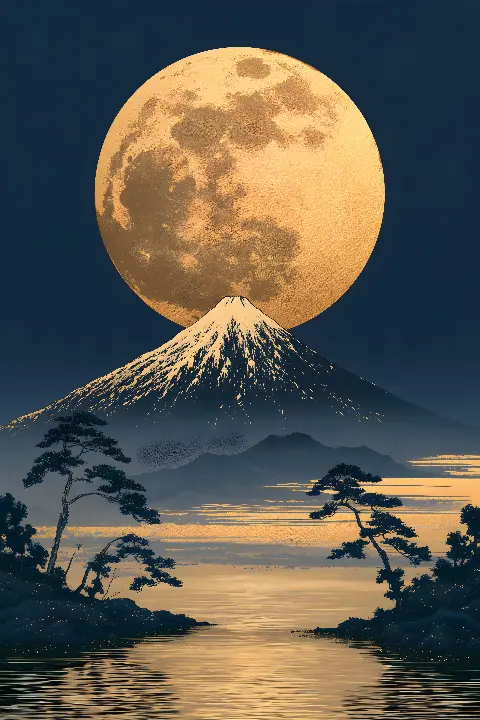
From the same series, The Golden Red Fuji shows the mountain turned red by the morning sun, a broad slope under a navy sky with thin gold veins running down its flanks. Moonlit Fuji is an original night view in Hokusai's spirit, with a huge gold moon behind a snowy peak and pine islands on a glowing lake.
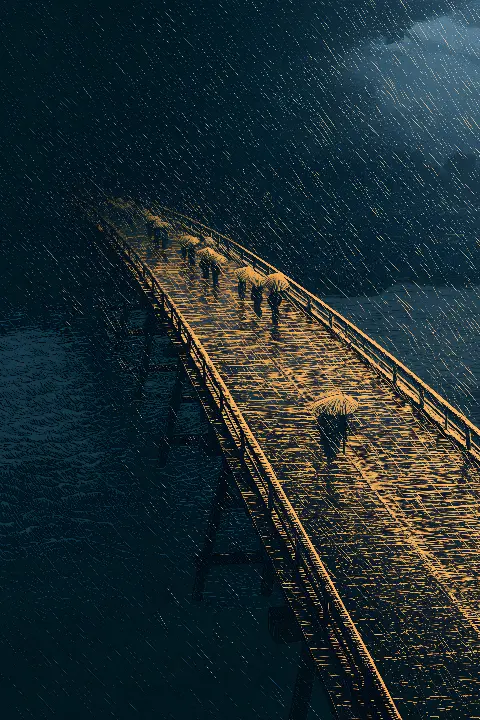
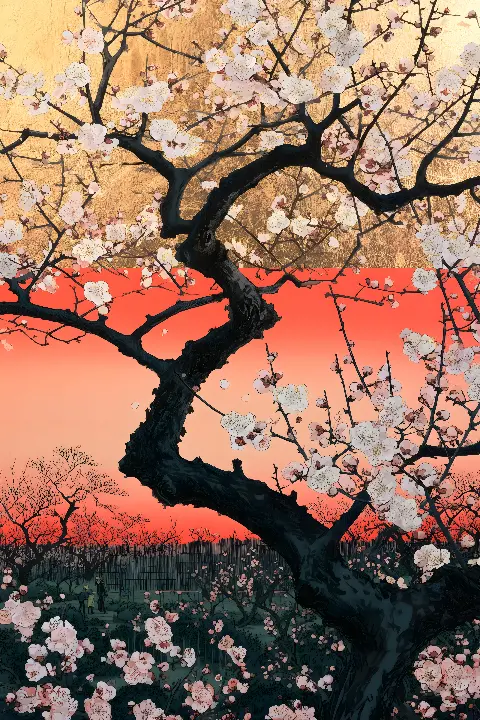
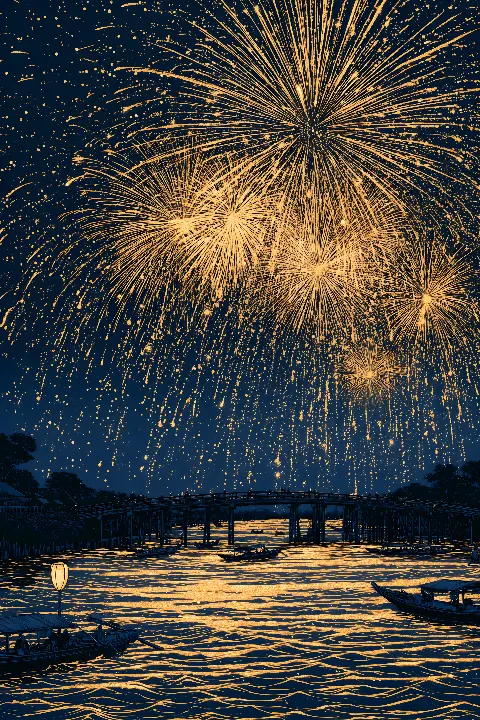
The wave pairs naturally with prints by Utagawa Hiroshige, the other great landscape artist of the period, whose One Hundred Famous Views of Edo appeared between 1856 and 1858. Golden Rain on the Bridge turns his famous sudden shower into slanting gold lines over a long wooden bridge, with small figures hurrying under umbrellas. The Golden Plum Garden pushes a gnarled plum trunk thick with white blossom right to the front, against a coral and gold sky.
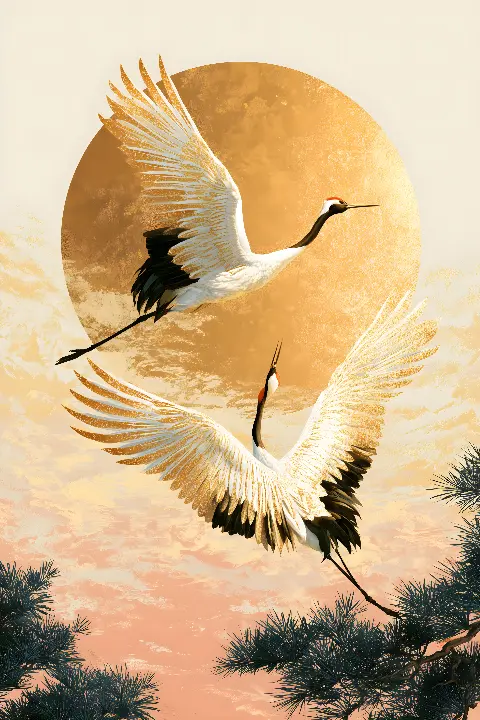
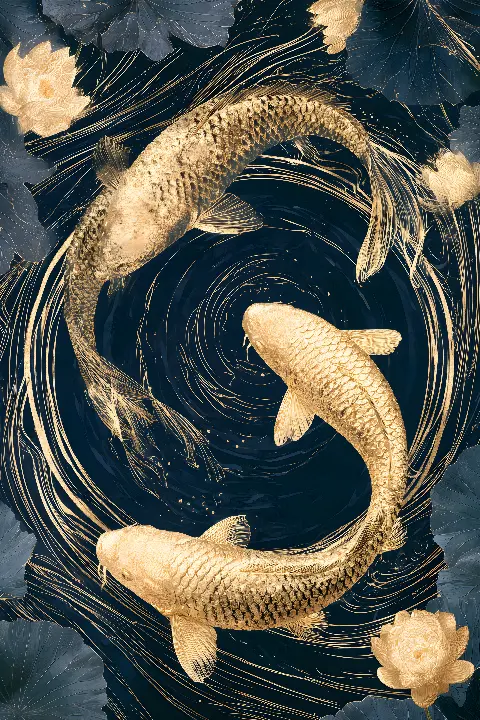
For a softer group, add Golden Cranes at Sunrise, two white cranes with red crowns crossing a large gold disc, or Golden Koi, two gold fish circling on deep indigo water. Keep the frames identical and the gaps even, and three or four works will read as one calm, connected wall.
The original sheet is small, but a great wave print can be much larger, because the composition is bold. Every work is a printable download; the portrait files at 7168 × 10752 px print sharply to about 60 × 90 cm. Printed versions are available on the site, and each download includes a Frame TV version.
Thin black or natural wood frames suit Japanese prints, with a generous pale mount in the manner of museum display. Its centre belongs at roughly 145 to 150 centimetres above the floor. The wave brings energy, so it works in a hallway, a study or above a sofa, while the night views suit a bedroom.
Hokusai's wave and his red Fuji, with Hiroshige's rain and blossom and Rinpa-inspired cranes and koi.
Its title is Under the Wave off Kanagawa, also known as The Great Wave off Kanagawa. It is one of the Thirty-six Views of Mount Fuji by Katsushika Hokusai, published around 1831 as a colour woodblock print.
Quite small. Each impression is about 26 by 38 centimetres, the standard size for a landscape print of the time. A modern print can be made much larger, and a bold image like the wave holds up well at 60 by 90 centimetres.
Yes. Hokusai died in 1849, and his prints belong to the public domain. Our works are reimagined in gold after his designs, using new colours and fine gold lines, and some, such as Moonlit Fuji, are original views in his spirit.
Other Japanese landscapes, especially Hiroshige's views of Edo, and nature subjects such as cranes, koi and blossom. Keep to matching frames and a shared palette, such as navy and gold, so the group reads as one.
Tell me the room and what you want it to feel like. I will send three works that fit, and a mock-up of each one in place.
Write to meThis site uses cookies for Google Analytics and Google Ads so I can see which pages and ads bring visitors. Nothing is sold or shared beyond that. Privacy