
Golden Masters
The Golden Wave
Hokusai Reimagined in Gold
from €9.99
GUIDES · STYLES
Waves, cranes, blossom and a mountain under the moon. Here is where the main Japanese traditions come from, what makes them recognisable, and how to give them the space they need at home.
Most Japanese wall art seen in Western homes comes from three sources. The first is ukiyo-e, pictures of the floating world: colour woodblock prints made in Edo, today’s Tokyo, mainly in the eighteenth and nineteenth centuries. The second is Rinpa, a Kyoto school of decorative painting that loved gold-leaf screens. The third is a craft idea more than a picture: kintsugi, the art of mending pottery with gold.
Each brings a different mood. Ukiyo-e is graphic and clear, with firm outlines and flat colour. Rinpa is lavish and calm at the same time, with birds, flowers and water on fields of gold. Kintsugi is quiet and reflective. Knowing which one you are drawn to makes it much easier to choose a picture for a particular room.
A woodblock print was a team effort. An artist drew the design, a carver cut it into wooden blocks, one for each colour, and a printer pressed the colours onto paper by hand. Publishers sold the sheets widely, so they were the popular art of their day. Katsushika Hokusai’s Under the Wave off Kanagawa, published around 1831, is probably the most famous piece of Japanese wall art in the world.
The Golden Wave keeps Hokusai’s composition but draws the breaking crest in thousands of fine gold lines on deep navy. Moonlit Fuji, in the spirit of his Thirty-six Views of Mount Fuji, sets the snow-capped peak beneath an enormous gold full moon, with pine-covered islands on calm water below.
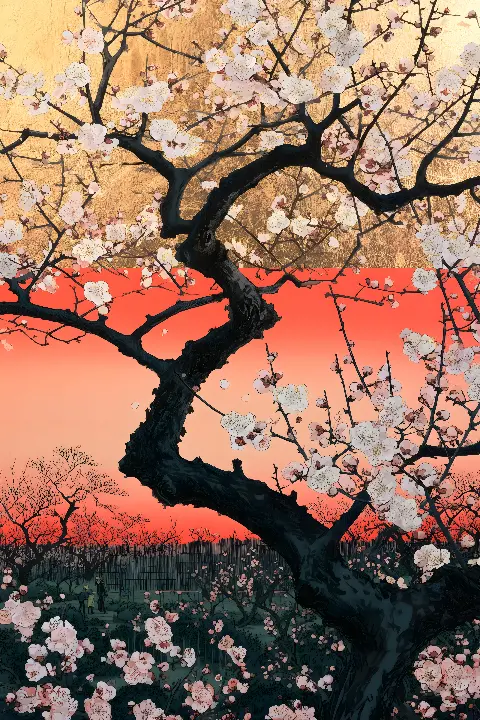
Utagawa Hiroshige, a generation younger, is known for weather and seasons. The Golden Plum Garden follows his Plum Garden at Kameido of 1857, with a gnarled dark trunk thick with white blossom right at the front of a coral and gold sky; Van Gogh admired the print enough to paint his own version in Paris in 1887. The Golden Iris Garden fills its foreground with tall violet irises outlined in gold.

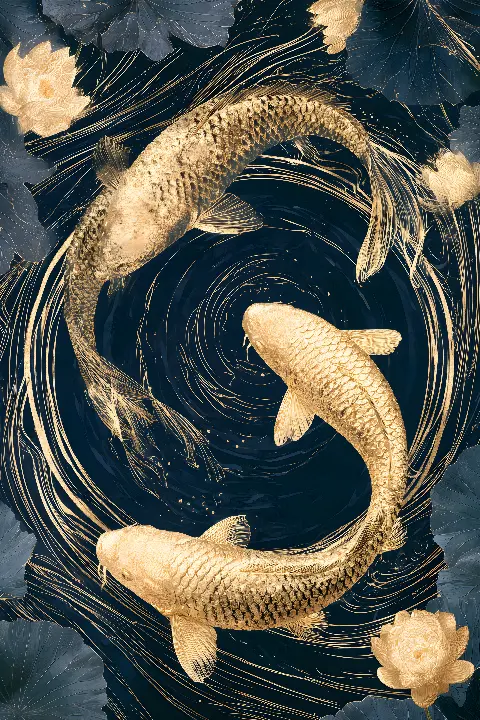
Rinpa began in Kyoto in the early seventeenth century and takes its name from Ogata Kōrin, who carried the style forward around 1700. Its painters covered folding screens in gold leaf and set birds and plants on them with great economy. Golden Cranes at Sunrise follows that spirit, with two white cranes, their crowns small red marks, crossing a large gold sun above dark pine branches, and Golden Koi circles two gold fish among pale lotus flowers on deep indigo water, every scale in raised gold.
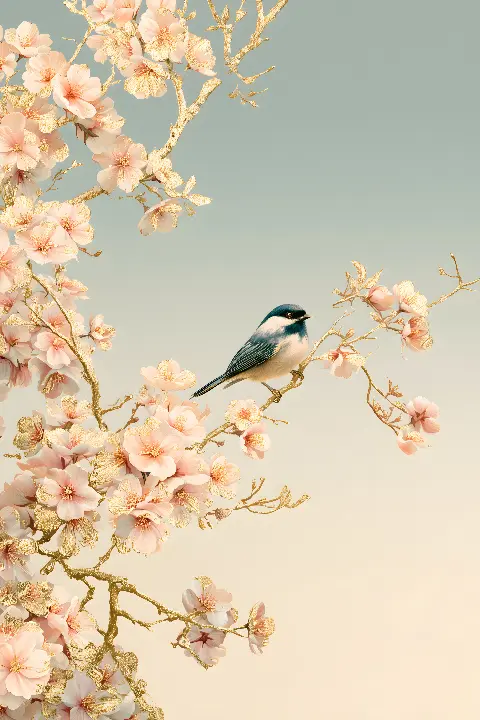
Hiroshige also made many kachō-e, bird-and-flower prints pairing one bird with one branch. Golden Sakura is almost all open space, a slender branch of pastel cherry blossom holding a small black-capped songbird, while Sakura and Songbird is fuller, the branch bending under dense pink blossom around a blue-grey bird. The Kintsugi Moon, a huge dark moon laced with glowing gold seams over a black sea, brings golden repair onto the wall.
In a traditional Japanese house a single hanging scroll is shown in the tokonoma, a raised alcove, often with a flower arrangement in front of it, and the scroll is changed with the seasons. The lesson for any home is to show less. Japanese aesthetics value ma, the meaningful empty space between things, and a picture with clear wall around it says more than one squeezed into a crowded gallery wall.
You can borrow the seasonal habit too. Hang the blossom prints in spring, the iris garden in early summer when irises flower, and the moon and Fuji pieces in autumn, the traditional season for moon viewing. A single frame in a hallway or above a low bench, changed three or four times a year, keeps the wall alive.
Navy and gold works, such as the wave and the koi, suit a living room, a study or a bathroom with dark tiles, and they hold their own over a sofa at a large size. The pale pastel sakura prints belong in bedrooms and quiet corners with soft white, sage or pale grey walls. The warm gold skies of the Hiroshige gardens sit well in dining rooms with wooden furniture.
Japandi rooms, which blend Japanese and Scandinavian ideas, are a natural home for Japanese wall art: light oak, linen, stone colours and very little clutter. Here a single strong picture does more than several. Choose thin frames in natural wood or black, and leave a wide pale mount to echo the margin of a woodblock sheet.
All nine are printable downloads, and the portrait files, 7168 × 10752 px, print sharply to about 60 × 90 cm. A Frame TV version comes with every download, and printed versions are available on the site. Matt paper suits Japanese wall art, because it keeps soft gradients and fine gold lines free of glare.
Hang a little lower than usual where people sit low. In rooms with low sofas or floor cushions, bring the centre of the picture down to about 140 cm instead of the usual 150 cm. Avoid surrounding one print with paper lanterns, fans and red lacquer; the picture already carries the reference, and the room works better when everything else stays simple.
Waves, cranes, koi, blossom, Fuji and a kintsugi moon, after Hokusai, Hiroshige and the gold screens of Rinpa.




Hokusai’s Under the Wave off Kanagawa, often called the Great Wave, is probably the most widely recognised. It was published around 1831 in his series Thirty-six Views of Mount Fuji and inspired many European artists once Japanese prints reached Paris in the nineteenth century.
Ukiyo-e are best known as colour woodblock prints from Edo, made in editions and sold widely, showing landscapes, actors, beauties and nature. Rinpa is a Kyoto school of painting, often on gold-leaf screens, with birds, flowers and water. One was printed in numbers, the other painted by hand.
Calm rooms with simple furniture: bedrooms, Japandi living rooms, studies and bathrooms. Give each picture plenty of empty wall around it. Navy and gold works suit darker rooms, while the pastel blossom prints suit light ones.
No. They are reimagined in gold after Hokusai and Hiroshige, whose work is in the public domain, or inspired by Rinpa and kintsugi. Each is a printable download that you can print at home, and printed versions are available on the site.
Tell me the room and what you want it to feel like. I will send three works that fit, and a mock-up of each one in place.
Write to meThis site uses cookies for Google Analytics and Google Ads so I can see which pages and ads bring visitors. Nothing is sold or shared beyond that. Privacy