
Art Nouveau Posters in Gold
The Zodiac Muse
Art Nouveau Poster in Gold
from €9.99
GUIDES · STYLES
Long hair, flowers, a halo of ornament and one calm face. The art nouveau poster was born on the walls of Paris in the 1890s, and it still makes a room feel softer and warmer.
The art nouveau poster began as advertising. In the 1880s and 1890s improved colour lithography let printers produce large, bright sheets in quantity, and the walls of Paris filled with them. Jules Chéret, often called the father of the modern poster, set the tone with lively figures in vivid colour, and a craze for collecting posters soon followed.
Art Nouveau itself was a wider movement, running from about 1890 to the First World War under different names: Jugendstil in Germany, Secession style in Vienna, Modernisme in Barcelona, Stile Liberty in Italy. Its English name comes from a Paris gallery that opened in 1895. Everywhere it shared a love of natural forms, from stems and petals to waves, hair and the long curving line nicknamed the whiplash.
No artist shaped the art nouveau poster more than Alphonse Mucha. Born in Moravia in 1860, he was working in Paris when, at the end of 1894, he designed Gismonda, a tall, narrow poster for the actress Sarah Bernhardt. Its success brought him a contract with her and made his manner, soon called le style Mucha, the fashion of the decade.
His formula is easy to recognise once you know it. A young woman fills a tall sheet, her hair flowing in ribbons. Behind her head sits a circle, a halo or a decorative disc that frames the face. Flowers and mosaic-like borders close the composition, and the colours are soft: sage, peach, cream, dusty blue and gold. In 1896 he made The Seasons, four panels showing the year as four women.
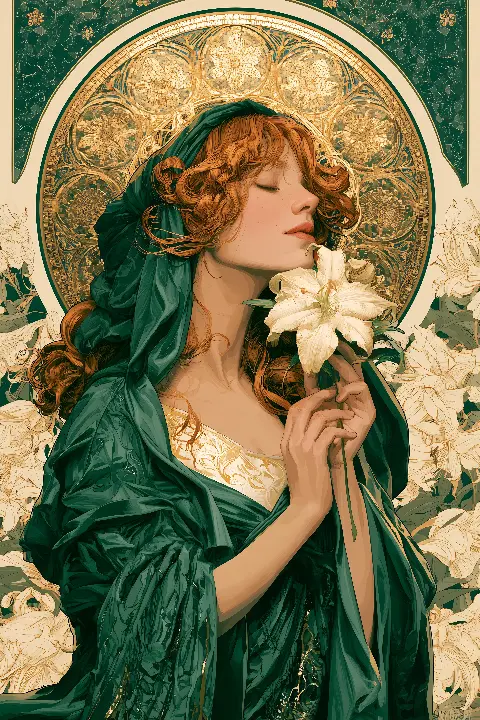
Every work here is reimagined in gold after Mucha’s manner instead of reworking one particular poster. The Zodiac Muse tips her head back with eyes closed, copper hair streaming to the left, against a great ring of raised gold medallions and tiny stars. The Emerald Lily turns the whole picture toward one gesture: a woman in an emerald hood breathing in a single white lily before a round gold halo.
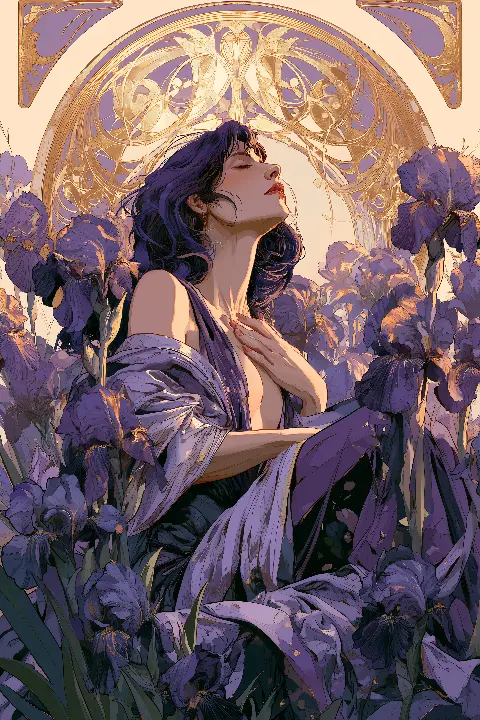
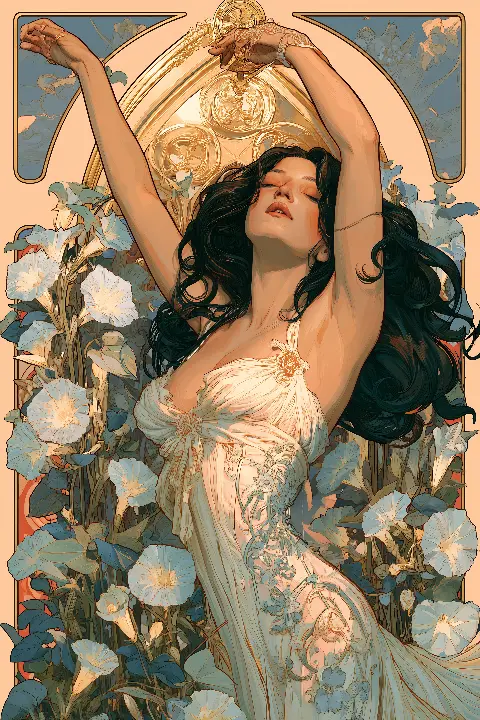
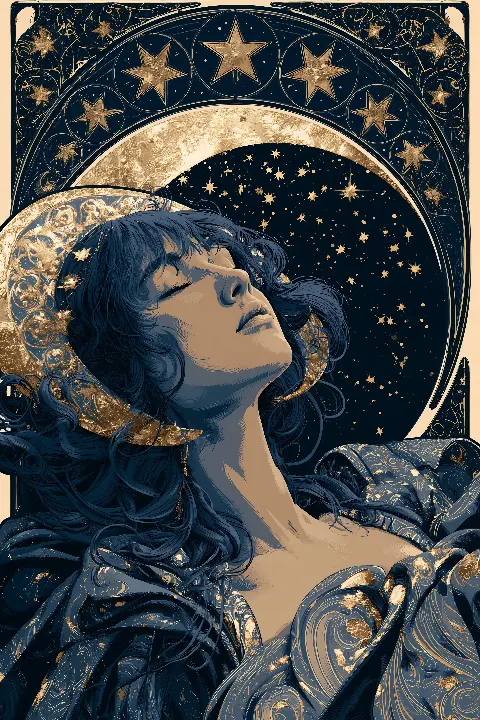
The Amethyst Iris rises out of a crowd of tall purple irises beneath a curving gold arch. The Moon Muse rests her face against a gold crescent, her deep blue hair melting into a night sky full of small gold stars. The Autumn Dance is the liveliest of the set, with auburn curls, terracotta drapery and falling orange and gold leaves swirling around a great gold circle. Morning in Gold is its gentle opposite: a dark-haired woman stretches both arms above her head among pale blue morning glories under a peach sky.
Three pastel pieces follow The Seasons more closely. Spring in Gold wears a crown of pink blossom inside a gold ring set with lilac flowers, and Summer in Gold holds wheat and sunflowers in front of an ornate halo. The Blossom Muse, in mint, blush and gold, stands in a sheltered gold arch with one hand at her chest.
Because each art nouveau poster is built around one dominant colour, it is easy to match to a wall. Green and gold suit olive, forest green or cream walls, and look at home in a bathroom with deep tiles. Navy and gold give a bedroom a quiet evening mood. Terracotta and copper tones belong in a living or dining room with wooden furniture.
Pastels need a lighter room. Spring and Summer look fresh on soft white, blush or pale sage walls, in a bedroom or on a landing that gets morning light. If the room already has a strong pattern, from wallpaper to a busy rug, choose one of the simpler pieces with a plain cream ground so the poster has space to breathe.
Mucha’s figures were drawn for tall formats, so give them height. The portrait files are 7168 × 10752 px and print sharply to about 60 × 90 cm. Above a bed, a chest of drawers or a reading chair, leave 15 to 25 cm between furniture and frame; on a bare wall, put the centre of the picture at about 150 cm from the floor.
Frames can be warmer here than for modern prints. A thin gold or brass frame repeats the halo, dark walnut suits the autumn tones, and a white mount gives the ornament a margin. Pairs and trios work well, because the muses face in different directions: hang them so the figures look inward, toward each other, never out of the group.
The most common mistake is hanging an art nouveau poster too small. These pictures depend on detail, such as freckles, fine lines in the hair and the engraved ornament of a crescent, and at a small size the eye cannot find it. Aim for at least 40 × 60 cm on a main wall. The second mistake is mixing too many ornate styles; one strong figure with plain furniture reads better than three.
Lastly, watch the light. Direct sun fades paper over time, and a glazed frame opposite a window reflects it. Hang where light falls across the picture from the side. Each download is a printable file with a Frame TV version included, and printed versions are available on the site if you would rather not print at home.
Muses, flowers and halos after Mucha, from cool emerald and amethyst to warm autumn tones and soft spring pastels.

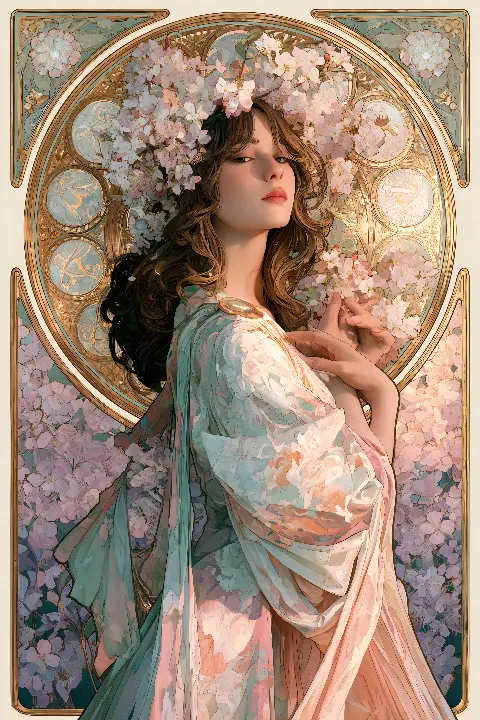
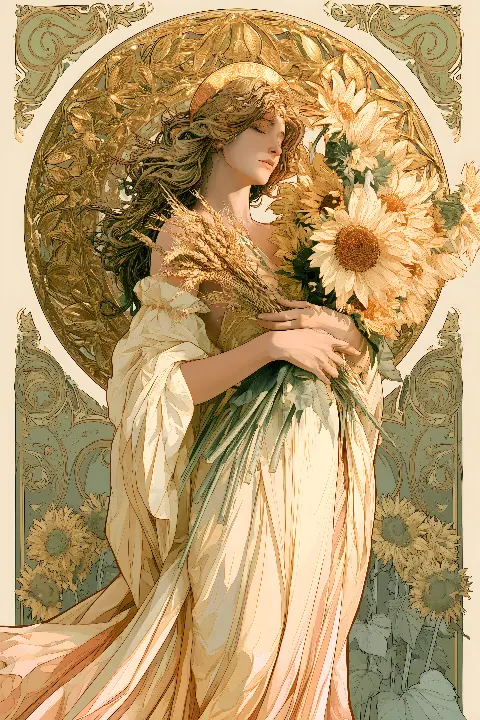
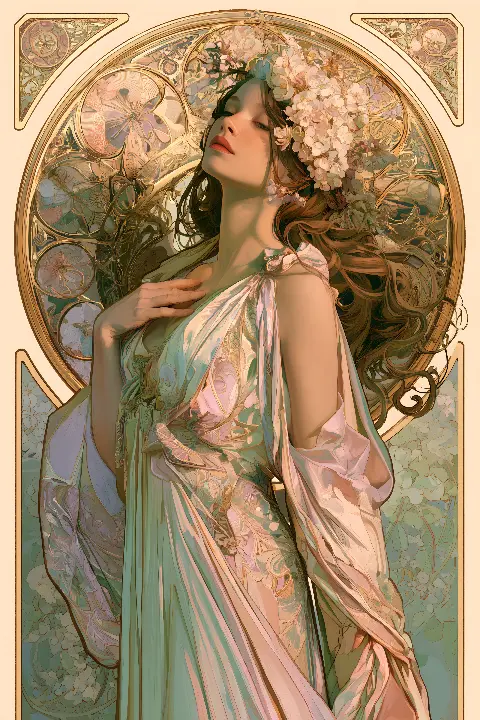
Alphonse Mucha, a Czech artist working in Paris, is the name most people link with the art nouveau poster, above all since his Gismonda poster for Sarah Bernhardt at the end of 1894. Jules Chéret and others had already made colour posters popular in the city.
Soft, natural colours dominate: sage and olive greens, peach, cream, dusty blue, violet and terracotta, nearly always with gold or bronze accents. Clear outlines and flowing curves hold them together, so even muted palettes read well from across a room.
No. They are new compositions reimagined in gold after Mucha’s manner, with halos, flowers and long flowing hair. Mucha died in 1939 and his work is in the public domain, but each of these designs is our own.
Bedrooms, dressing rooms, reading corners and hallways suit them well, because the figures are calm and intimate. Hang the centre at around 150 cm from the floor, or 15 to 25 cm above a bed or chest, and give the picture room on either side.
Tell me the room and what you want it to feel like. I will send three works that fit, and a mock-up of each one in place.
Write to meThis site uses cookies for Google Analytics and Google Ads so I can see which pages and ads bring visitors. Nothing is sold or shared beyond that. Privacy