GUIDES · ART MOVEMENTS
Alphonse Mucha and Art Nouveau, explained.
Flowing hair, flowers, halos and whiplash curves: for many people Alphonse Mucha simply is Art Nouveau. Here is how he became famous overnight, and what the style was trying to do.
The poster that made him famous
Alphonse Mucha (1860–1939) was born in Moravia, now part of the Czech Republic, and came to Paris in 1887 to study. For years he scraped a living as an illustrator. Then, over the Christmas holidays of 1894, a printer needed a poster for the great actress Sarah Bernhardt’s new play Gismonda, and Mucha, almost by chance, got the job.
The poster appeared on the walls of Paris on the first day of 1895: a tall, narrow figure of Bernhardt in a golden mosaic halo, painted in muted colours, unlike anything in the streets. Collectors bribed bill-posters to get copies or cut them down at night. Bernhardt gave Mucha a six-year contract, and he became the most fashionable designer in Paris.
Le style Mucha
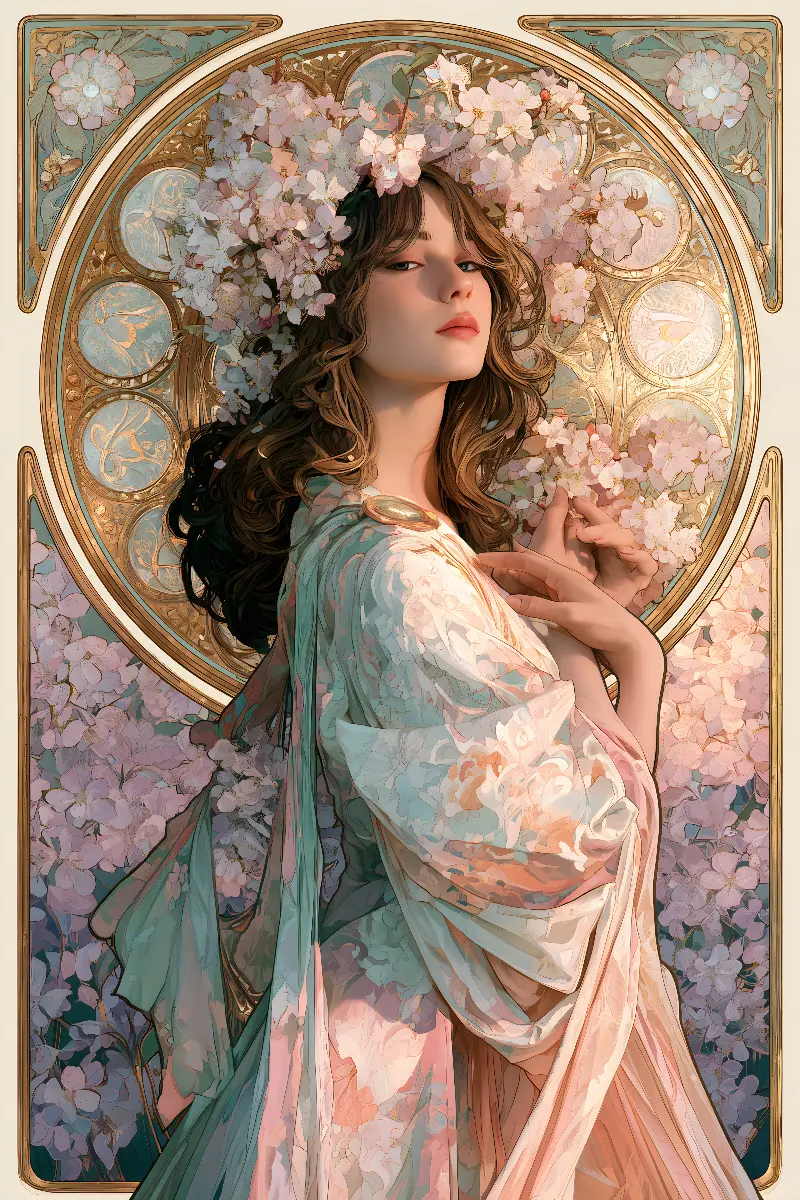
Mucha’s posters and panels share an unmistakable look. A young woman stands or sits at the centre, often with long, flowing hair that curls into ornamental shapes. Behind her head is a circle — a halo, a mosaic, a ring of flowers — that frames her like a saint in a Byzantine icon. Flowers, leaves and stars fill the background, and everything is held together by a strong contour line and soft, harmonious colours.
He designed advertisements for biscuits, champagne, bicycles and cigarette papers, and he also made panneaux décoratifs: decorative panels without any advertising text, printed cheaply so that ordinary people could hang art at home. The most famous are The Seasons (1896), four women personifying spring, summer, autumn and winter; followed by The Flowers and The Arts (1898), and The Times of the Day (1899).
What is Art Nouveau?
Art Nouveau — “new art” — was an international style of roughly 1890 to 1910 that tried to break with the copying of historical styles and create something modern, inspired by nature. Its name came from the Paris gallery of the dealer Siegfried Bing, the Maison de l’Art Nouveau, which opened in 1895.
The style had many names. In Germany it was Jugendstil, after the Munich magazine Die Jugend; in Vienna the Secession style; in Italy Stile Liberty, after the London shop Liberty & Co.; in Spain Modernisme. Its hallmarks are long, sinuous “whiplash” curves, plant and flower forms, insects, peacocks, women with flowing hair, and the idea that a building, its furniture, its lamps and its posters should form one work of art.
Victor Horta’s town houses in Brussels, Hector Guimard’s entrances for the Paris Métro (1900), Émile Gallé’s glass, Louis Comfort Tiffany’s lamps and Antoni Gaudí’s buildings in Barcelona all belong to it. Its roots lay partly in the Arts and Crafts movement and partly in Japanese prints.
Mucha’s later life
Mucha was never comfortable being remembered only as a poster artist. From 1910 he worked for nearly twenty years on The Slav Epic, twenty enormous canvases about the history of the Slavic peoples. When Czechoslovakia became independent in 1918, he designed its first stamps and banknotes. He died in Prague in 1939, shortly after being interrogated by the Gestapo following the German occupation.
His Paris work fell out of fashion between the wars and came back with a rush in the 1960s, when his posters and flowing lines inspired a new generation of psychedelic poster artists. It has never really left since.
Art Nouveau in gold
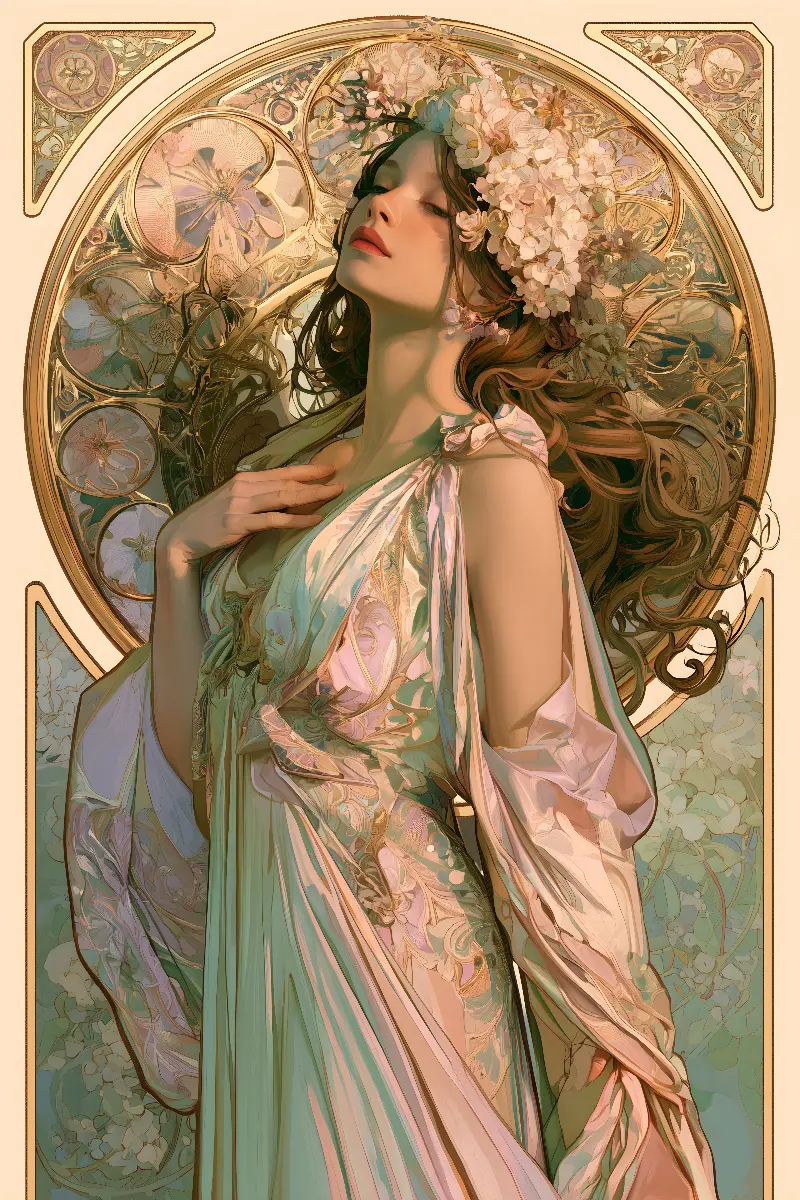
Gold was already part of Mucha’s art — halos, mosaics and metallic inks — so his work translates naturally into gold leaf. The Pastel Masters collection reimagines his style in Spring in Gold, Summer in Gold, The Blossom Muse and The Sunflower Muse (the Art Nouveau Seasons set), and the Christmas in Gold collection adds The Winter Muse, The Robin Muse and two Art Nouveau reindeer.
Mucha died in 1939, so his works are in the public domain in the European Union and most other countries.
Questions
What is Art Nouveau in simple words?
Art Nouveau (“new art”) was an international style of about 1890–1910 in art, architecture and design, inspired by nature: flowing curves, flowers, plants and decorative female figures. In German it is called Jugendstil.
Why is Alphonse Mucha famous?
For his Art Nouveau posters and decorative panels in Paris, beginning with his 1895 poster for Sarah Bernhardt in Gismonda, which made him famous overnight. His Seasons (1896) are among the most reproduced images of the style.
What is the difference between Art Nouveau and Art Deco?
Art Nouveau (c. 1890–1910) uses flowing, organic curves and plant forms. Art Deco (1920s–1930s) is geometric, streamlined and machine-age, with zigzags, sunbursts and stepped forms.
Is Mucha’s art in the public domain?
Yes. Alphonse Mucha died in 1939, so his works are in the public domain in the European Union and most other countries.
For a wall you're responsible for.
Tell me the room and what you want it to feel like. I will send three works that fit, and a mock-up of each one in place.
Write to me