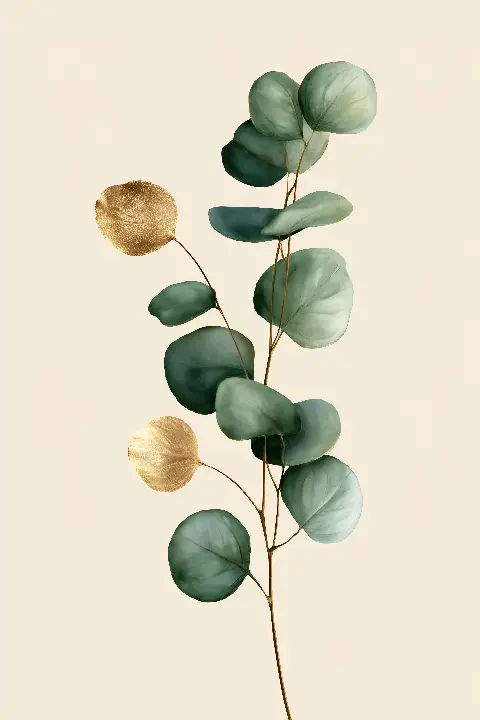
Sage Green Wall Art
Eucalyptus in Gold
Sage Green Wall Art
from €9.99
GUIDES · COLOUR
Sage is the green that behaves like a neutral: soft, grey and easy to live with. This guide covers tone-on-tone and contrast, the colours that lift it, and which pictures suit which room.
Sage green wall art works because sage sits halfway between a colour and a neutral. It is a green muted with grey, so it never shouts, and it moves between warm and cool depending on the light. Next to oak, linen, cream and stone it feels natural; next to gold it looks quietly expensive. That is why it fits so many styles at once, from Scandinavian and Japandi rooms to cottage kitchens and boho living rooms.
The same softness is also the risk. Sage pictures can disappear if everything around them is the same tone. The trick is to decide whether you want a picture that melts into the wall or one that stands out, and choose accordingly. A sage print on a sage wall beside sage cushions is restful for a week and flat after a month.
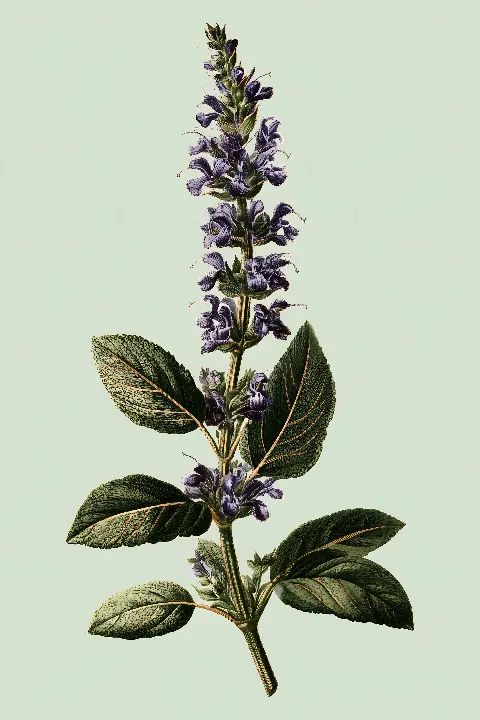
On a sage wall, choose sage green wall art that works tone-on-tone and let texture do the work. The Golden Olive Branch is a good example: slender leaves sweep diagonally across a soft sage-green sheet, and a cluster of glossy black olives in the middle, with two olives and one leaf in gold, gives the eye somewhere to land. The Garden Sage works the same way, a single sprig on pale mint-sage with a spike of violet flowers as the only strong colour.
On white, cream or linen walls, a cream ground with sage accents reads best. Eucalyptus in Gold shows one branch of round leaves washed in sage and deep green watercolour, two of them gleaming in gold leaf, with a great deal of open cream space. Ginkgo in Sage and Gold is lighter still: fine gold outlines of small fan-shaped leaves, only two of them filled with a pale sage wash. Both leave so much cream untouched that the wall seems to continue into the picture.

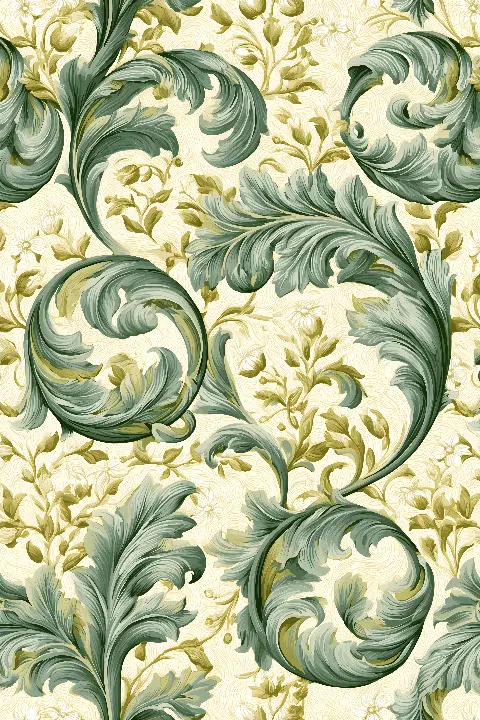
Sage green wall art comes in three very different kinds of picture. The botanical kind, leaves and herbs, is the natural fit. The pattern kind comes from William Morris, who designed Pimpernel in 1876 and Strawberry Thief in 1883. Sage Pimpernel recolours his large curling leaves in sage and gold on warm cream, while The Sage Strawberry Garden moves his speckled thrushes, peonies and small strawberries into a pale sage and cream key, far lighter than the deep blue of the original textile.
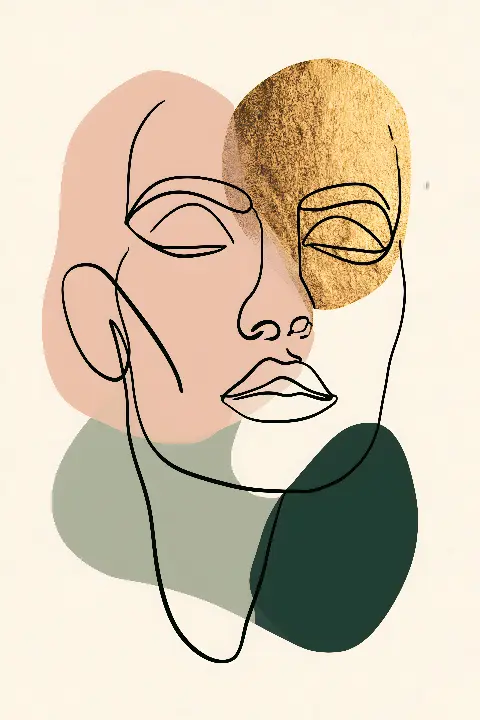
The modern kind is graphic. The Sage Line draws a face with closed eyes in one continuous line over blush, sage and deep green shapes, with a round patch of gold leaf over one eye. Sage Arches and Golden Sun stacks earthy bands from dark sage to terracotta under a gold half-sun, a mid-century shape with a boho warmth.
Gold is the easiest partner, because it warms sage without changing its mood. Terracotta and rust add heat and suit boho and Mediterranean rooms. Blush pink softens it, which is why sage and blush appear together in so many bedrooms. Mustard and ochre work too, in small doses. Cream is the bridge between them all.
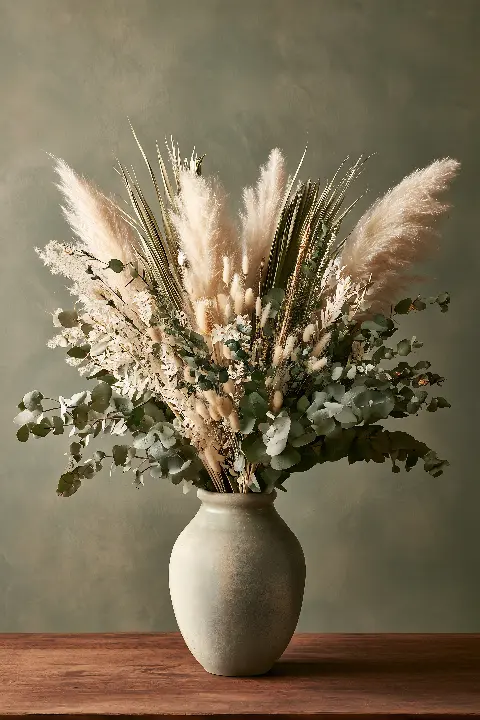
Pampas in Sage shows how far a muted palette can go: cream and beige plumes in a round stone-grey vase on a warm wooden table, with bunny tails, dried palm and silvery eucalyptus, and only a few strands touched with gold. Deep forest green, charcoal or black next to sage makes a stronger, more dramatic combination, best kept to one accent in the room.

Kitchens and dining rooms suit olives, herbs and Morris patterns. Bedrooms suit the airy line drawings and soft florals, above a bed or a bedside table. Living rooms can take the bolder arch or a still life above the sofa. Entrances and bathrooms suit the single eucalyptus branch, which lets a narrow wall breathe.
In bathrooms, keep paper prints away from steam: hang them in the driest part of the room or choose a moisture-resistant printed surface. Whatever the room, sage green wall art looks most at home beside natural materials: a wooden shelf, a linen blind, a ceramic vase.
Sage green wall art changes with light more than people expect. North light makes it cooler and greyer; warm bulbs in the evening pull it towards olive. Look at the picture where it will hang at both times of day before you commit to a frame. Pale oak, white and thin brass frames suit sage best; a black frame sharpens the graphic works.
All the works here are printable downloads, and the portrait files at 7168 × 10752 px print sharply to about 60 × 90 cm. Each download includes a Frame TV version, and printed versions are available on the site. Centre it roughly 150 cm above the floor, or leave a gap of 15 to 25 cm above a sideboard or headboard.
Nine works in soft sage, from eucalyptus, olive and garden sage to William Morris patterns and modern line art.


Pale oak and white frames keep the look soft and natural, and a thin brass or gold frame picks up the gold accents. A slim black frame gives the graphic, modern works a sharper edge. Avoid heavy dark wood, which can make sage look dull.
It can, and tone-on-tone looks calm and considered, but choose a picture with one stronger accent such as dark olives, violet flowers or gold, so it does not disappear. On white or cream walls, a cream-ground print with sage details reads more clearly.
Gold, cream, terracotta, rust and blush pink are the easiest partners. Natural materials such as oak, linen, rattan and stone suit it too. For a deeper look, add one accent of forest green or charcoal rather than several strong colours.
Yes. Its muted, grey-green tone suits a quiet room, especially in soft line drawings, florals or a pale Morris pattern. Hang a single piece above the bed, or a pair above the bedside tables, and keep the frames light.
Tell me the room and what you want it to feel like. I will send three works that fit, and a mock-up of each one in place.
Write to meThis site uses cookies for Google Analytics and Google Ads so I can see which pages and ads bring visitors. Nothing is sold or shared beyond that. Privacy