
Golden Masters
Golden Starry Night
Van Gogh Reimagined in Gold
from €9.99
GUIDES · PRINTING
A printable is a picture you buy as a file and print where and how you like. Here is what the pixels mean, which paper to choose, where to print and how to frame the result.
Printable wall art is artwork sold as a high-resolution digital file rather than as a finished print. You download it, then print it at home, at a local print shop or through an online photo lab, in the size and on the paper you choose. The picture is yours as soon as the download finishes, and you can print it again whenever you like.
The format suits people who want control. You can print the same picture small for a shelf and large for a wall, try it on plain paper before committing to fine art stock, and print a fresh one if a frame gets damaged or you move house. The trade-off is that the quality of the final piece depends on the printing, so it pays to understand a few basics.
With printable wall art, sharpness comes down to pixels per inch. At 300 pixels per inch, the usual standard for crisp photographic prints, every 1,000 pixels give you about 8.5 cm of paper. The portrait files here measure 7168 × 10752 px, which works out at about 60 × 90 cm at full sharpness. Larger prints are possible at a slightly lower density, because a big picture is seen from further away.
The files have a 2:3 ratio, so they fit sizes such as 20 × 30, 40 × 60 and 60 × 90 cm without cropping. A-series sizes such as A3 and A2 are slightly squatter, so either let the printer add a thin white border or have the image trimmed a little at top and bottom, after checking which edge carries important detail. Golden Starry Night, for instance, has its dark cypress rising on the left and its small village along the bottom, so any trim is safer at the top.

Home printers handle printable wall art well in small sizes up to A4 or A3, especially photo printers with pigment inks. For anything larger, a print shop or photo lab will give better results. Ask for giclée or fine art printing if you want archival pigment inks on heavy paper, or for a photo print on lustre or matte paper if you want something quicker.
Whoever prints it, send the original file without resizing it yourself, say clearly that it must not be cropped or stretched, and ask for a test strip if the colours matter to you. Screens are brighter than paper, so a print always looks a touch darker than the image on your phone. That is normal, not a fault. Our guide to printing a digital download goes through the process in more detail.
Matte papers have no shine, which makes them the safest choice for dark backgrounds. The Golden Sunburst, a symmetrical bronze-gold ornament of stepped arches and fanned rays on pure black, would pick up every reflection on gloss; on matte cotton paper the black stays deep and the edges stay crisp. Golden Starry Night behaves the same way, its rolling gold swirls on deep navy reading clearly only without glare.
Lustre and satin papers have a slight sheen that makes colours look more saturated, which suits vivid pieces. The Golden Kingfisher, with its turquoise back and warm orange chest against a deep teal ground, gains intensity on a satin finish. Light, airy designs such as Eucalyptus in Gold, a single branch of sage and deep green leaves rising through open cream space, look natural on a textured watercolour paper.
One honest note: on ordinary paper, gold is printed as warm ochre and yellow tones that read as gold, not as metal. Metallic photo papers exist and add real shimmer, but they also add shine, so try a small test before ordering a large one.
Standard frame sizes make printable wall art easy to finish. Choose the print size first, then a ready-made frame to match, with or without a mount. A mount, the card border inside the frame, adds space around the picture and makes even a modest print look considered; 5 to 8 cm is a good starting width. If the print and the frame do not match, ask the printer to add a white border rather than trimming the image.
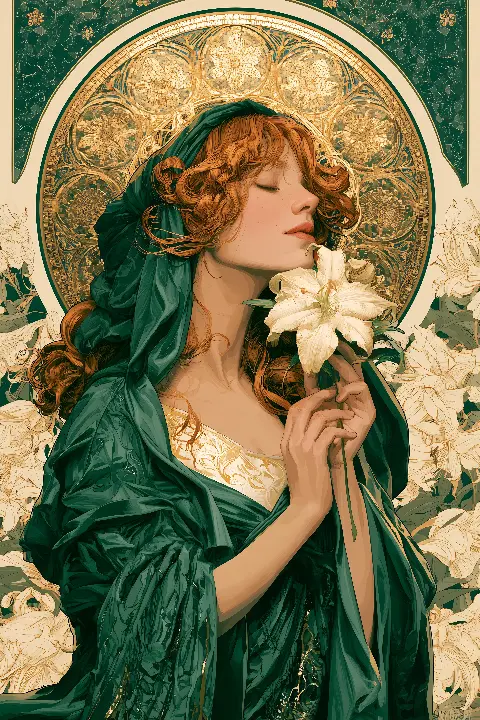
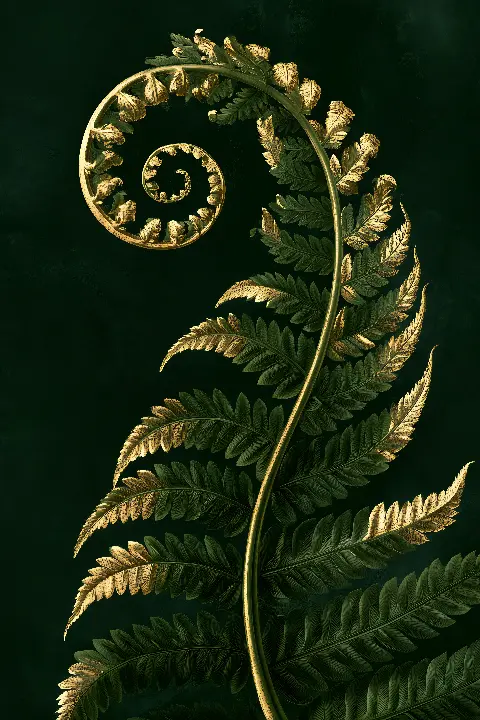
Let the picture choose the frame. The Eternal Kiss, two lovers wrapped in one gold, orange and black mosaic cloak, looks rich in a slim gold frame. The Golden Fern, a tall frond curling into a gold fiddlehead on deep forest green, suits dark wood or black. The Emerald Lily, a woman in an emerald hood breathing in a white lily before a gold halo, works well with a cream mount that echoes the lilies behind her.
Glass protects the paper but reflects light; acrylic is lighter and safer over beds and in children's rooms. For dark pictures in bright rooms, non-reflective glazing is worth considering.
Each download includes a Frame TV version as well as the print file, so the same picture can be shown on a television in art mode when nobody is watching. That makes a piece of printable wall art two things at once: a framed print in one room, a screen image in another. The Golden Crescent, a clean gold arc in a near-black sky above engraved clouds, works equally well on paper above a bed and on a screen in the living room.
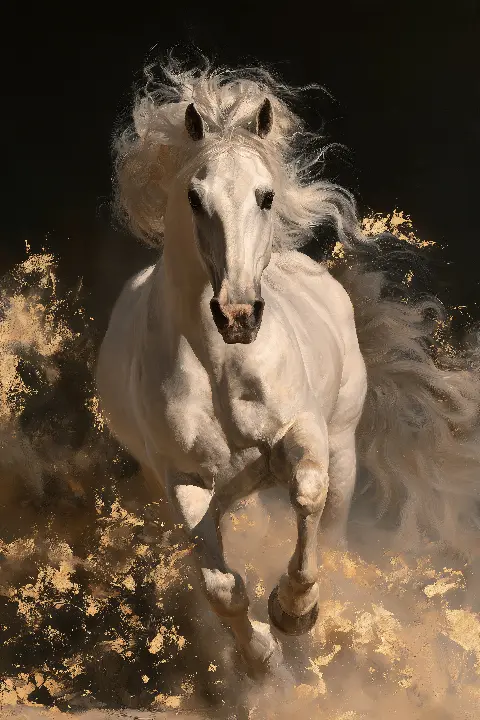
If you would rather not print at all, printed versions of the works are available on the site. The White Stallion, galloping straight out of the darkness with gold leaf flying around its legs, shows how a picture can suit either route: a large finished print for a corridor or study, or a file you print yourself at exactly the size your wall needs.
Nine printable downloads in gold, each with a high-resolution print file and a Frame TV version included.




That depends on the file. The portrait files here measure 7168 × 10752 px, which prints sharply at 300 pixels per inch to about 60 × 90 cm. Smaller sizes in the same 2:3 ratio, such as 40 × 60 or 20 × 30 cm, print without cropping.
Yes. Take or send the original file, ask for it to be printed without cropping or stretching, and choose the paper. High-street print shops handle small sizes well; for large prints a photo lab or fine art printer usually gives deeper blacks and truer colour.
Matte fine art paper suits dark backgrounds because it does not reflect light. Satin or lustre paper makes bright colours look richer. Textured watercolour paper suits soft, airy designs. If in doubt, print a small test on two papers and compare them in your room.
Screens shine light through the image, while paper only reflects it, so prints always look slightly darker and less brilliant. Ask the printer for a test strip, judge prints in daylight, and avoid turning the screen brightness up when comparing colours.
Tell me the room and what you want it to feel like. I will send three works that fit, and a mock-up of each one in place.
Write to meThis site uses cookies for Google Analytics and Google Ads so I can see which pages and ads bring visitors. Nothing is sold or shared beyond that. Privacy