
Horse Wall Art in Gold
The Little Foal
Horse Art Print in Gold
from €9.99
GUIDES · IN THE ROOM
A nursery changes quickly, but the pictures on its walls can stay. Choose soft colours, gentle subjects and secure fixings, and the same works will still feel right when the cot has become a bed.
Most nursery wall art is bought for a baby and outgrown within two or three years. The alternative is to choose pictures that are gentle without being babyish: animals, moons, birds and flowers drawn with care, the kind of subject a five-year-old still loves and a teenager does not have to take down. Subjects from art history help, because they were never made for one age.
The Little Foal is a good example. Two grey-white horses lower their heads over a small white foal, their necks forming an arch that shelters it, with a pale grey-blue mist behind and faint flecks of gold drifting like dust in morning light. It is tender, but it is a painting, not a cartoon, and it will sit as easily above a teenager's desk as above a changing table.
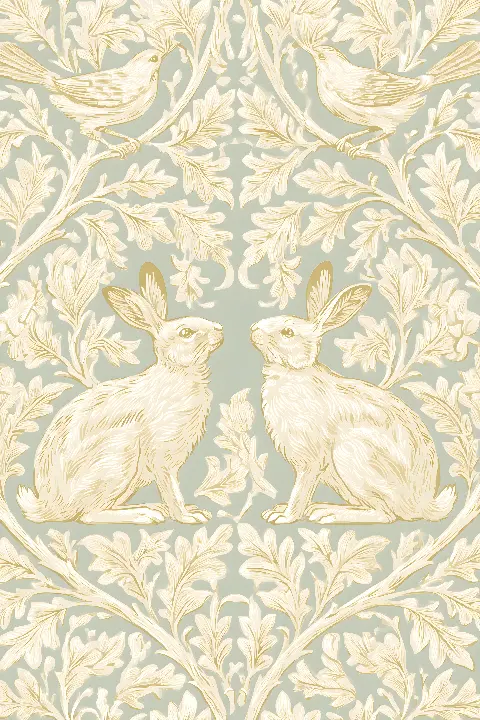
Pale walls in sage, cream, powder blue or soft grey are the usual nursery choices, and the pictures should stay close to them. Brother Rabbit in Gold works almost tone on tone: two cream hares face each other in mirror image among leaves and small birds on a pale sage ground, so the animals appear only as you look, and the birds after them. William Morris designed the pattern in the early 1880s and named it after the Brer Rabbit stories, which he loved.
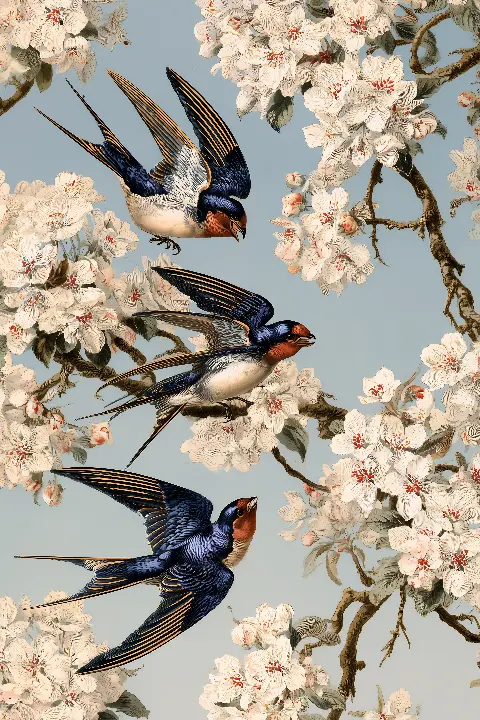
Gender-neutral nurseries suit greens, creams and gold particularly well. Swallows in Blossom adds a little more colour without turning loud: pink and white apple blossom frames an open patch of pale blue sky where three barn swallows fly, their rust-red faces and forked tails pointing in different directions, so a child's eye can chase them round the picture.
Keep strong contrast for one picture at most. A room of soft tones with one darker work, such as a night sky, has a focus; a room full of bright primaries rarely feels calm.
Night pictures belong naturally in a room built around sleep. The Golden Crescent is the simplest: a smooth arc of gold with no face and no ornament, its horns turned up to the right, set among small stars and four-pointed sparkles, with soft engraved clouds billowing up from the bottom edge.
Catching the Moon tells a story a child can follow. A lone figure stands in a small boat on clouds lit gold from below, drawing a fishing line up towards a full golden moon. Folk tales in many countries tell of people trying to catch the moon, usually with affection rather than mockery, and the picture invites the same bedtime question: will they manage it?
The Sky Whale is the picture-book choice. A whale made of soft golden light glides through the clouds above a sleeping seaside town, warm light in its small windows, while a shaft of gold falls from the sky above. It is read slowly, from top to bottom, like a page in a story.
Animals are the subject children name first, so a nursery with two or three of them always offers something to point at. The Goldfinch and Thistle has the look of an old natural history page: a little goldfinch with a red face, black-and-white head and yellow wing bars clings to a tall thistle stem, and one of the flower heads has turned to gold.
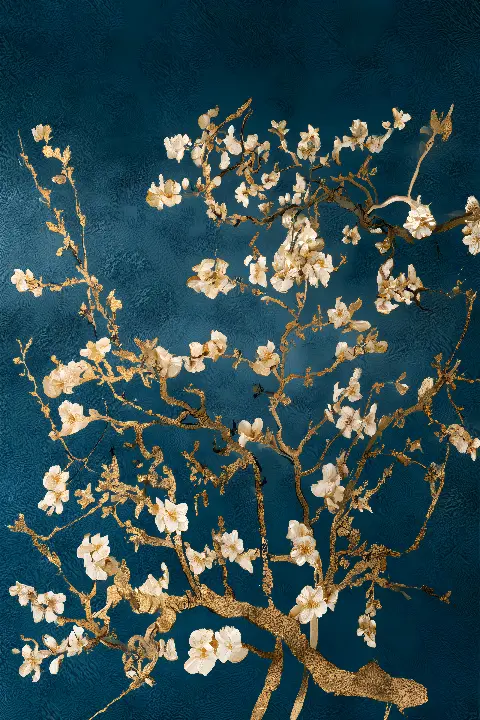
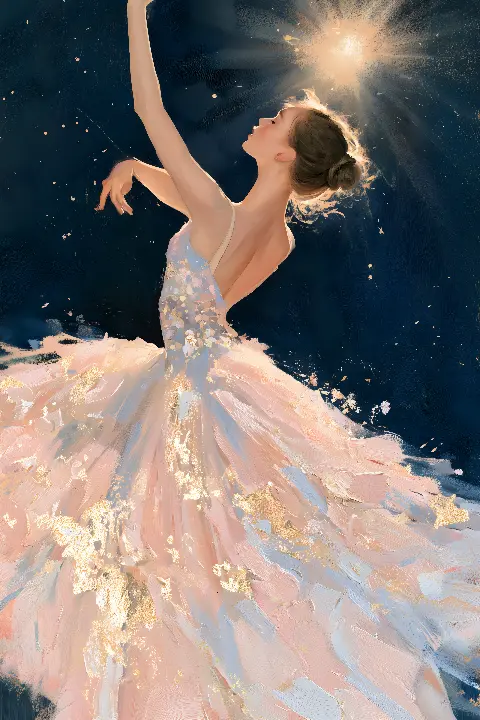
For a room that leans towards ballet, The Golden Ballerina shows a Degas-inspired dancer leaning back with one arm raised towards a burst of light, her pink and white tutu flecked with gold against deep navy. Golden Almond Blossom carries a story of its own: Van Gogh painted Almond Blossom in Saint-Rémy in February 1890 as a gift for his newborn nephew, and this version keeps the white and cream flowers on deep teal while turning the branches gold. As nursery wall art for a new baby, it is hard to think of a more fitting picture.

Many parents prefer not to hang anything heavy directly above the cot. If you do want a picture there, keep it light, choose acrylic glazing instead of glass, fix it with two screws or security hooks rather than a nail, and place it high enough that a standing toddler cannot reach it. Often the better spot is the wall opposite the cot or above a chest of drawers, where the picture can be seen from the feeding chair.
Think about two eye levels when hanging nursery wall art. Adults see the room from standing height and from the chair; a small child sees it from the floor. A low row of small frames along one wall, out of reach but at a child's eye height, gives them pictures of their own, while one larger work at adult height anchors the room.
Keep frames away from radiators and from windows with blind cords, and avoid anything with loose parts or a hanging wire that small hands could pull.
Nurseries are usually small rooms, so sizes stay modest: 30 × 40 or 40 × 50 cm above a chest of drawers, a matching pair above a changing table, and up to 50 × 70 cm on the main wall. These works are all printable downloads, and because the portrait files are 7168 × 10752 px, they will print sharply right up to about 60 × 90 cm when the child moves to a bigger room.
That is the advantage of a file for nursery wall art: print it small now and larger later. A Frame TV version comes in the same download, and printed versions can be ordered on the site.
Foals, hares, birds, moons and a whale in the clouds: nine gentle works in soft colours that suit a baby's room and still suit it years later.



Ideally nothing heavy. If you want a picture there, choose a light frame with acrylic glazing, fix it with two screws or security hooks, and hang it out of reach of a standing toddler. The wall opposite the cot is often the better place for the main picture.
Soft greens, creams, powder blue and blush suit most nurseries, and gold adds warmth without glare. One darker picture, such as a night sky, gives the room a focus. Filling every wall with strong primary colours rarely feels calm.
Usually 30 × 40 to 50 × 70 cm, because nurseries tend to be small. Use smaller pairs above a changing table or a chest of drawers and one larger work on the main wall. The files print sharply up to about 60 × 90 cm later on.
Choose by subject and colour rather than by theme. Animals, birds, moons and gentle landscapes in sage, cream and gold suit any child, and works such as The Little Foal or Brother Rabbit in Gold stay lovely as the child grows.
Tell me the room and what you want it to feel like. I will send three works that fit, and a mock-up of each one in place.
Write to meThis site uses cookies for Google Analytics and Google Ads so I can see which pages and ads bring visitors. Nothing is sold or shared beyond that. Privacy