Golden Masters
Golden Starry Night
Van Gogh Reimagined in Gold
from €9.99
GUIDES · ARTISTS
Starry skies, sunflowers and almond blossom, painted in a few restless years in the south of France. Here is the story behind his most loved pictures and how to choose and hang one well.
A Van Gogh print usually shows something painted in the last three years of a short career. Vincent van Gogh was born in Zundert in the Netherlands in 1853 and died at Auvers-sur-Oise, north of Paris, in 1890. He began painting seriously only around 1880, and in roughly ten years produced some 860 oil paintings, selling very few in his lifetime.
In Paris, between 1886 and 1888, his palette brightened and he collected Japanese woodblock prints, whose flat colour and bold outlines stayed with him. In February 1888 he moved to Arles in Provence, and from May 1889 he lived at the asylum in Saint-Rémy. Almost every picture people now hang at home comes from those two places.
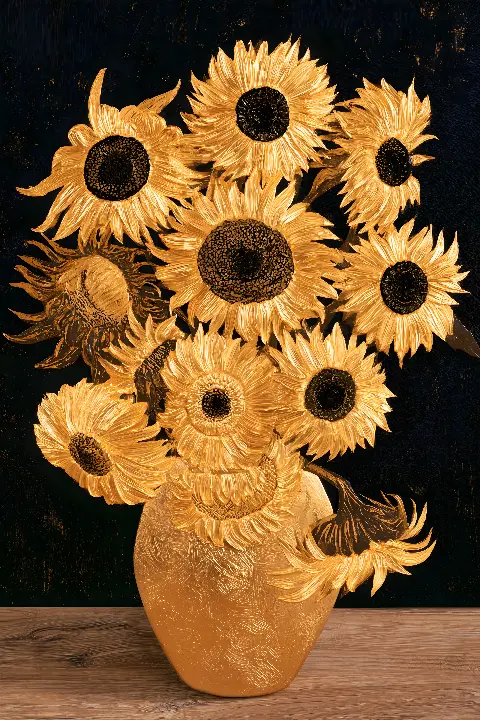
In August 1888 Van Gogh painted his large sunflower still lifes to decorate the room where Paul Gauguin would stay. Golden Sunflowers keeps the heavy heads at different heights, some facing out and some drooping, and sets them in a gilded vase on a dark table against deep black, so every gold petal stands out sharply.
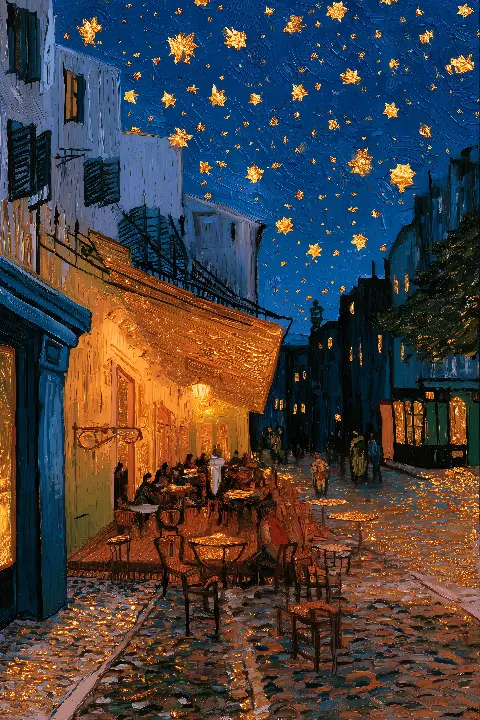
A month later he painted Café Terrace at Night on the spot, in a square in Arles, his first starry sky. The canvas is now in the Kröller-Müller Museum in the Netherlands. Golden Café Terrace at Night keeps the strong diagonal: a warm orange awning on the left, gold-flecked cobbles sloping away, and a deep ultramarine wedge of sky crowded with gold stars. In a letter to his sister he was pleased to have painted a night picture without any black.
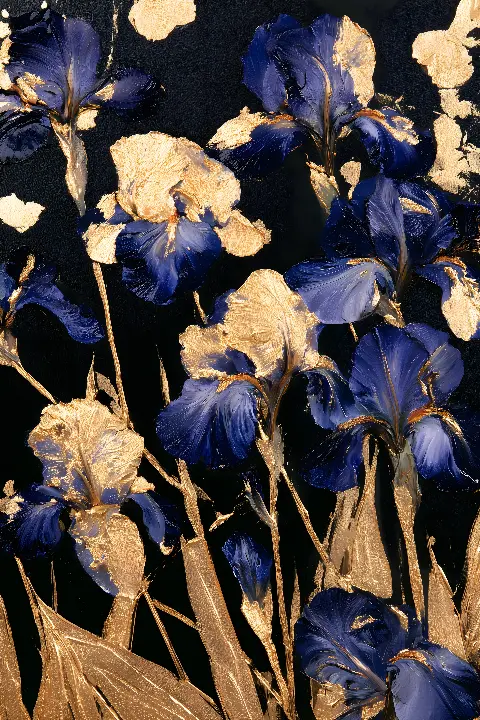
Irises was painted in May 1889, soon after he arrived at the asylum, from the flower beds in its garden; it is now at the Getty Museum in Los Angeles. Golden Irises crowds tall stems almost to the top of the frame, alternating deep violet-blue and pale gold flowers, with upright gold leaves giving a strong vertical rhythm.
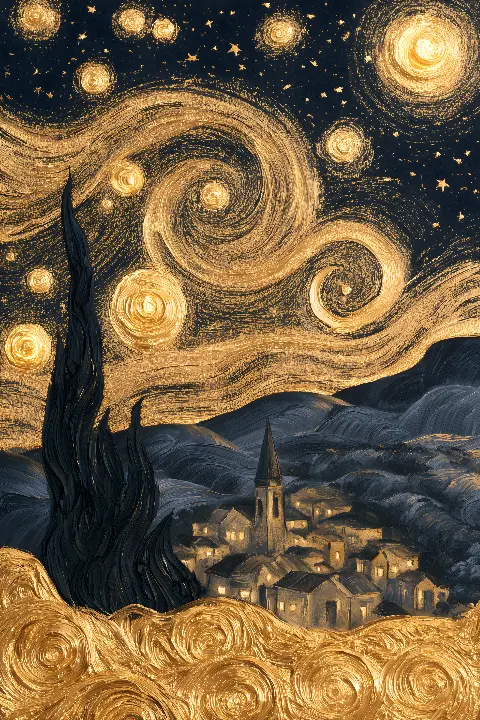
The Starry Night followed in June 1889, based on the view from his window before sunrise, with the village added from memory. It hangs in the Museum of Modern Art in New York. Golden Starry Night reduces it to gold and navy: rolling swirls, stars inside rings of glow, and a dark cypress rising like a flame on the left.
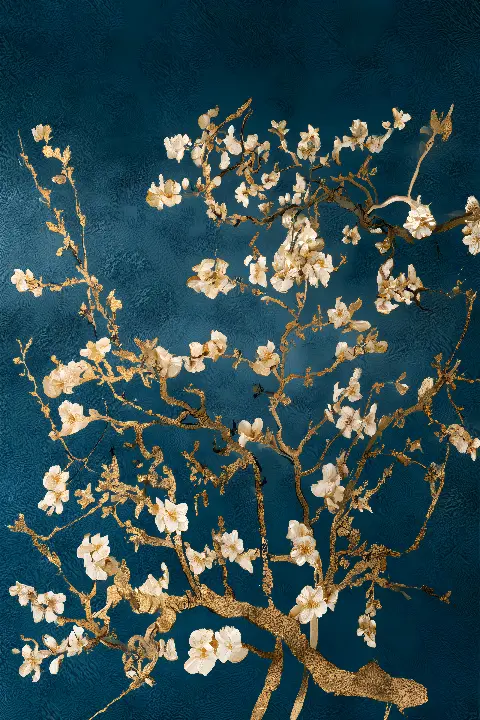
In February 1890 he painted Almond Blossom for his newborn nephew; the canvas is in the Van Gogh Museum in Amsterdam. Golden Almond Blossom spreads thin gold-brown twigs and white and cream flowers across deep teal, with no trunk in sight. Golden Wheatfield with Cypresses completes the group, a tall cypress beside a field of warm gold under curling clouds.
Start with the ground colour, because it sets the mood more than the subject. Navy and black grounds, as in the night sky and the sunflowers, give a living room or a study depth in the evening. Teal and blossom feel fresh and suit a bedroom or a nursery. The café terrace, with its lamplight and tables, belongs where people gather, in a dining room or a kitchen.
Think about direction too. The cypress and the irises lead the eye upwards, so they suit tall, narrow walls between windows or along a staircase. The almond branches spread sideways and are calmer above a bed or a desk. Two works from the same year, such as the irises and the starry night, make a natural Van Gogh print pair.
Van Gogh painted with thick impasto, and part of the pleasure of his pictures is the ridged paint. A flat print has no relief, but our gold versions are drawn so that the swirls and petals look raised, and a matte, slightly textured cotton paper helps a Van Gogh print read that way. Glossy paper makes the gold look like foil.
Every work is a printable download. The portrait files at 7168 × 10752 px print sharply to about 60 × 90 cm, printed versions are available on the site, and each download includes a Frame TV version. For framing, a slim black or dark walnut frame suits the night scenes, while light oak flatters the blossom.
Place the centre of the frame about 145 to 150 centimetres from the floor. Above a sofa, leave 20 to 25 centimetres between the back of the seat and the bottom of the frame, and aim for about two thirds of the sofa's width, usually with two or three prints side by side, since a single portrait print is at most about 60 cm wide.
Gold responds to angled light. A wall lamp or picture light from one side makes the swirls in the sky shimmer; strong direct sun from a window opposite flattens them and fades paper over time. If the wall faces a window, choose non-reflective glazing.
Starry skies, sunflowers, irises and almond blossom from Arles and Saint-Rémy, retold in gold leaf on deep grounds.

Van Gogh's The Starry Night, painted in June 1889 at Saint-Rémy, hangs in the Museum of Modern Art in New York. It has been in the collection there since 1941.
Yes. Van Gogh died in 1890, so his paintings have been in the public domain for many decades. Our works are reimagined in gold after his compositions, keeping his designs while changing the colours, the ground and the material.
Golden Almond Blossom is a gentle choice, with white flowers on calm teal; Van Gogh painted the original to celebrate a new baby. For a darker, cosier bedroom, Golden Starry Night works well above the bed.
Aim for roughly two thirds of the sofa's width. For a typical three-seat sofa of about 200 centimetres, that means a group around 130 centimetres wide, such as two 60 by 90 centimetre prints hung side by side with a narrow gap.
Tell me the room and what you want it to feel like. I will send three works that fit, and a mock-up of each one in place.
Write to meThis site uses cookies for Google Analytics and Google Ads so I can see which pages and ads bring visitors. Nothing is sold or shared beyond that. Privacy