GUIDES · ARTISTS
Van Gogh’s Starry Night and Sunflowers: the stories behind the paintings.
Vincent van Gogh painted almost all of his famous pictures in less than three years, in the south of France. Here is what was happening when he painted The Starry Night, the Sunflowers and the others.
A painter for ten years
Vincent van Gogh (1853–1890) was born in the Netherlands, the son of a pastor. He worked for an art dealer, as a teacher and as a lay preacher before deciding, at twenty-seven, to become an artist. In the ten years that followed he made around 850 paintings and more than a thousand drawings — and sold almost none of them in his lifetime.
We know an unusual amount about how he worked, because he wrote constantly, above all to his younger brother Theo, an art dealer in Paris who supported him. More than 800 of his letters survive. They are full of colour: what he is painting, which pigments he needs, why yellow matters to him.
Arles and the Sunflowers
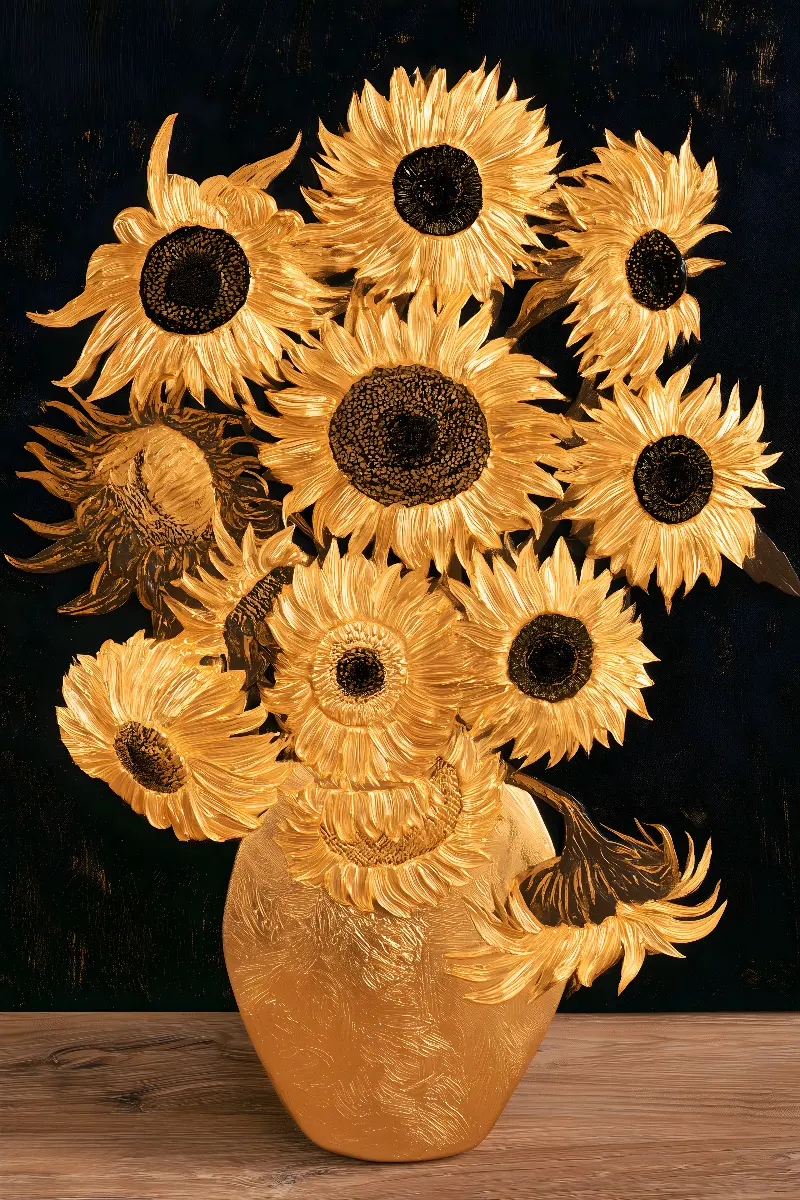
In February 1888 Van Gogh left Paris for Arles in Provence, looking for southern light and colour. He rented the Yellow House and dreamed of a studio of the south, where artists would work together. When Paul Gauguin agreed to join him, Van Gogh painted a series of Sunflowers in August 1888 to decorate Gauguin’s room.
The sunflowers are painted at every stage of life, from fresh flowers to drooping, seed-heavy heads, in a few shades of yellow against yellow or blue. The yellow came largely from chrome yellow, a modern pigment that was bright and cheap — and has darkened slightly over time. He painted four versions that August and three more repetitions in January 1889; today they hang in London, Amsterdam, Munich, Philadelphia and Tokyo, one is in a private collection, and one was destroyed in Japan during the Second World War.
The Night Café and the café terrace
Arles also gave him night. In September 1888 he painted The Night Café, an all-night café near the station, where, he wrote, he tried to express “the terrible passions of humanity” with red and green. The same month he painted Café Terrace at Night, with a blue sky full of stars above a lamp-lit yellow terrace — his first painting of a starry sky — and soon after Starry Night over the Rhône, with the gas lights of the town reflected in the river.
Gauguin arrived in October. The two months together ended in December 1888 with a crisis in which Van Gogh cut off part of his own ear. In May 1889 he entered the asylum of Saint-Paul-de-Mausole in Saint-Rémy-de-Provence of his own will.
The Starry Night
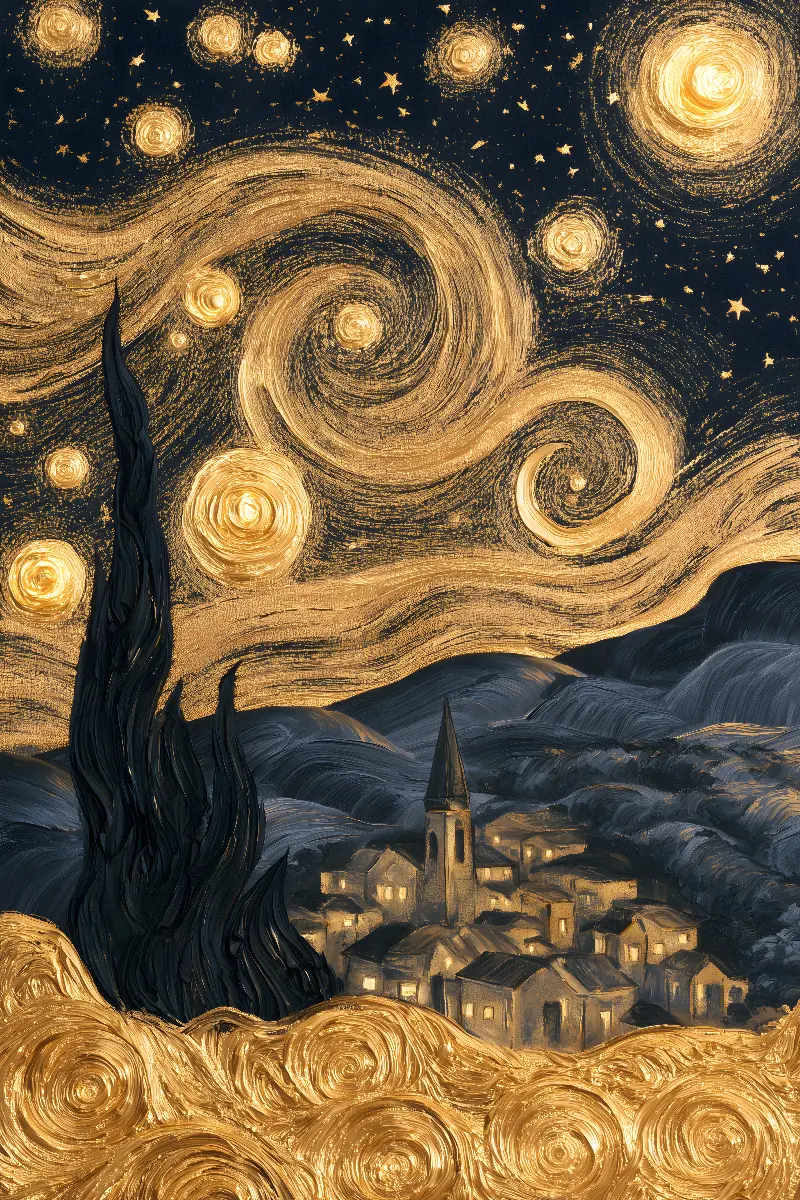
From his room at Saint-Rémy, Van Gogh could see the fields and the Alpilles hills to the east. In June 1889 he painted the view before sunrise: a swirling sky, the morning star, a crescent moon, a dark cypress like a flame in the foreground — and a small village with a church spire that was not actually visible from his window, added from memory and imagination.
He was not entirely happy with it; in his letters he called it a study. Today The Starry Night is one of the most recognised paintings in the world, at the Museum of Modern Art in New York since 1941. The movement of the sky — the spirals, the halos round the stars — is what makes it unforgettable: a night that is alive.
Irises and Almond Blossom
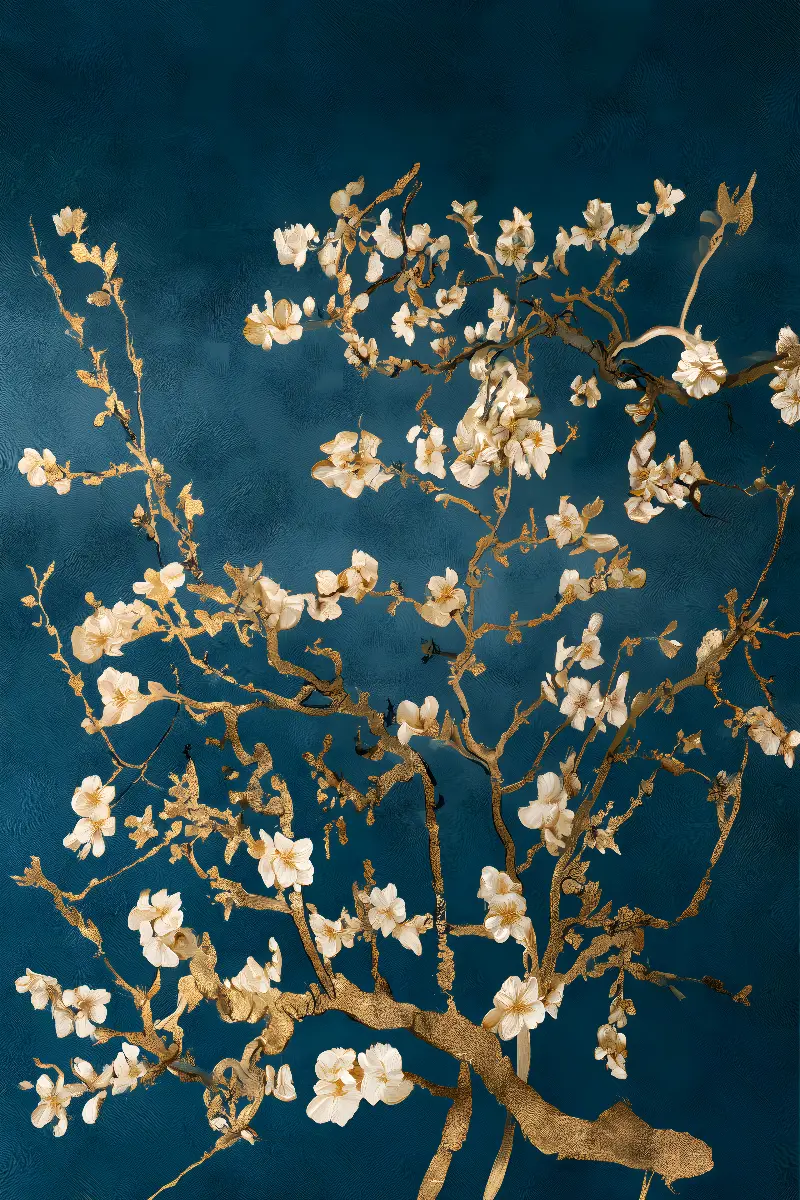
The garden of the asylum gave him Irises (1889), painted in his first week there: a field of blue-violet flowers with one white iris, cut off at the edges of the canvas like a Japanese print. In February 1890, when Theo’s son was born and named Vincent after him, Van Gogh painted Almond Blossom for the baby’s parents: white blossom on twisting branches against a clear blue sky, a symbol of new life. The family kept it, and it now hangs in the Van Gogh Museum in Amsterdam.
He moved to Auvers-sur-Oise near Paris in May 1890 and died there in July, at thirty-seven.
Van Gogh in gold
The Golden Masters collection reimagines these pictures with raised gold leaf: Golden Starry Night, Golden Sunflowers, Golden Irises and Golden Almond Blossom, plus Golden Christmas Eve, a snowy village in his style for the Christmas in Gold collection. Van Gogh’s works have long been in the public domain.
Gold suits him: he talked constantly about yellow as the colour of sunlight and warmth, and leaf catches the light the way his thick paint does.
Questions
Where is Van Gogh’s The Starry Night?
At the Museum of Modern Art (MoMA) in New York, since 1941. Van Gogh painted it in June 1889 at the asylum in Saint-Rémy-de-Provence.
Why did Van Gogh paint sunflowers?
He painted them in Arles in August 1888 to decorate the room of his friend Paul Gauguin, who was coming to live and work with him. He saw yellow as the colour of light, warmth and friendship.
How many paintings did Van Gogh sell?
Very few — traditionally only one is documented as sold during his lifetime, The Red Vineyard, although he exchanged and gave away many works. He made around 850 paintings in about ten years.
What are Van Gogh’s most famous paintings?
The Starry Night, Sunflowers, Café Terrace at Night, The Night Café, Irises, Almond Blossom, The Bedroom and his self-portraits.
For a wall you're responsible for.
Tell me the room and what you want it to feel like. I will send three works that fit, and a mock-up of each one in place.
Write to me