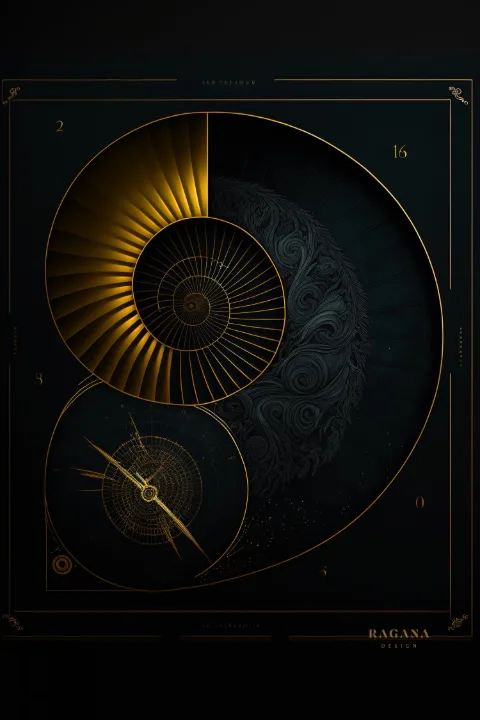
Golden Fibonacci
The Chronos Compass
Navigating the Golden Eternity
from €9.99
GUIDES · GOLDEN RATIO
One, one, two, three, five, eight: a simple rule of addition gives a ratio, a spiral and a whole family of images. Here is how the maths works and how it turns into art for your walls.
Fibonacci art is art built on the Fibonacci sequence or on the shapes that come from it: the golden rectangle, the spiral drawn through a grid of squares and the golden ratio of about 1.618. Sometimes the numbers appear openly, as labels and construction lines; sometimes they are hidden in the proportions, deciding where a curve turns or where a shape sits on the sheet.
Its appeal is that it joins two things people rarely see together: strict mathematics and organic form. The same rule that produces a list of numbers also produces a curve that looks like a shell, a fern or a breaking wave. A well-made Fibonacci print lets you see both at once, the order and the growth.
The sequence starts with 1 and 1, and each number after that is the sum of the two before it: 1, 1, 2, 3, 5, 8, 13, 21, 34, 55 and onwards. It is named after Leonardo of Pisa, later known as Fibonacci, who described it in his book Liber Abaci in 1202 as the answer to a puzzle about breeding rabbits. Indian scholars had found the same numbers centuries earlier while counting the rhythms of Sanskrit verse.
The interesting part comes when you divide each number by the one before it. 5 ÷ 3 is about 1.667, 8 ÷ 5 is 1.6, 13 ÷ 8 is 1.625 and 21 ÷ 13 is about 1.615. The results swing back and forth and close in on 1.618, the golden ratio, usually written with the Greek letter phi. The further along the sequence you go, the smaller the difference becomes.
Draw two small squares side by side, then a square of side 2 against their long edge, then 3, 5, 8 and so on, each new square laid against the rectangle you have so far. The rectangle grows towards the golden proportion. Now draw a quarter circle across each square, corner to corner, and a smooth curve appears: the Fibonacci spiral. It is a very close approximation of the true golden spiral, a logarithmic spiral that widens by a factor of 1.618 with every quarter turn.
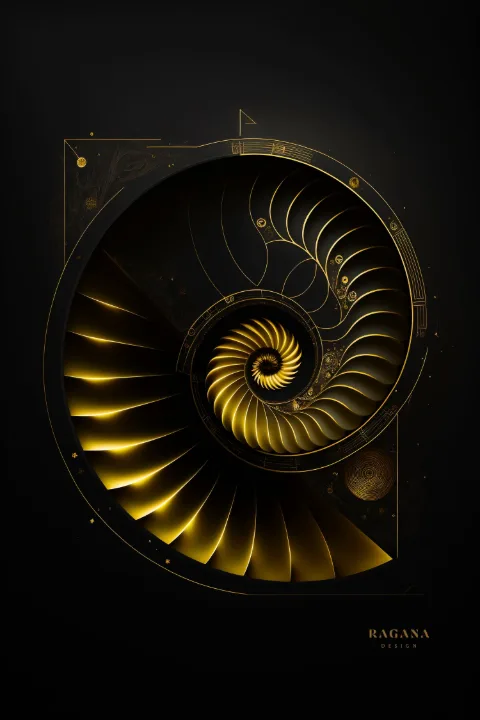
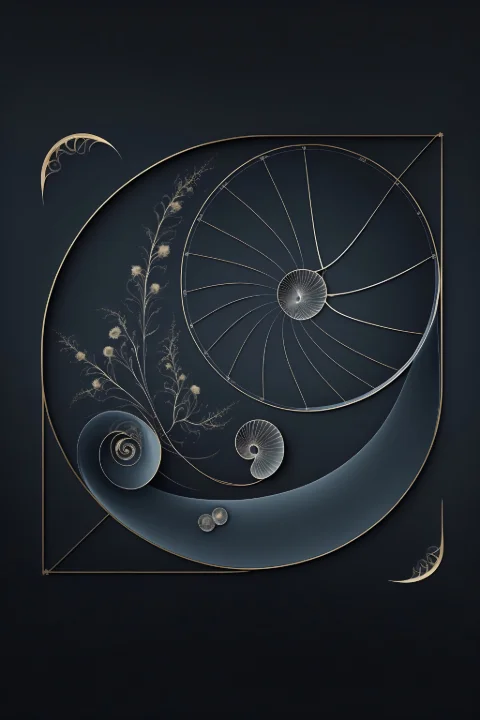
Minimalist Fibonacci shows that construction almost bare. Thin hairlines divide a blue-black sheet into nested rectangles, and a fine spiral in silver and slate blue unwinds through them, beside a pair of tiny shells and a leafy sprig touched with gold. The Golden Aperture keeps the scaffolding faint and lets the result shine: a nautilus seen side-on, mostly black, its chambers lit gold from within, each a little larger than the last.
Nature supplies much of Fibonacci art's imagery, and plants are where the sequence turns up most reliably. In sunflower heads, pine cones and pineapples, seeds and scales sit in two sets of spirals, and the counts are usually neighbouring Fibonacci numbers such as 21 and 34 or 34 and 55. The reason is packing: each new seed appears at roughly 137.5 degrees from the last, the golden angle, which fills the space without gaps. The Sovereign Garden draws that pattern out, a gold spiral ring with fine lines radiating like the ribs of a seed head and small shells and gold leaves gathered at the lower left.
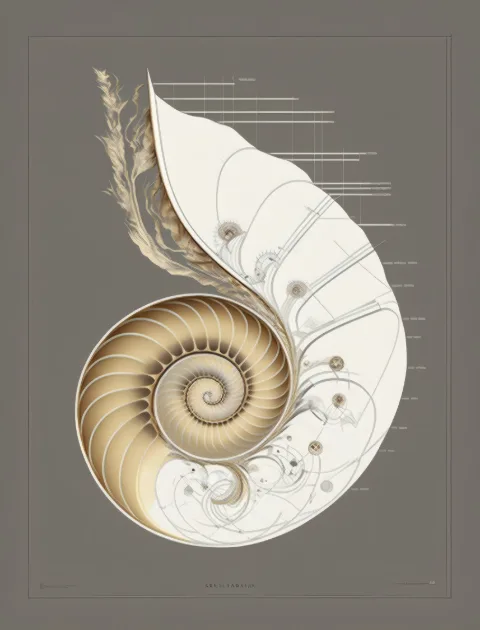
Shells are more complicated. The nautilus grows in a logarithmic spiral, keeping its shape as it gets bigger, but measurements show that its spiral is usually not the golden one. The golden nautilus has stuck anyway, and in Fibonacci art the shell works as an emblem rather than a measurement. The Luminescent Nautilus glows turquoise around a gold core, with a smaller translucent shell curling beneath it, and The Imperial Nautical Schematic sets a pale nautilus over a faint nautical chart, its upper whorl opening into a feather.
Artists and architects have used the sequence as a working tool for a long time. In the 1940s Le Corbusier developed the Modulor, a system of human-scaled measurements built on the golden ratio and a Fibonacci-like series. From about 1970 the Italian artist Mario Merz set Fibonacci numbers in neon on walls, igloos and gallery spaces, turning the sequence itself into the work.
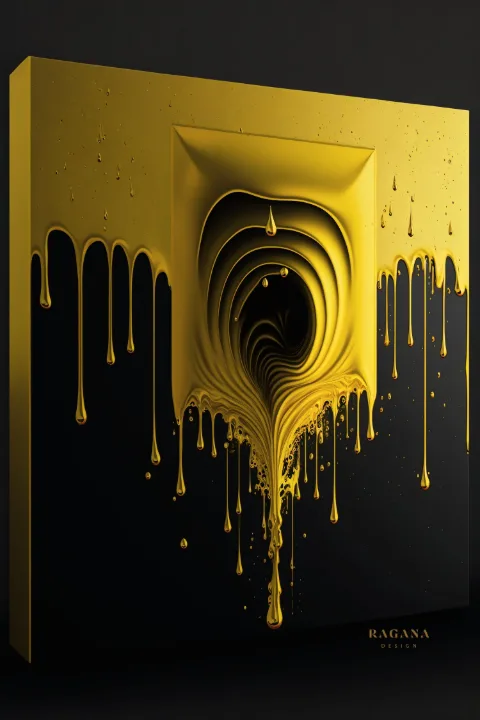
Today Fibonacci art ranges from strict geometry to free, ornamental forms that use the grid as a hidden frame. The Celestial Fountain is a gold fan-shell rising and spilling back in droplets on black, with a small palm motif at its centre. The Golden Flame climbs almost the full height of the sheet with a teal-and-gold feather at its core. The Gilded Portal turns the proportion into architecture, a gold panel whose stepped hollow turns inward while thick runs of gold drip onto the black below.
With Fibonacci art, decide first how much of the mathematics you want to see. Diagram-like pieces with grids and numbers suit studies, offices, clinics and modern living rooms, where they read as calm and exact. The Chronos Compass sits in the middle ground: a half-gold circle with a ribbed spiral turning through it rests over a dark dial, with the small numbers 2 and 16 in the corners like references on a technical sheet. Freer pieces, where the spiral becomes a flame, a fountain or a doorway, suit hallways and dining rooms, where a bright form on black gives the wall a focal point.
The proportion can guide the hanging too. Instead of centring a print on a long wall, try placing its centre about 38 percent of the way along, the golden section of the width. All of these works come as printable downloads: each portrait file, 7168 × 10752 px, prints sharply to about 60 × 90 cm, and a Frame TV version is included with every download.
Spirals, shells, flames and gateways drawn on the Fibonacci grid, from strict geometry to free ornament.



Fibonacci art is artwork based on the Fibonacci sequence, in which each number is the sum of the two before it, or on the shapes it produces: the golden rectangle, the Fibonacci spiral and the golden ratio of about 1.618.
Not quite. The Fibonacci spiral is drawn from quarter circles in squares of Fibonacci sizes, so its curvature changes in steps. A golden spiral is a smooth logarithmic spiral that widens by 1.618 every quarter turn. At any visible size they look almost identical.
The nautilus grows in a logarithmic spiral, but careful measurements show it is usually not a golden spiral. It remains a popular symbol in Fibonacci art because it shows how a form can grow while keeping exactly the same shape.
Geometric, diagram-like prints suit studies, offices, clinics and calm living rooms. Bolder pieces with a bright form on black make a strong focal point in a hallway or dining room. Try placing the print at the golden section of a wall rather than dead centre.
Tell me the room and what you want it to feel like. I will send three works that fit, and a mock-up of each one in place.
Write to meThis site uses cookies for Google Analytics and Google Ads so I can see which pages and ads bring visitors. Nothing is sold or shared beyond that. Privacy