
Golden Masters
Golden Water Lilies
Monet Reimagined in Gold
from €9.99
GUIDES · ARTISTS
Claude Monet painted light more than things. From a hazy harbour at dawn to the lily pond he dug himself, here is what lies behind his pictures and how to bring one into a room.
A Monet print brings a particular kind of calm into a room, and it starts with one hazy harbour. Claude Monet was born in Paris in 1840 and grew up in Le Havre on the Normandy coast, where the painter Eugène Boudin encouraged him to work outdoors. Painting in the open air, fast, before the light changed, became his method for the rest of his life.
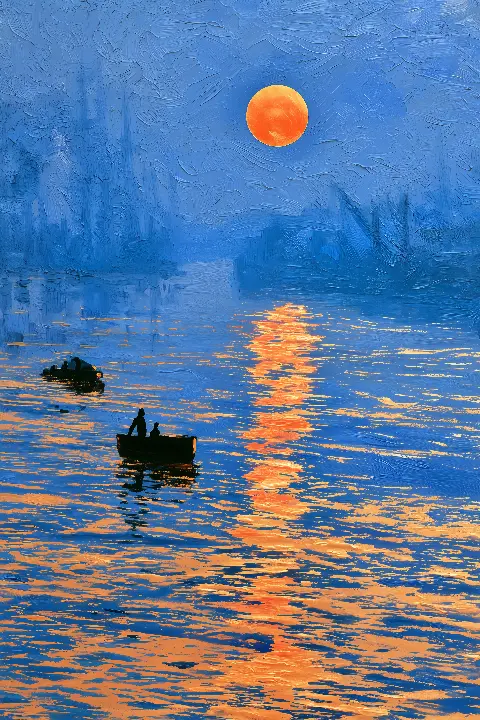
In 1872 he painted the port of Le Havre at dawn and called it Impression, Sunrise. Shown in Paris in 1874 at the first independent exhibition of the group, the title gave a mocking critic his word, and the painters took it as their name. The canvas is now in the Musée Marmottan Monet in Paris.
Golden Impression, Sunrise keeps the structure of that morning. Almost everything is blue haze, a small orange sun hangs near the top right, and its reflection trembles down the water in short strokes of orange and gold towards two small dark rowing boats.
In 1873, living at Argenteuil just outside Paris, Monet painted a field of poppies with a woman and child walking through the grass; it was shown at the same 1874 exhibition and is now in the Musée d'Orsay. Golden Poppy Field turns the red flowers to rose gold and peach, set down as dense dabs beneath a low horizon and a cream sky flecked with gold.
He painted figures with parasols against the sky in 1875 and again in 1886. Golden Woman with a Parasol takes the low viewpoint: a woman in a long pale cream dress on a grassy hill, her gold parasol tilted left and her skirt lifting in the wind.

In 1883 Monet moved to Giverny, a village in Normandy, and spent the rest of his life shaping its garden. He diverted a small stream to make a pond, planted water lilies and built an arched wooden footbridge in the Japanese style, inspired by the woodblock prints he collected. From 1899 he painted the bridge again and again, and the pond became his main subject until his death in 1926.
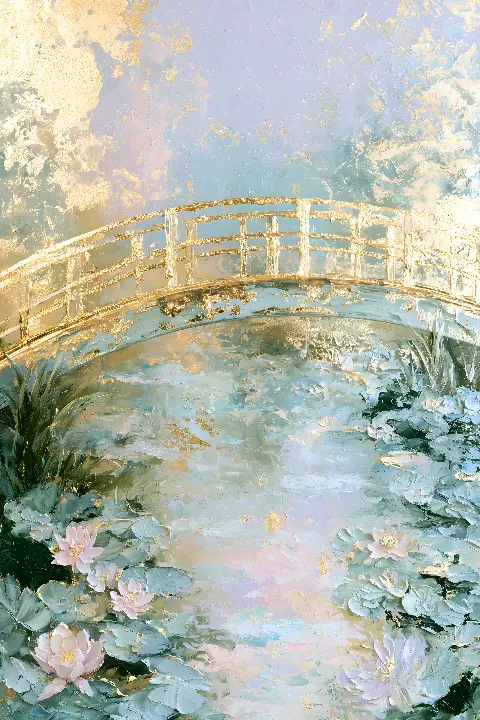
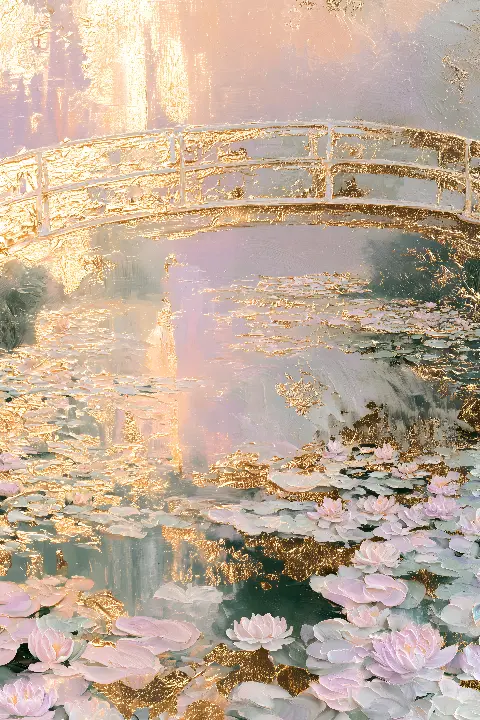
The Golden Bridge at Giverny shows the arch as a clear gold curve rising out of a haze of mint, lilac and blush. Blush Bridge at Giverny is its warmer partner, with pink lilies in the foreground and rose and violet light lying on the water. Golden Water Lilies goes dark instead: jade and gold pads on almost black green water, crossed by three vertical shafts of gold light.
The late water-lily canvases grew huge and lost the horizon altogether. The great panels at the Musée de l'Orangerie in Paris surround the visitor with water.
Monet's soft edges and low contrast make his pictures easy to live with, which is why they work so well in bedrooms and bathrooms. A pastel bridge suits a bedroom painted in sage, lilac or warm white. The dark lily pond is calm in a different way, cool and evening-like, and fits a bathroom with dark tiles or a reading corner.
If the room has a view of greenery, let the Monet print echo it. Golden Poppy Field brings a summer meadow to a north-facing room that never gets much sun. The harbour at sunrise, with its grey-blue haze, settles well over a sofa in a living room with navy or terracotta accents.
Impressionist pictures are made to be seen from a few steps away, where the separate strokes merge into light. A small Monet print viewed from the sofa loses that effect, so go larger than you think. Stand where you will usually see it from, a sofa or a bed, and judge the size from there rather than up close at the wall. Every work is a printable download; the portrait files at 7168 × 10752 px print sharply to about 60 × 90 cm, and printed versions are available on the site.
For a pair, the two bridges belong together: one cool, one warm, the same arch in different light. Hang them with six to eight centimetres between frames and treat them as one unit when you measure the wall. Each download also includes a Frame TV version.
Pale oak, white or soft gold frames suit a pastel Monet print; a slim black frame gives the dark water lilies a crisp edge. Add a mount if the wall is busy; in a bright room, a pale mount helps the soft colours hold their own against the paint. Hang the centre at about 145 to 150 centimetres from the floor, lower in a room where people mostly sit.
Keep prints out of direct sun, which fades paper and flattens gold. A warm lamp to one side in the evening does what Monet chased all his life: it changes the light on the picture as the hours pass.
The harbour at dawn, a windy hill, a poppy field and the bridge and lilies of Giverny, in gold and soft pastels.

Monet's Impression, Sunrise of 1872, a view of the harbour at Le Havre at dawn. A critic used its title to mock the 1874 exhibition, and the name stuck. The painting is in the Musée Marmottan Monet in Paris.
Many museums hold them, but the most famous are the large panels at the Musée de l'Orangerie in Paris. His garden at Giverny, where he created the pond, can also be visited, and the restored garden still has its pond, footbridge and lilies.
Golden Water Lilies, with its dark green water and gold light, suits a bathroom with dark tiles. Golden Impression, Sunrise also works, calm and blue. Hang prints away from the shower and choose sealed frames in a steamy room.
Yes. The Golden Bridge at Giverny is cool, in mint and lilac, and Blush Bridge at Giverny is warm, in pink and rose. Side by side they show the same arch in two different lights.
Tell me the room and what you want it to feel like. I will send three works that fit, and a mock-up of each one in place.
Write to meThis site uses cookies for Google Analytics and Google Ads so I can see which pages and ads bring visitors. Nothing is sold or shared beyond that. Privacy