GUIDES · THE GEOMETRY
The golden ratio in music: Bartók, Debussy, the keyboard and the room.
Where the ratio has been found in music, where it was put there on purpose, and where it is a coincidence that happens to sound good. With the one example that holds up under a ruler, a keyboard that counts in Fibonacci, and the reason the “golden interval” is the most dissonant one there is.
The one example that holds up
Béla Bartók’s Music for Strings, Percussion and Celesta opens with a fugue of 89 bars. It begins pianissimo, grows in one long arc to a single fortissimo at bar 55, and falls away for the remaining 34 bars. 55 and 89 are consecutive Fibonacci numbers, 34 is the one before them, and 55 ÷ 89 = 0.618. The Hungarian analyst Ernő Lendvai noticed this in the 1950s and went on to find the same proportion in the movement’s entrances, its key changes and the number of bars between them, and then in most of Bartók’s mature music.
Two things are true at once. The climax at bar 55 is real, audible and exactly where the ratio says; and Lendvai’s larger system — in which nearly every dimension of Bartók’s music is golden — is an analysis that Bartók never confirmed, that counts bars in whichever way makes the numbers work, and that later scholars have taken apart with some care. Bartók left no note saying he used the ratio. What he left is a piece whose one great peak sits at 0.618 of its length, which is either a decision or the best coincidence in twentieth-century music. I think it is a decision, and I would not bet the house on it.
Debussy, who may have done it on purpose
The other serious case is Claude Debussy. The pianist and scholar Roy Howat measured the proportions of La Mer, Reflets dans l’eau and L’isle joyeuse and found the golden section at their structural turns — the return of a theme, the moment the texture breaks — often to the bar, and found Fibonacci numbers in the bar counts of the sections between. Debussy, unlike Bartók, left a hint: a letter about a proof-reading in which he objects that a missing bar would spoil “the divine number”. It is one sentence, and it is more than anyone else has.
Beyond these two the ground gets soft quickly. There are analyses of Mozart’s sonatas that find the exposition and the development dividing near the golden section; measured across all of them, the ratios spread from 0.5 to 0.7 and cluster where sonata form would put them anyway. Bach, Beethoven and Chopin have all been claimed, none convincingly. The test is the same as for a painting: if you have to count from a different bar each time to make the number come out, the number is yours, not the composer’s.
The keyboard, which counts in Fibonacci by accident
An octave on the piano has 8 white keys and 5 black, the black ones in a group of 2 and a group of 3; count the octave at both ends and there are 13 keys. 2, 3, 5, 8, 13: the sequence is there, and it is on every poster about the subject. It is also an accident. The numbers come from the twelve-tone equal temperament that Western music settled on in the eighteenth century — twelve semitones to the octave because twelve is the smallest number that makes the fifths and thirds come out nearly pure — and from the diatonic scale having seven notes, so that the twelve split into 7 white and 5 black. Thirteen is only reached by counting the top C twice. The keyboard is Fibonacci the way a coincidence is: exactly, and for no reason.
Intervals, and the interval that is not there
Here the story becomes interesting for the opposite reason. Musical consonance comes from simple frequency ratios: the octave is 2 : 1, the fifth 3 : 2, the fourth 4 : 3, the major sixth 5 : 3, the minor sixth 8 : 5. Two of those — 5 : 3 = 1.667 and 8 : 5 = 1.6 — are ratios of neighbouring Fibonacci numbers, which is why people say the sixths are golden. They bracket φ; neither is it. And the interval that actually is φ, a frequency ratio of 1.618 or about 833 cents, is not in the scale at all, because it is the most irrational number there is — the one hardest to approximate by any simple fraction — and an interval that no simple fraction approximates is, to the ear, the least consonant one possible. The golden ratio is not a harmony. It is the precise absence of one.
That is a useful thing to know, because it draws the line that the rest of the subject needs. Where the ratio appears in music it appears in time — in where the climax falls, where a section turns — not in pitch. Proportion is a matter of form. Harmony is a matter of small whole numbers. The two are different kinds of mathematics, and only the first is golden.
The room
The place where the ratio does honest work in music every day is the room the music is played in. A rectangular room has resonances at frequencies set by its three dimensions, and if the dimensions are in simple ratios — a cube, or 1 : 2 : 4 — the resonances pile up on the same notes and the room booms on some pitches and swallows others. Dimensions in irrational ratios spread the resonances out evenly, and 1 : 1.618 : 2.618 — height, width, length, each the golden ratio of the last — is one of the classic recommendations for a studio or a listening room, alongside a few others found by trial. It works for the same reason the golden interval sounds bad: φ is the number that keeps things from lining up.
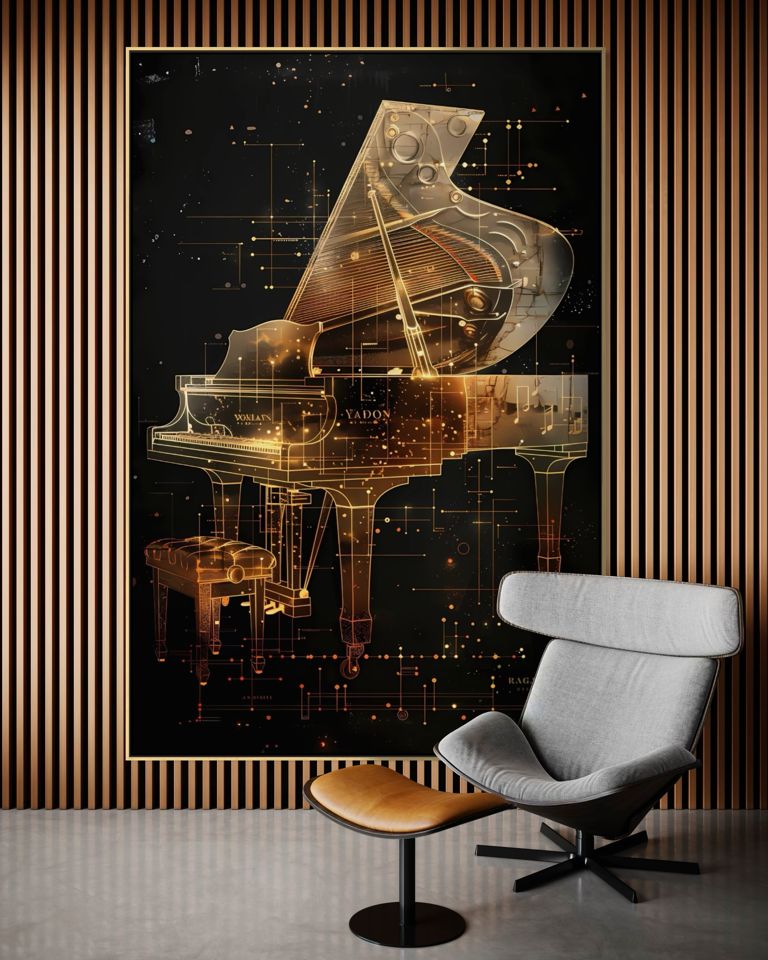
It is also why the instruments on this site are drawn the way they are. The Celestial Grand Piano, The Ethereal Golden Harp and The Golden Saxophone are blueprints — the instrument set out on the grid, the spiral through its body, the proportion in the plan rather than claimed for the sound. A music room is a good place for that kind of picture: the wall gets the geometry and the air keeps the harmony, which is the right division of labour.


Questions
Did Bartók use the golden ratio?
The fugue of Music for Strings, Percussion and Celesta has its single climax at bar 55 of 89, the golden section, and that is real and audible. The broader claim that all of Bartók’s music is built on the ratio comes from Ernő Lendvai’s analysis, which Bartók never confirmed and which later scholars have shown to depend on flexible counting.
Did Debussy use the golden ratio?
Probably, in some pieces. Roy Howat’s analysis finds the golden section at the structural turning points of La Mer, Reflets dans l’eau and L’isle joyeuse, often to the bar, and Debussy once objected to a missing bar in a proof because it would spoil “the divine number”.
Is the piano keyboard based on the Fibonacci sequence?
The numbers are there — 8 white keys, 5 black in groups of 2 and 3, 13 if the octave is counted twice — but by coincidence. They come from twelve-tone equal temperament and the seven-note diatonic scale, not from the sequence.
Is there a golden ratio interval in music?
A frequency ratio of exactly φ, about 833 cents, is not in any standard scale. Because φ is the most irrational number, it is the interval least approximated by a simple fraction, and so the least consonant. The minor sixth (8 : 5) and major sixth (5 : 3) bracket it and are consonant precisely because they are simple fractions.
What are golden ratio room dimensions?
Height : width : length of 1 : 1.618 : 2.618. Irrational ratios spread a room’s resonances apart instead of stacking them, which is why proportions like this are recommended for studios and listening rooms.
The instruments, on a wall.
Piano, harp, saxophone, guitar, bass and more, each drawn as a gold blueprint on the golden ratio. Printable downloads from €34.
Instruments of Infinity