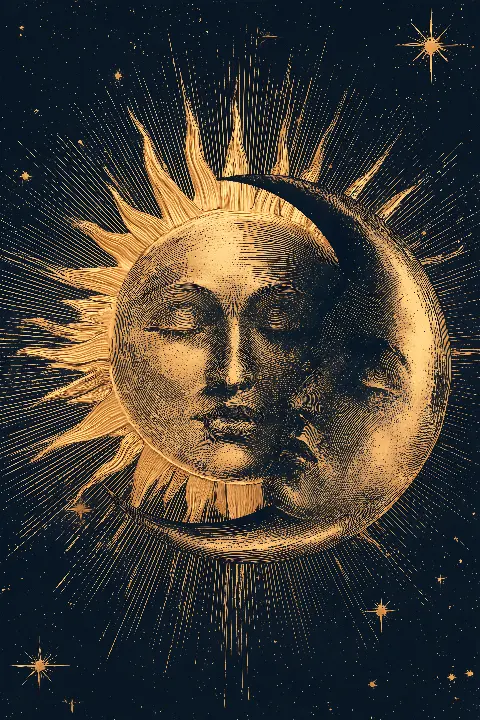
Celestial Wall Art in Gold
The Sun and Moon Embrace
Celestial Art Print in Gold
from €9.99
GUIDES · THEMES
Suns with faces, moons in every phase and engraved star charts have decorated walls for centuries. This guide explains where the imagery comes from, how to pick a motif and how to hang it well.
Celestial wall art is any picture whose subject is the sky: the sun, the moon and its phases, stars, constellations, planets and the signs of the zodiac. It ranges from scientific star maps to folk-art suns with sleeping faces, and from a bare gold crescent to a crowded astrological chart. What links them is a feeling of looking up, of something calm and much larger than the room.
Most celestial pictures today share a palette that was settled long ago: deep navy or black for the night, gold or cream for the light. That pairing is practical as well as pretty. It works in almost any room, flatters warm and cool walls alike, and lets very different pieces hang together, so a sun, a moon and a zodiac wheel can share one wall without clashing.
The look many people now call celestial comes largely from European printmaking. In 1603 Johann Bayer published Uranometria, the first atlas to chart the whole sky, with each constellation engraved as a figure. In 1660 Andreas Cellarius produced Harmonia Macrocosmica, a book of hand-coloured celestial charts still admired for its beauty. Engravers built every shape from fine hatched lines, and that line quality is what gives antique sky charts their texture.
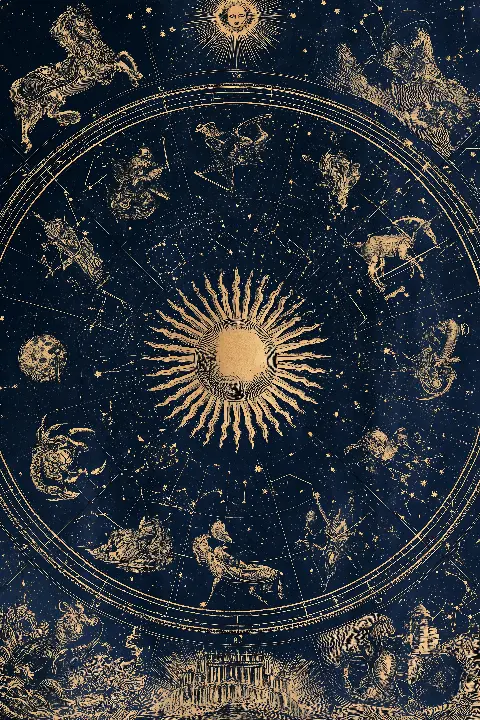
The Golden Zodiac follows that tradition closely. A radiant gold sun sits inside a great circular ring at the centre of a dense navy chart, and around it engraved figures and animals crowd the sky, among them a rearing horse at the top left and a crab or scorpion at the lower left, all stitched together by fine constellation lines. It is a picture to read slowly, so it suits a wall above a desk or a bookcase, where people stand close.
The sun with a human face is older still. It appears in medieval manuscripts, alchemical books and tarot cards, often beside a crescent moon with a profile of its own, the pair standing for day and night, gold and silver, two opposites in balance.
Each part of the sky gives celestial wall art a different tone. A sun is warm, open and energetic; a crescent moon is quiet and inward; a field of stars is restful because it has no single focus. Decide what you want the room to feel like before you choose. The Sun and Moon Embrace puts both in one picture, a round gold sun with closed eyes and a crescent moon curving round it, cheek pressed to cheek, so the mood is tender rather than dramatic.
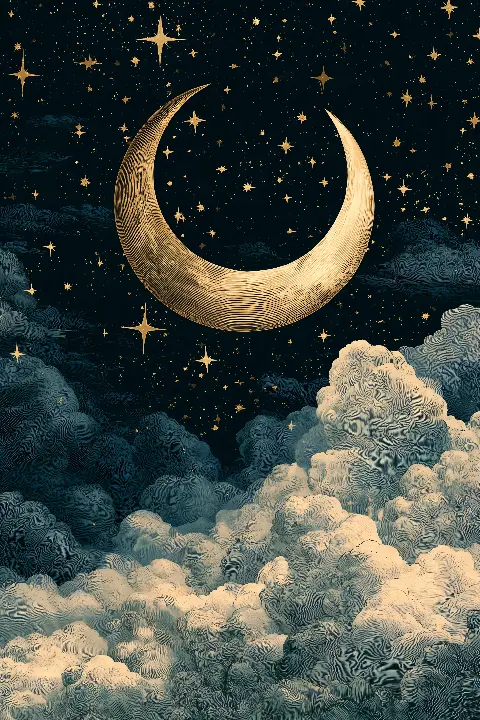
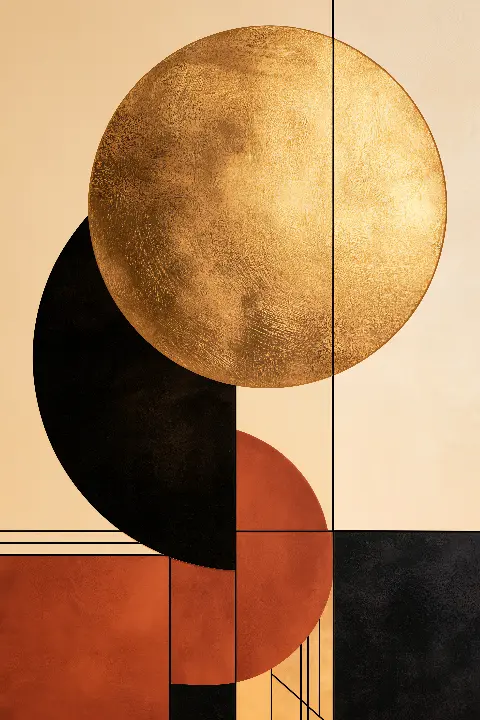
The Golden Crescent is the moon at its simplest, a clean gold arc with no face and no ornament, high in a near-black navy sky above clouds drawn in curling engraved lines. At the other end of the scale, The Golden Sun treats the sun as pure geometry in the Bauhaus manner: a large gold disc above black and terracotta circles on warm cream. It brings the celestial theme into a modern living room or hallway without a single star.
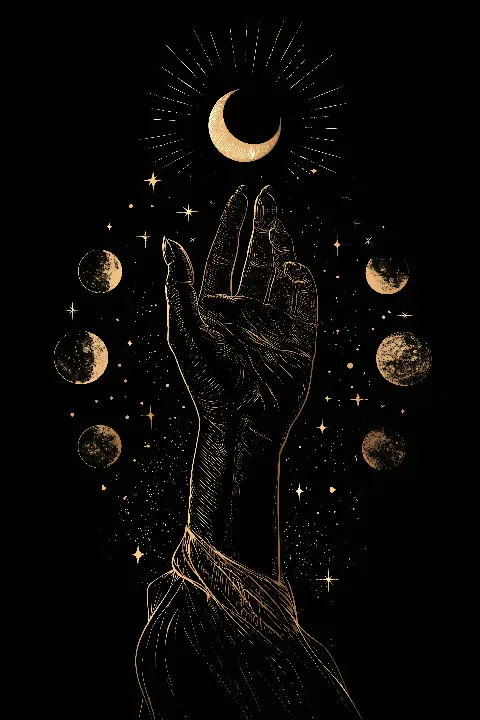
For a softer, more boho mood, The Hand That Holds the Moon shows one open hand reaching up towards a thin gold crescent, with six small moon discs curving round it like a ring of lanterns, all drawn in fine gold lines on black.
Bedrooms are the natural home for celestial wall art, partly because the imagery belongs to the night and partly because navy and gold are gentle colours to wake up to. Above a double bed, a single large print or a pair works well: aim for a total width of about two-thirds of the headboard, and leave 20 to 30 cm between the top of the headboard and the bottom of the frame.
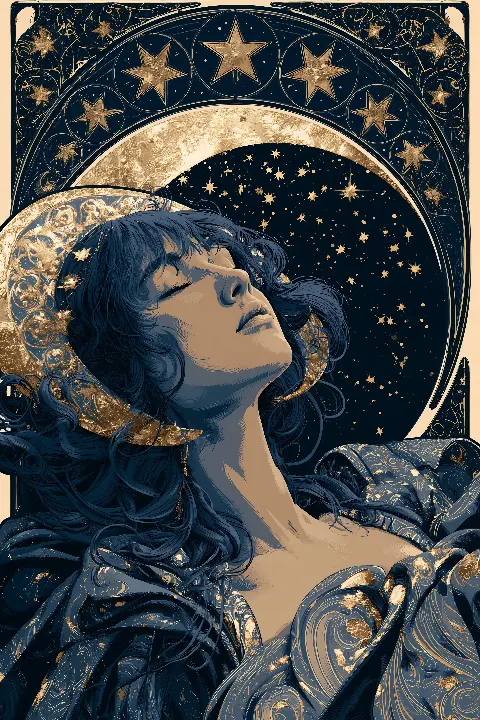
The Moon Muse suits this spot. A resting woman with deep blue hair lies against a great gold crescent, a dark circle of night sky full of small gold stars behind her, and from a distance the whole design reads as a glowing medallion of blue and gold. In a child's room or a nursery, quieter pieces with more open space feel lighter; a crescent above soft clouds is easier to live with there than a busy chart.
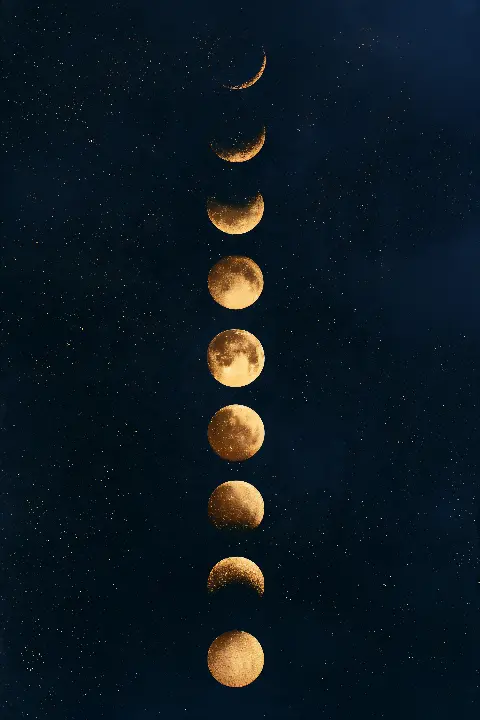
The moon takes about 29.5 days to pass from one new moon to the next, and its changing shape is one of the oldest calendars there is. In celestial wall art, phase charts turn that cycle into a pattern. Phases of the Golden Moon lines up nine gold moons in a single column down the centre of a midnight-blue sheet, from a slender crescent at the top through fuller shapes, so it suits tall, narrow walls: between two windows, beside a wardrobe or at the end of a corridor.
Pairs tell small stories. The Kintsugi Moon shows a huge dark moon resting on the horizon, its cracks filled with glowing gold, after the Japanese art of mending pottery with gold. Catching the Moon is lighter in spirit: a lone figure stands in a small boat on gold-lit clouds, a fishing line drawn up towards a full golden moon. Side by side, one is serious and one is playful, and both share the same dark sky.
Navy, ink blue and charcoal walls make gold skies glow, but celestial wall art also looks fresh on warm white, sand and terracotta, where the dark picture becomes a strong focal point. Gold frames emphasise the antique-chart feeling; thin black frames make the same picture look more contemporary. A wide cream mount works well for engraved designs, giving them the air of a plate from an old atlas.
Use matte paper or non-reflective glazing for dark grounds, since gloss turns a night sky into a mirror. Every work here is a printable download; portrait files of 7168 × 10752 px print sharply to about 60 × 90 cm, and each download includes a Frame TV version, so a starry picture can also fill a television screen while it is switched off.
Suns, crescents, moon phases and zodiac charts in gold on navy and black, all printable downloads.


Celestial wall art shows the sky: suns, moons and their phases, stars, constellations and zodiac signs. The style often borrows from antique engraved star atlases and folk-art suns with faces, usually in gold or cream on navy or black.
Bedrooms are the classic choice because the imagery belongs to the night, but studies, reading corners and hallways work well too. Detailed star charts reward close viewing above a desk, while a simple crescent suits a nursery or a calm guest room.
In older imagery the sun and moon often stand for day and night, warmth and coolness, or two opposites held in balance. Many people choose a sun and moon pair for a shared bedroom for that reason, but the pictures work just as well simply as decoration.
A long vertical moon phase design needs a tall, narrow wall: between windows, beside a wardrobe or at the end of a corridor. Centre it at about 145 to 150 cm from the floor and leave space on both sides so the column reads clearly.
Tell me the room and what you want it to feel like. I will send three works that fit, and a mock-up of each one in place.
Write to meThis site uses cookies for Google Analytics and Google Ads so I can see which pages and ads bring visitors. Nothing is sold or shared beyond that. Privacy