GUIDES · ART HISTORY
Famous Christmas paintings, and how Christmas art began.
For most of history, Christmas paintings meant the Nativity. Snow, trees, cards and Santa came much later. Here is a short history of Christmas art, through the pictures that shaped it.
The Nativity: the first Christmas art
For more than a thousand years, Christmas art meant one subject: the birth of Christ. Early Christian art showed the child in a manger with an ox and a donkey; medieval painters added the shepherds, the angels and the three kings.
Around 1305 Giotto painted the Nativity on the walls of the Scrovegni Chapel in Padua with a new tenderness: Mary leans over to look at her child, the animals watch, the shepherds turn their backs to the viewer. It is one of the first Christmas paintings in which you feel the people as people. In 1423 Gentile da Fabriano painted the Adoration of the Magi, now in the Uffizi in Florence — a glittering procession full of real gold leaf, horses, monkeys and hunting leopards.
Botticelli’s Mystic Nativity
Around 1500 Sandro Botticelli painted the Mystic Nativity, now in the National Gallery in London, and the only painting he ever signed. Angels in white, red and green dance in a ring above the stable holding olive branches; below, angels embrace men while small devils flee into the rocks. Painted in troubled times in Florence, it is both a Christmas picture and a vision of peace — and its colours of red, green and gold are, by chance, the colours we still use for Christmas.
Snow comes to Bethlehem
Snow, now so much a part of Christmas themes, hardly appears in Christmas paintings before the sixteenth century. One picture changed that: Pieter Bruegel the Elder’s The Census at Bethlehem (1566), in Brussels. Bruegel moved the story to a Flemish village in deep winter — children skating on the ice, people warming themselves at fires, a man slaughtering a pig — and in the middle, almost lost in the crowd, Mary on a donkey led by Joseph. A year earlier he had painted Hunters in the Snow, the most famous winter landscape in European art.
Candlelight became another Christmas mood. Painters such as Gerrit van Honthorst, in the 1620s, lit the Adoration of the Shepherds from the child himself, so that every face glows out of the dark.
The Christmas tree, the card and Santa
The Christmas we know is largely nineteenth-century, and its art came with it. In 1843 the first commercial Christmas card was printed in London: Henry Cole asked the painter John Callcott Horsley to design it, and it showed a family raising a toast. In 1848 the Illustrated London News published an engraving of Queen Victoria, Prince Albert and their children around a decorated tree at Windsor — and the German custom of the Christmas tree swept through Britain and America.
The image of Santa Claus as a round, bearded, jolly man in fur owes most to the cartoonist Thomas Nast, who drew him for Harper’s Weekly from the 1860s onwards; advertising illustrations of the twentieth century fixed him in red and white.
Winter art from other traditions
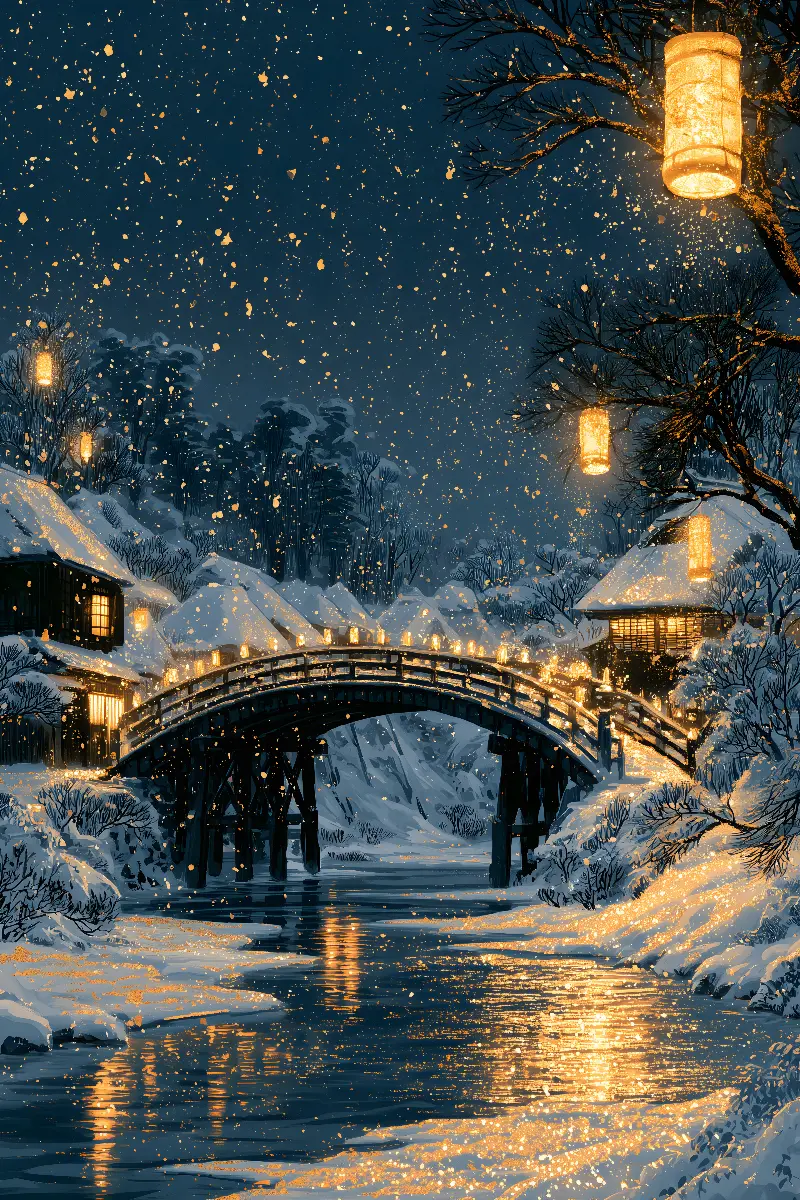
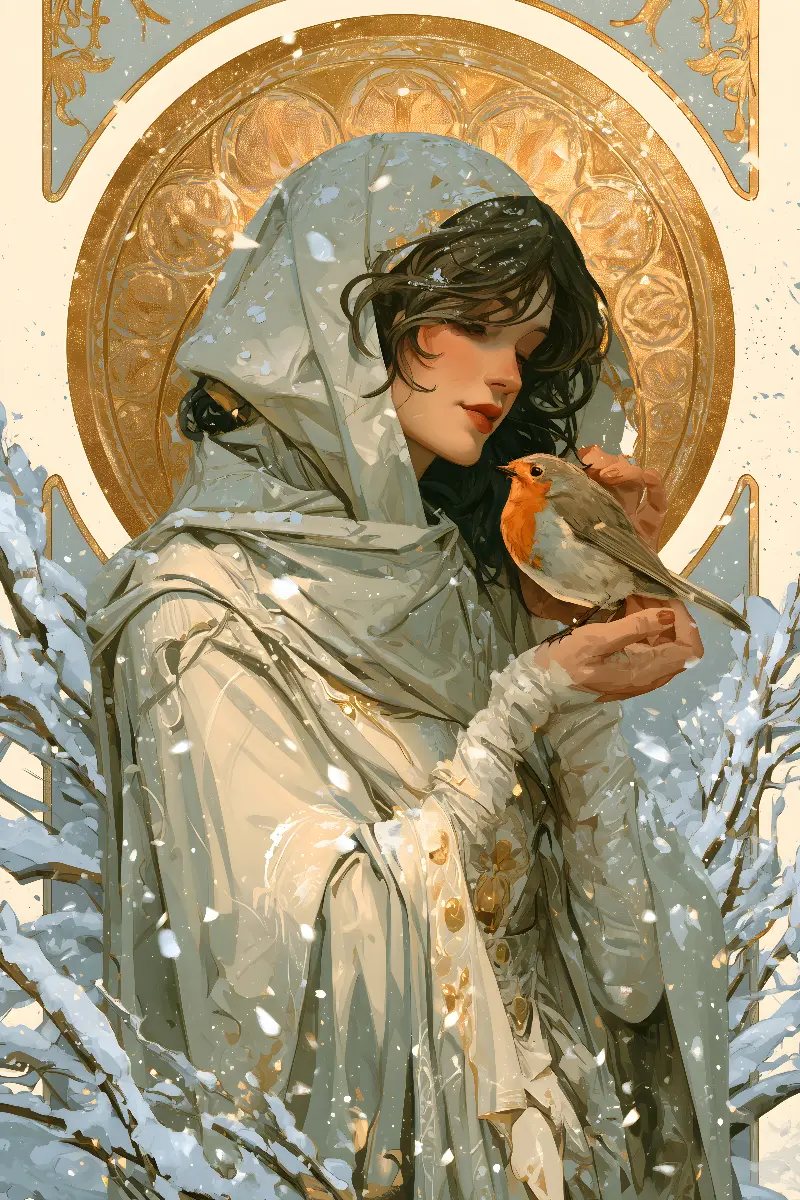
Some of the most loved Christmas art today was never meant for Christmas at all. Japanese woodblock prints of snow — Hiroshige’s Evening Snow at Kambara from the Tōkaidō series, his snowy views of Edo — have the hush of a winter night. Alphonse Mucha’s Winter (1896), from his decorative panels of The Seasons, shows a young woman wrapped in a cloak warming a small bird. William Morris drew robins and holly; Gustav Klimt’s golden trees and spirals look festive to modern eyes. These are the sources the Christmas in Gold collection draws on.
Christmas paintings for your own walls
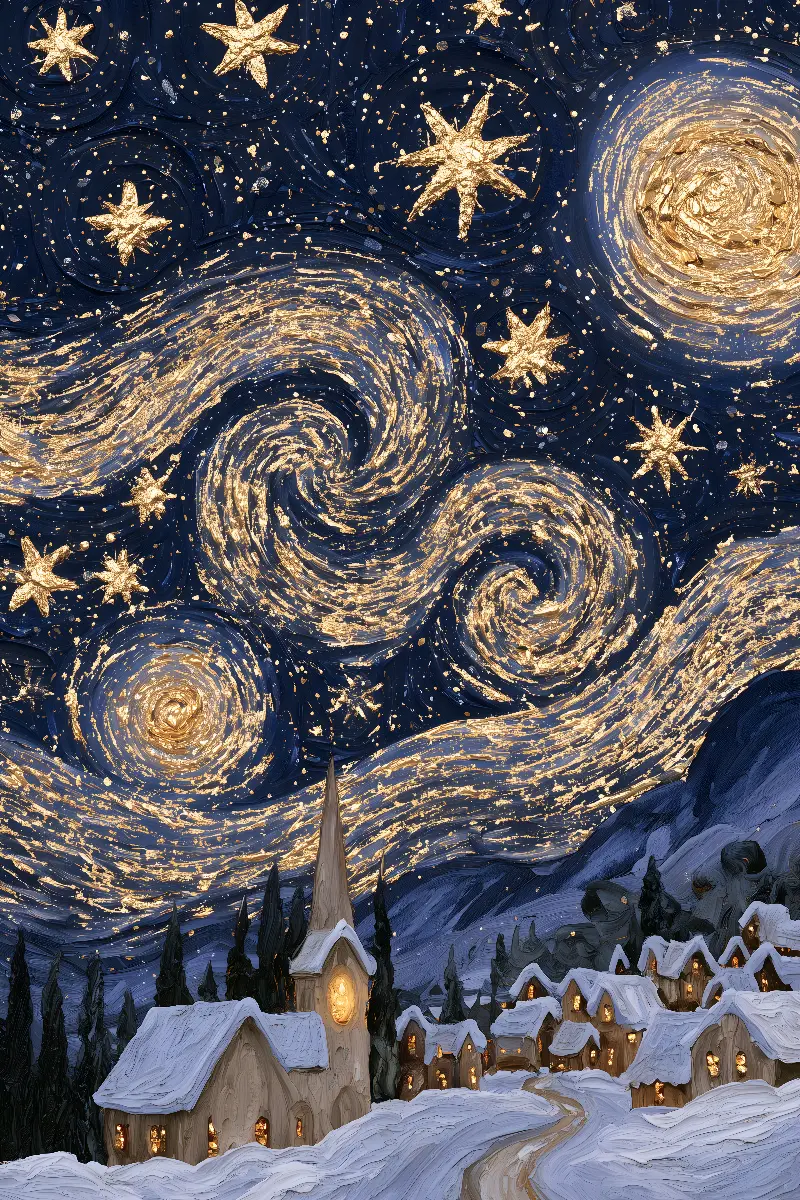
Most famous Christmas paintings hang in churches and museums. For a home, the winter scenes, birds, trees and lights of the later traditions are usually easier to live with for the whole season. The Christmas in Gold collection reimagines them with gold leaf: Snow Lanterns after Hiroshige, Golden Christmas Eve after Van Gogh, Robins and Holly after Morris, The Golden Christmas Tree after Klimt, and The Winter Muse and The Robin Muse after Mucha.
For ideas on hanging them, read Christmas wall decor ideas.
Questions
What is the most famous Christmas painting?
There is no single answer, but Giotto’s Nativity (c. 1305), Botticelli’s Mystic Nativity (c. 1500) and Bruegel’s Census at Bethlehem (1566) are among the most famous. Gentile da Fabriano’s Adoration of the Magi (1423) is one of the richest.
When did Christmas trees appear in art?
Christmas trees became popular in Britain and America after an 1848 engraving in the Illustrated London News showed Queen Victoria and Prince Albert’s family around a decorated tree.
Who designed the first Christmas card?
The painter John Callcott Horsley designed the first commercial Christmas card in 1843, for Henry Cole in London.
Why are red, green and gold the Christmas colours?
They come from many sources: evergreen holly and fir, red berries, and the gold of candlelight and of medieval religious paintings. Botticelli’s Mystic Nativity already uses all three.
For a wall you're responsible for.
Tell me the room and what you want it to feel like. I will send three works that fit, and a mock-up of each one in place.
Write to me