FOR SPACES · CLINICS, DENTAL & THERAPY PRACTICES
Medical office wall art that lowers the pulse.
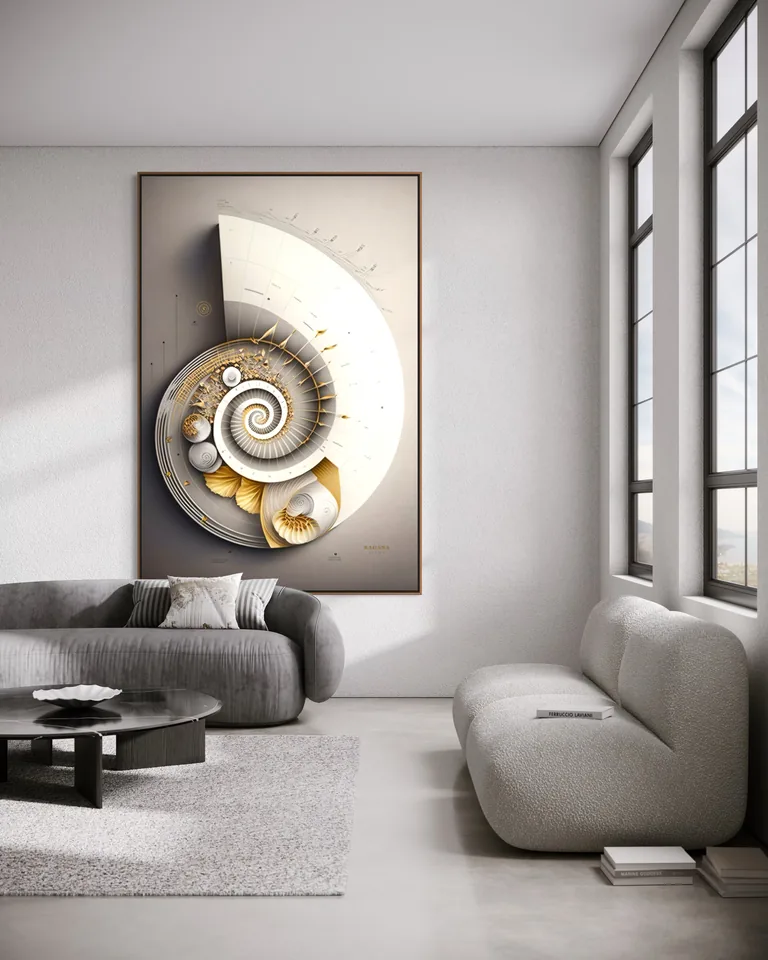
A waiting room is where people sit with a worry. The picture on that wall has one job: to give the eye something calm to rest on. These works were made for that — a single clear form, a quiet palette, a composition the eye settles into without deciding to.
What a waiting room needs from a picture
Most wall art for a doctor's office is either a stock photograph of a beach or an abstract that means nothing. Neither helps. What works in a medical or dental office is a subject the eye recognises as alive and unhurried — a nautilus, a fern, a seed head — drawn so cleanly that it rewards a second look but never demands one. The Fibonacci spiral is the shape of growth at rest, and patients read it that way before they have thought about it.
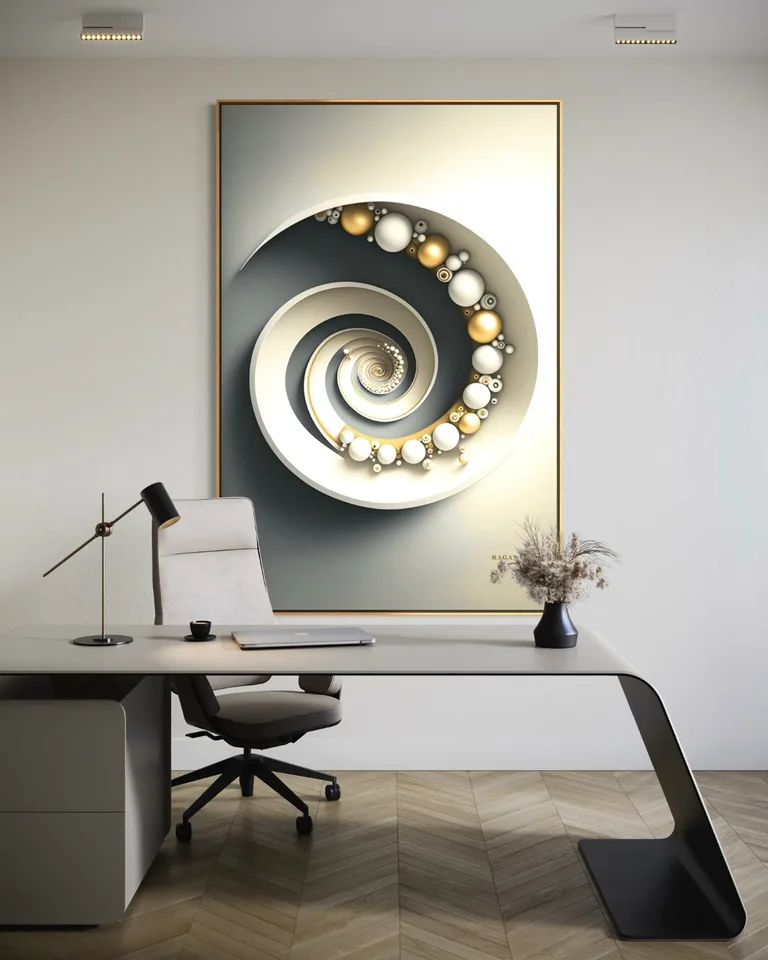
No faces, no text, no bright red. The white and pearl works — ivory spirals on a warm white ground — suit a bright waiting room and a dental practice; the gold-on-navy works suit a consulting room or a therapy office, where the light is lower and the conversation longer.
Which works, in which room
- Waiting room: one work the size of the wall allows, opposite the seats rather than behind reception. Ivory Nautilus Minimalist, The Alabaster Origin, The Celestial Navigator.
- Treatment room, dental chair: the wall or ceiling the patient actually sees lying back. A pale work, mid-size, nothing that moves. The Pearl collection.
- Therapy office, counselling room: something with depth and warmth to look at during a silence. The Celestial Nautilus, The Botanical Schematic of Growth.
- Corridor: a series of three from one collection, same size, same frame, hung at one height.
Hygiene, surface and hanging
In a clinic the surface matters as much as the image. Fine-art paper behind sealed museum glass is the cleanest finish and reads as “gallery”; aluminium (Dibond) with a matte laminate can be wiped with disinfectant and is right for treatment rooms. Both are standard at any trade printer, and both can be produced from the files supplied. Hang at eye height for a seated person — lower than you would at home — and at the golden section of the wall rather than its centre.
| Room | Surface | Why |
|---|---|---|
| Waiting room | Fine-art paper, museum glass, sealed frame | Cleanest finish, no reflections with anti-glare glass |
| Treatment room, dental chair | Aluminium Dibond, matte laminate | Wipeable with disinfectant, no glass |
| Therapy or counselling room | Paper, deep mat, thin frame | Warm and quiet |
| Corridor | Acrylic face-mount or Dibond | Robust where trolleys pass |
The licence, plainly
A practice is a public space, so it needs the commercial licence: €377 per work, per practice, for as long as the practice exists. Any size, any surface, any number of prints within that practice. It comes with a signed certificate naming the work, the licensee and the premises. A practice with two locations licenses each one.
Questions
Is a small practice with one waiting room a commercial space?
Yes. Anywhere the public is admitted needs the commercial licence, regardless of size. It is €377 per work, per practice, with the certificate.
Can we see the work on our wall before buying?
Yes. Send a photo of the wall and its width, and I return three works fitted to it within two days, with a note on size and surface.
Which works are safe for anxious patients?
The white and pearl series: no faces, no text, no strong contrasts. Ivory Nautilus Minimalist and The Alabaster Origin are the two most chosen for waiting rooms.
How large can it be printed?
At waiting-room viewing distance, comfortably to 120 cm on the long edge; the commercial licence includes the larger master file.
For a wall people wait in front of.
Send me the room — a photo and the width — and I will return three works that fit it, with a note on the right surface for the space.
Ask for three options