Greek Mythology Wall Art in Gold
Athena in Gold
Greek Mythology Art in Gold
from €9.99
GUIDES · MYTHOLOGY
Marble gods and gold detail bring very old stories into modern rooms. This guide explains who is who, what each symbol means, and which god suits which room and wall.
The Greek myths have been told for nearly three thousand years. Homer's Iliad and Odyssey were probably composed in the eighth or seventh century BC, Renaissance painters revived the gods as a subject, and writers have kept retelling them ever since. Greek mythology wall art draws on that long familiarity: even people who could not name every god recognise a trident, an owl or a head of snakes.
The look most people expect is white marble, yet ancient statues were usually painted in strong colours, and the pure white we picture today owes much to weathering and later taste. The works here keep the marble and add gold leaf, which sits between the two ideas: the calm of a sculpture gallery with some of the richness the statues once had.
Greek gods are recognised by their attributes, the objects that travel with them. Athena carries a spear and wears a helmet, and her owl stands for wisdom. Apollo holds a lyre and wears a laurel wreath. Poseidon has his trident. Medusa is known by her hair of snakes, Pegasus by his wings and Persephone by the pomegranate. Once you know these signs, every picture becomes a story you can read.
In Greek mythology wall art, choosing a figure is also choosing a meaning. A study or library suits wisdom and craft, a music room suits the god of the lyre, a bathroom suits the sea, and a bedroom can carry the darker, more romantic myths. The sections below go through each figure in turn.
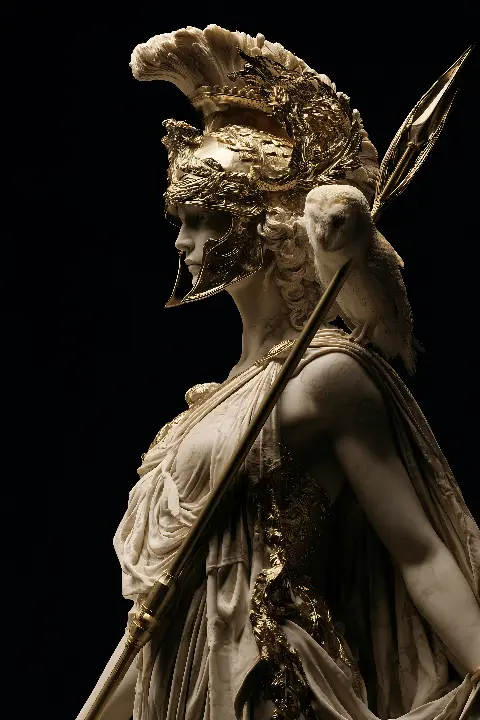
Athena was the goddess of wisdom, strategy and crafts such as weaving, and the patron of Athens; she was said to have sprung fully armed from the head of Zeus. Athena in Gold shows her in sharp profile, wearing a gilded crested helmet, with a long spear across her body and a small owl on her shoulder, the detail people point out once they have found it. Side light leaves half of her in black, so the profile is as crisp as the head on a coin.
Apollo was the god of music, poetry, light and prophecy, and the laurel became his tree after the nymph Daphne was turned into one to escape him. Apollo in Gold lifts his head to the left, crowned with a gilded laurel wreath and thin gold rays, and holds an ornate golden lyre against his body. It belongs above a piano, a record cabinet or a desk, wherever music or work happens.
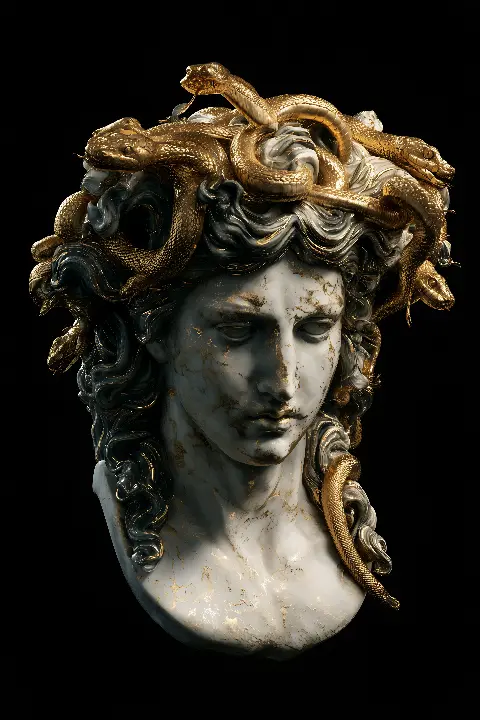
Medusa was one of the three Gorgons, and her gaze turned anyone who met it to stone. The hero Perseus cut off her head while watching only her reflection in his polished shield, and from her severed neck sprang the winged horse Pegasus. Hung together, these two pieces of Greek mythology wall art tell the beginning and the end of a single story.
Medusa in Gold turns the monster into something unexpected. A calm marble face looks downward with lowered eyes, so the deadly stare never meets ours, while dark curls and coiling gold snakes crowd around it. Fine gold veins cross the marble like the mended seams of kintsugi. Many modern readers see Medusa as a victim rather than a villain, and the picture leaves room for that reading.
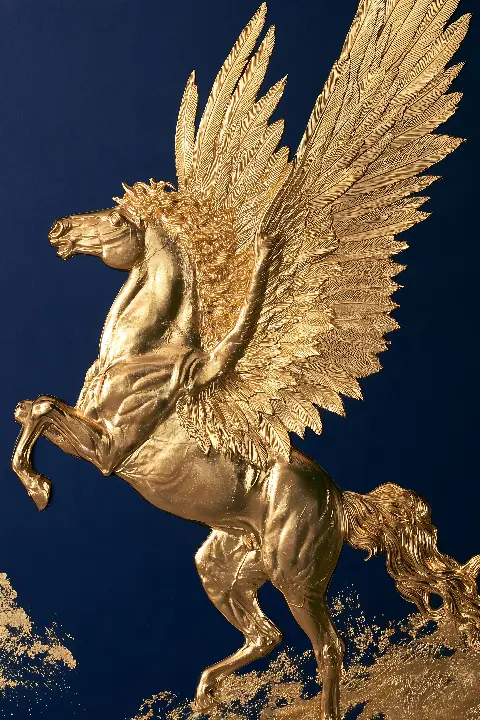
Pegasus in Gold is all lift: worked in polished gold, the horse rears to the left while two great feathered wings sweep up and to the right across a deep navy sky. It is brighter and more hopeful than the bust beside it, and on its own it suits a child's room or a hallway.
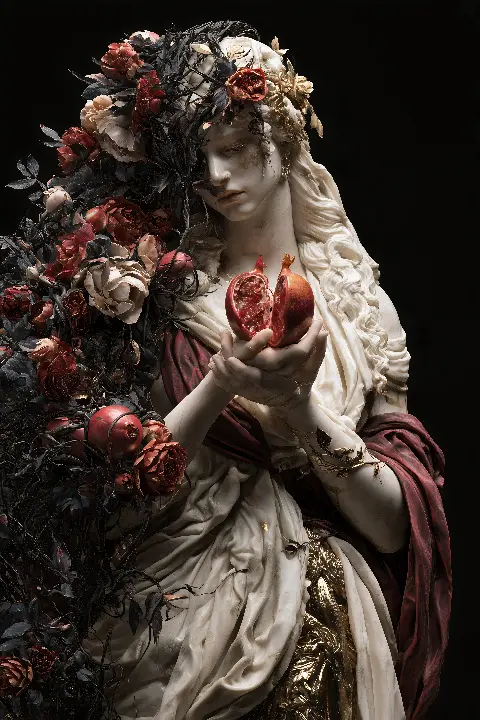
Persephone, daughter of the harvest goddess Demeter, was carried off to the underworld by Hades. Because she had eaten pomegranate seeds there, she was bound to go back to him for part of every year, and her mother's grief during those months was said to bring winter. Persephone in Gold bows her head over a split red pomegranate held in both hands, crowned with red and cream roses, while darker roses and vines pour down beside her. Its reds make it rich enough for a dining room or a bedroom in burgundy or deep green.
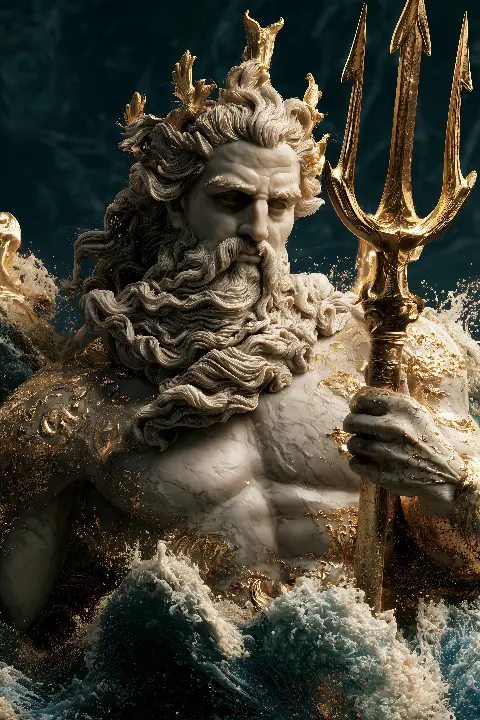
Poseidon ruled the sea, and he was also the god of earthquakes and of horses. Poseidon in Gold rises from foaming dark teal waves, crowned and with a long curling beard, his muscular marble torso clear of the water and a tall golden trident standing upright at the right. It is the obvious choice for a bathroom or a seaside house, but it looks just as grand above a desk on teal or navy walls.
Gods look strongest in company. Two figures make a pair, three make a classical triptych, and six can fill a long wall in two rows of three. Athena and Apollo both look to the left, so place them on the right of a group or beside a figure who faces forward, such as Medusa, so that their gaze leads back into the arrangement. Use identical frames, black or thin gold, and keep the gaps to 5 to 8 cm.
Dark walls in charcoal, deep green, navy or teal make the marble glow, and warm lamps bring out the gold leaf. Every work here is a printable download; the portrait files of 7168 × 10752 px print sharply to about 60 × 90 cm, and each download includes a Frame TV version. Printed versions are also available on the site for anyone building a set of Greek mythology wall art without printing it themselves.
Six gods and heroes in marble and gold, from Athena with her owl to Poseidon rising from the waves.

Athena is the classic choice, as goddess of wisdom, strategy and crafts; her owl has stood for learning for centuries. Apollo, god of music and poetry, suits a creative workspace or a room with a piano or a record collection.
No. In ancient Greece the face of Medusa was used as a protective sign on shields, armour and buildings, meant to ward off harm. Today many people see her as a figure of strength, and a calm Medusa bust is simply a striking portrait.
Persephone ate pomegranate seeds in the underworld, so she was bound to go back to Hades for part of each year. The myth explained the seasons: her mother Demeter mourned while she was away, and the earth lay bare until spring.
Use identical frames and equal gaps of 5 to 8 cm. Let figures face towards the centre of the group, so left-facing gods sit on the right. Three prints in a row or six in two rows of three work well above a sofa or sideboard.
Tell me the room and what you want it to feel like. I will send three works that fit, and a mock-up of each one in place.
Write to meThis site uses cookies for Google Analytics and Google Ads so I can see which pages and ads bring visitors. Nothing is sold or shared beyond that. Privacy