JOURNAL · CALM
Why the golden ratio calms the eye.
Not because it is sacred. Because a proportion the eye can resolve without effort is a proportion it can stop working on — and stopping is what calm is.
Raul Gabriel Nagy · 24 September 2026 · 5 min read
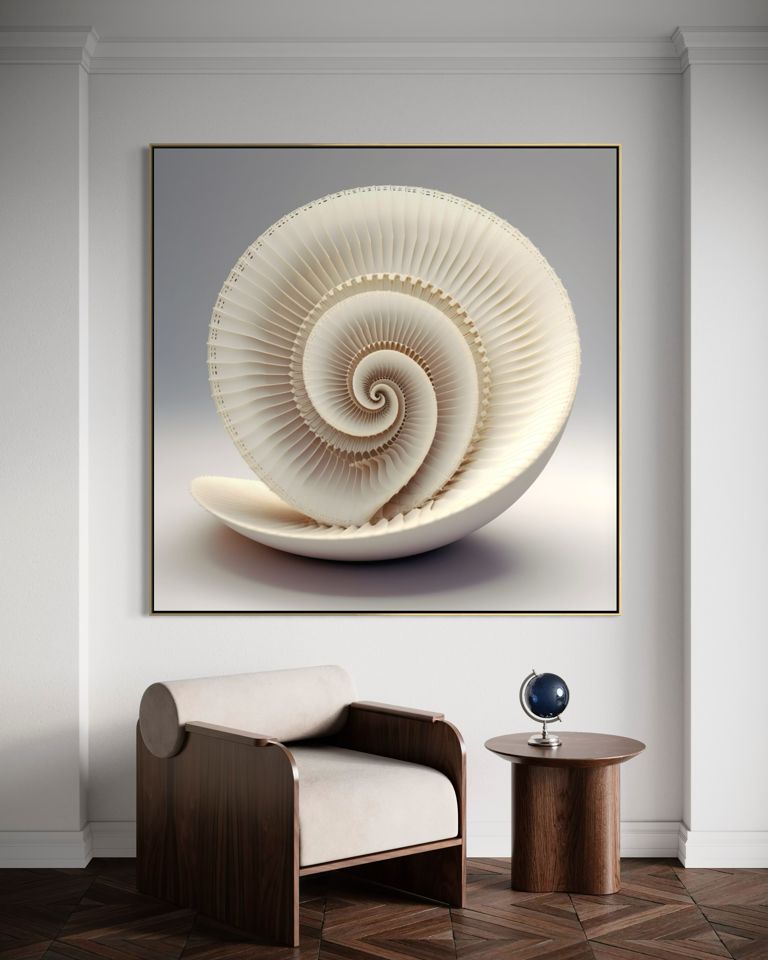
The eye is a muscle that is always looking for a place to stop. Give it one, and the rest of the room goes quiet.
There is a plain finding in perception research that survives all the mysticism around this number: people rate shapes as more pleasant when they can process them fluently. A rectangle whose sides relate by a simple, stable ratio is resolved faster than one whose proportion the eye has to keep re-checking. Experiments that ask people to choose the most pleasant rectangle do not find a sharp peak at exactly 1.618 — the preference is a broad hill, somewhere between the shape of a postcard and the shape of a door — but the golden rectangle sits on top of that hill, and a spiral built from it repeats the same resolvable proportion at every scale.
That repetition is the part that matters for a wall. A work drawn on one ratio, from the outline down to the smallest line, gives the eye the same answer wherever it lands. Nothing on the surface asks for a second look. That absence of asking is what people mean when they say a room feels settled, and it is the reason the works on this site are constructed rather than composed: the spiral is not placed where it looks good, it is placed where the geometry says it goes, and the eye can tell the difference even when it cannot say why.
What calm is, mechanically
Look at a busy wall — a gallery of small frames, a print with text on it, anything with several competing focal points — and your eye does a small amount of work every time it passes over it. You do not notice the work; you notice, at the end of the evening, that you are slightly more tired than the day explains. A wall with one subject, one curve and one point of highest contrast asks for none of that. The eye lands, resolves, and is released. Calm is not the absence of detail. It is detail that has already been resolved for you.
This is also why the works are quiet in colour. A dark navy ground with a single line of gold, or an ivory ground with a shell drawn in the same ivory a tone deeper: in both cases there is exactly one place for the eye to go, and it is the place the geometry has prepared.
What to do with this
Choose one work, not three. Put it where the eye lands when you sit, not where a guest would look standing up. Keep the ground dark or very pale and let the single line of gold be the only high contrast on the wall. The guide on hanging wall art on the golden ratio has the measurements; this note is only the reason.
Calm is not the absence of detail. It is detail that has already been resolved for you.
From the studio notes
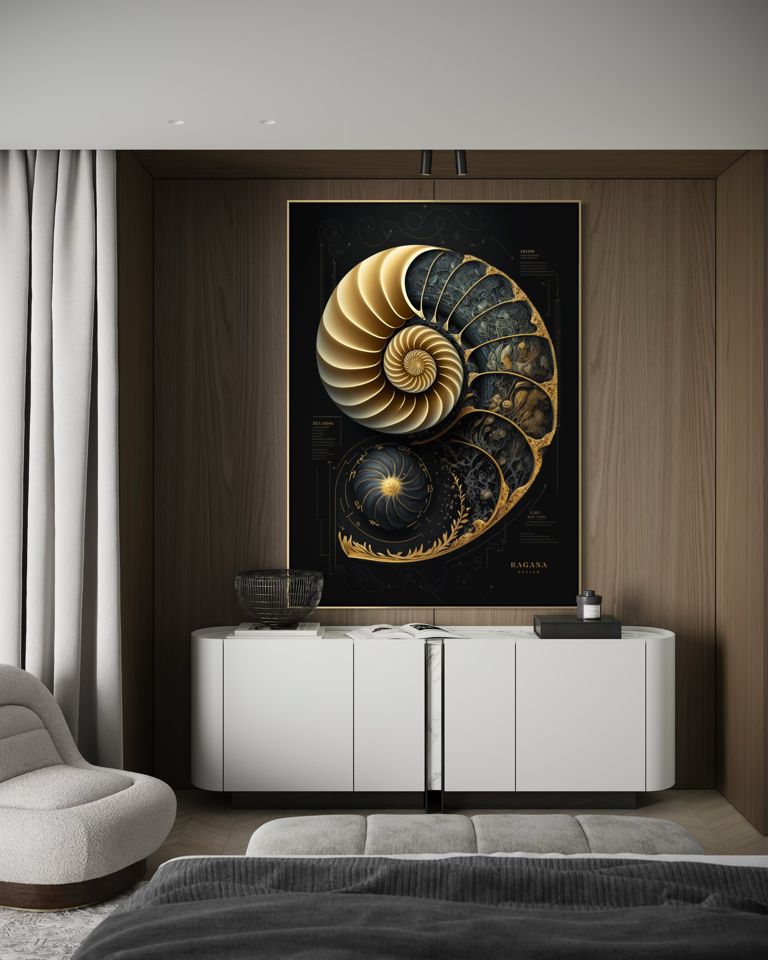
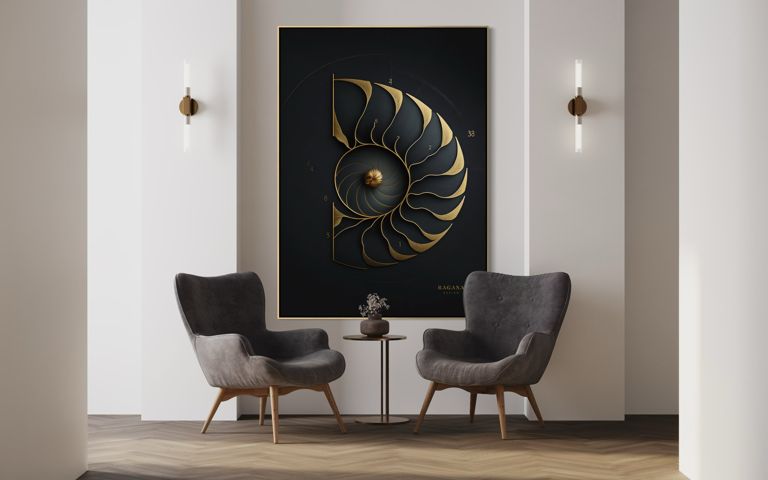


For a wall you're responsible for.
Tell me the room and what you want it to feel like. I will send three works that fit, and a mock-up of each one in place.
Write to me